
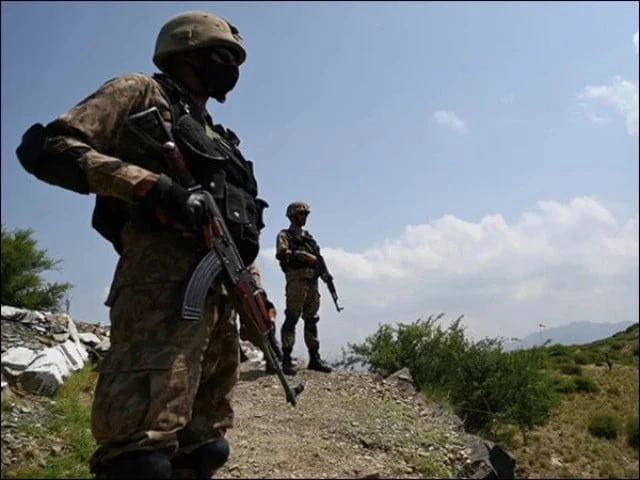
Terrorists target police station, two banks and loot cash; CM warns extremists turning to organized crime
QUETTA/ISLAMABAD:
At least a dozen terrorists were killed by security forces after launching coordinated attacks on government and commercial buildings in northwest Balochistan, military media said on Friday, adding that a hostage-taking attempt by the attackers was also foiled.
Between 15 and 20 terrorists affiliated with India-sponsored Fitna al-Hindustan carried out several attacks in Kharan town, the Inter-Services Public Relations (ISPR) said in a statement. Their targets included Kharan Town Police Station, National Bank of Pakistan and Habib Bank Limited.
According to the ISPR, the terrorists looted Rs 3.4 million in cash from banks. They also attempted to take hostages at the police station, but the rapid and effective response of security forces thwarted their plans.
The government has officially referred to Baloch terrorist groups as “Fitna al-Hindustan” to highlight their role as a proxy for India, which Islamabad says seeks to destabilize Pakistan, particularly Balochistan, as part of a broader hybrid warfare strategy.
Clean-up operations are underway in Kharan and surrounding areas, army media said. As part of the National Action Plan and the Azm-e-Istihkam vision, approved by the federal government, security forces remain engaged in counter-terrorism operations until foreign-sponsored terrorism is eradicated from the country, the statement added.
Chief Minister Mir Sarfaraz Bugti praised security forces for their quick action, confirming that one civilian was injured during the operation and is being treated at the Combined Military Hospital. He said four terrorists were killed immediately in three locations, while the remaining attackers were neutralized in subsequent engagements.
Such incidents reveal a worrying trend, with terrorists increasingly shifting from ideological activities to organized criminal acts, including bank robberies, he said. “Every time they take to the streets, they will be defeated, and every time they try to hide in their holes, we will ferret them out through intelligence-based operations (IBO).”
CM Bugti described this as a fully operational “response mechanism” based on intelligence shared by local communities.
He also raised concerns over digital infrastructure in remote areas of Balochistan, questioning the installation of mobile internet towers in sparsely populated areas such as Sangan. He warned that uncontrolled 4G networks could create security vulnerabilities and sought clarification on who authorized such installations, warning that such facilities could be exploited by hostile elements to target law enforcement and undermine state security.
The Chief Minister announced a major provincial initiative worth Rs 3 billion to expand optical fiber connectivity across Balochistan. The project aims to connect schools, colleges, universities and hospitals via fiber optic cables, ensuring wider internet access while maintaining monitoring to prevent misuse.
He highlighted the broader regional context, linking the recent increase in security concerns to developments following the Taliban’s capture of Kabul in 2021. Citing official military figures, he said law enforcement conducted more than 75,000 ICPs across the country in 2025, leading to the deaths of more than 2,500 terrorists.
Afghanistan, after the return of the Taliban regime, has once again become a base for transnational groups and a haven for terrorists, a fact confirmed by the United Nations Analytical Support and Sanctions Monitoring Team in its latest report.
The Kabul regime insists that no terrorist groups operate in or from Afghanistan. This position, however, collapses under the weight of evidence presented by UN member states. As the UN monitoring team says, the Taliban’s handling of terrorism remains the central concern. “The de facto authorities continue to deny that terrorist groups have a footprint on or operate from its territory. This assertion is not credible,” the report said.
More troubling is the emergence of a nexus between religious extremists, notably the TTP and TTP-Jamaatul Ahrar, and ethno-nationalist groups such as the Baloch Liberation Army (BLA) and its Majeed Brigade, allegedly facilitated by the Afghan Taliban, further complicating Pakistan’s counterterrorism efforts.
Intelligence assessments indicate a sustained presence of Baloch groups, including the BLA, in Afghanistan. Senior officials are believed to operate from Kandahar and Kabul, with the Ain-o-Mina region of Kandahar long identified as a logistics hub. A senior BLA official, Aslam Achhu, had already been killed there. In Kabul, militants are reportedly integrated into civilian neighborhoods, including the Old City neighborhoods around Pul-e-Khishti and the affluent Wazir Akbar Khan neighborhood.


