
ISLAMABAD:
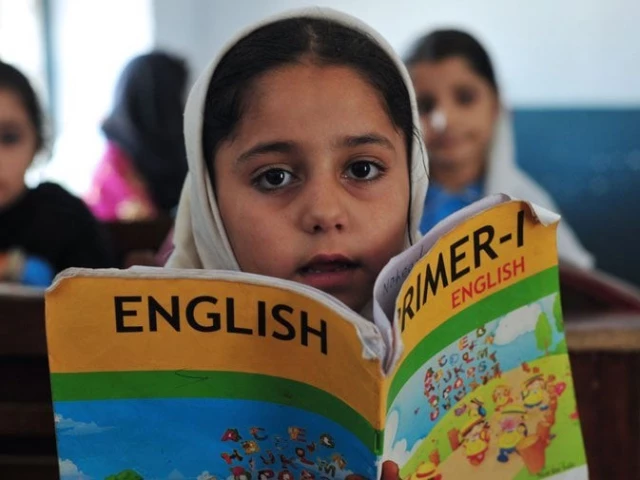
Pakistan faces a daunting task to ensure that every child – especially the most disadvantaged – not only goes to school but continues to learn, as a startling revelation showed on Thursday that 26 million children across the country are out of school.
The disclosure was made in a report titled ‘Girls’ Education Statistics and Trends Report 2023-24 (GESTR)’, which was released by Minister of Education and Vocational Training Khalid Maqbool Siddiqui in the federal capital.
The report, prepared in collaboration with the Pakistan Institute of Education (PIE), Malala Fund, Pakistan Alliance for Girls’ Education (PAGE) and the Ministry of Education, reveals that 25.37 million children aged 5 to 16 are out of school, including 13.41 million girls and 11.96 million boys.
In total, the report indicates that 26.2 million children are currently deprived of education.
According to UNICEF, Pakistan has the second highest number of out-of-school children in the world.
GESTR says Punjab tops the list with 9.6 million out-of-school children, including 4.83 million girls and 4.77 million boys. It is also the country with the highest number of out-of-school girls.
Sindh follows with 7.82 million out-of-school children, including 4.09 million girls. In Khyber-Pakhtunkhwa, 4.92 million children are out of school, including 2.29 million girls, while Balochistan has 2.94 million children, including 1.53 million girls. In Islamabad, 90,000 children are out of school, including 40,000 girls.
The report paints a grim picture of school dropouts at all levels of education. While 20.815 million children are enrolled at the primary level, this number drops to 9.207 million at the intermediate level, 4.699 million at the enrollment level and 2.825 million at the intermediate level. At the university level, only 718,000 students enroll in degree programs.
Sex-disaggregated data shows that 10.906 million boys and 9.888 million girls are enrolled at the primary level. At the intermediate level, 4.877 million boys and 4.33 million girls continue their education. At the matric level, this number decreases to 2.545 million boys and 2.154 million girls. At the upper secondary level, 1.476 million boys and 1.349 million girls are enrolled.
However, at the university level, female enrollment exceeds that of men, with 428,000 women compared to 290,000 men, indicating a gradual improvement in women’s access to higher education.
The report highlights infrastructure improvements, noting that 96% of schools have permanent buildings, 92% have toilets and 82% provide potable water. The primary school completion rate for girls increased from 75% to 89%. However, problems such as malnutrition affecting children’s height and weight persist.
He also points out that due to rapid population growth, the number of schools per 1,000 children has declined. Only 23% of schools have ramps for people with disabilities, and even fewer offer special teaching materials or assistive devices. Only 19% of schools have digital devices, while only 23% of teachers in girls’ schools have received basic training.
Alarmingly, the share of the education budget has declined from 13% to 11%, with 94% of funds going to salaries, leaving little room for development spending. Although women are close to parity in higher education, their participation in the labor market remains at only 24%.


