
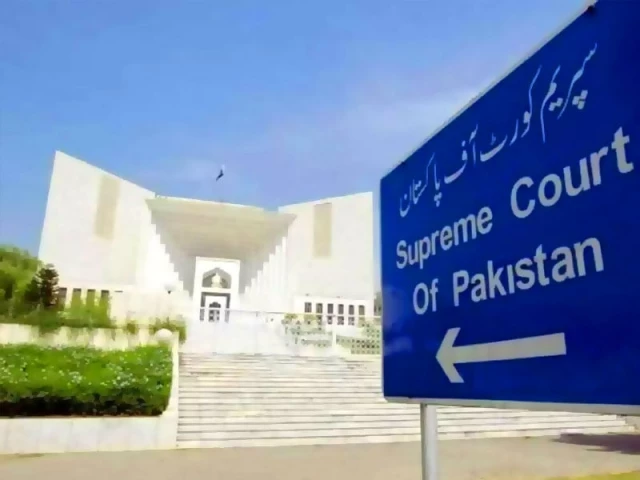
The Constitutional Bench of the Supreme Court to resume hearings of petitions challenging the 26th Constitutional Amendment today. The live proceedings will be available on the YouTube channel of the “Supreme Court of the Supreme Court”.
SC begins proceedings on 26th Amendment petitions
The Supreme Court on Tuesday granted live streaming of proceedings on petitions challenging the 26th constitutional amendment, marking a major step toward transparency in a case that sparked one of the most consequential constitutional debates in recent years.
An eight-member Constitution Bench (CB) headed by Justice Amin-ud-Din Khan granted the petitioners’ request. The bench’s unanimous decision was welcomed by lawyers and civil society, who called it a vital move to ensure “public access” to legal proceedings involving issues of fundamental importance.
Lawyer Abdul Moiz Jaferii noted that live streaming in such cases had been recognized by the Supreme Court as a public obligation. “It opens the doors of justice to everyone with an Internet connection and provides access to the judicial decision-making process. This should be the standard in every superior court,” he said.
The latest hearing began with the bench occupying a group of petitions against the 26th Amendment — the legislation that restructured the judiciary, changed tenure standards and sparked deep concern about the independence of the judiciary. The court said it would first take up pleas seeking the formation of a full court before moving on to procedural requests such as live streaming.
Tehreek-i-Tahaffuz Ayeen-i-Pakistan President Mustafa Nawaz Khokhar, represented by lawyer Shahid Jameel, pushed for the formation of a full tribunal, noting that “objections were raised on our petition regarding the formation of a full tribunal.” After the deliberations, the bench ordered that the petition be formally registered.
Khawaja Ahmad Hosain, lawyer for former Chief Justice Jawad, Khawaja, demanded that the proceedings be broadcast live, arguing that “the entire nation wanted to see what is happening.” He also supported live streaming the court’s full argument, emphasizing that the constitutional seriousness of the issue required full transparency.
Lawyer Salahuddin argued that “every citizen should have access to information of public importance,” adding that the 26th Amendment was passed “in the dead of night” without public debate. The Khyber-Pakhtunkhwa government representative said his team had “no personal objection to any judge on the bench.”
After hearing arguments, the court ruled in favor of live-streaming the proceedings and adjourned the case until today.
However, legal experts warn that the petitioners’ real challenge will be to persuade the CB to order the constitution of a full tribunal to hear the matter, as several lawyers argue that a bench created under the disputed amendment cannot impartially decide its own validity.
Former senator Mustafa Nawaz Khokhar has already filed a petition to implement the majority decision of the Supreme Court (Practice and Procedure) committee, which ordered that petitions against the amendment be heard by a full court. The decision of the 2-1 majority of the committee – elected on October 31, 2024 – had directed the SC registrar to list the file on November 4, but it was never scheduled. The CB has now ordered that Khokhar’s petition be listed along with the objections.
Khokhar called the case one of the most consequential in Pakistan’s judicial history, saying the judiciary now faces a defining choice: “reassert its independence or submit entirely to those traditionally hostile to it.”
Observers note that the exclusion of senior judges like Justices Syed Mansoor Ali Shah, Munib Akhtar, Athar Minallah, Shahid Waheed and Malik Shahzad Ahmad Khan could undermine the legitimacy of the bench. They also question how a CB created under the 26th Amendment can judge its own constitutionality.
Currently, the CB has 15 members, although previous challenges to the constitutional amendments, such as 18 and 21 – have been heard by the full 17-member courts.
History and context of the cases
The 26th Constitutional Amendment Act, 2024, passed in October last year, brought sweeping changes to Pakistan’s judicial structure. It abolished the Suo Motu powers of the Supreme Court under Article 184(3), fixed a three-year tenure for the Chief Justice of Pakistan (CJP), and authorized the Prime Minister – through a parliamentary committee – to appoint the next CJP from among the three senior-most judges.
The amendment also restructured the Judicial Commission of Pakistan (JCP), expanded parliamentary oversight of the formation of the benches and mandated the elimination of interest-based (RIBA) from the financial system by January 1, 2028.
A total of 36 petitions filed by the High Court Bar Associations, PTI, civil society representatives and former judges challenge the amendment, calling it an assault on judicial independence. They argue that it shifts control of key judicial functions – ratings, appointments and bench compositions – away from the executive, upsetting the constitutional balance of power.
The petitioners also allege that the amendment was rushed through Parliament without meaningful debate and proper two-thirds approval under Article 239 of the Constitution. They urge the Supreme Court to strike down it entirely or, at a minimum, ring clauses modifying the CJP appointment mechanism and the composition of the JCP.
Critics argue that removing Suo Motu powers strips the court of its ability to protect citizens’ fundamental rights, particularly in cases where vulnerable groups cannot approach the court directly. Supporters, however, say it prevents judicial overreach and restores democratic balance.
Earlier, Justices Mansoor Ali Shah and Munib Akhtar had urged Chief Justice Yahya Afridi to convene a full bench, citing the “constitutional magnitude” of the issue. The CJP refused, reasoning that a full tribunal could expose internal judicial deliberations to unnecessary public scrutiny.
The petitioners continue to demand that the entire Supreme Court hear the case, pointing to precedents like the 18th and 21st Amendment cases and the Supreme Court (Practice and Procedure) Act, 2023, where full benches were formed due to similar constitutional holdings.
With live streaming now approved, all eyes are on whether the CB will take the next crucial step – ordering a full court – to ensure the judiciary’s own restructuring is debated by all its full members.


