
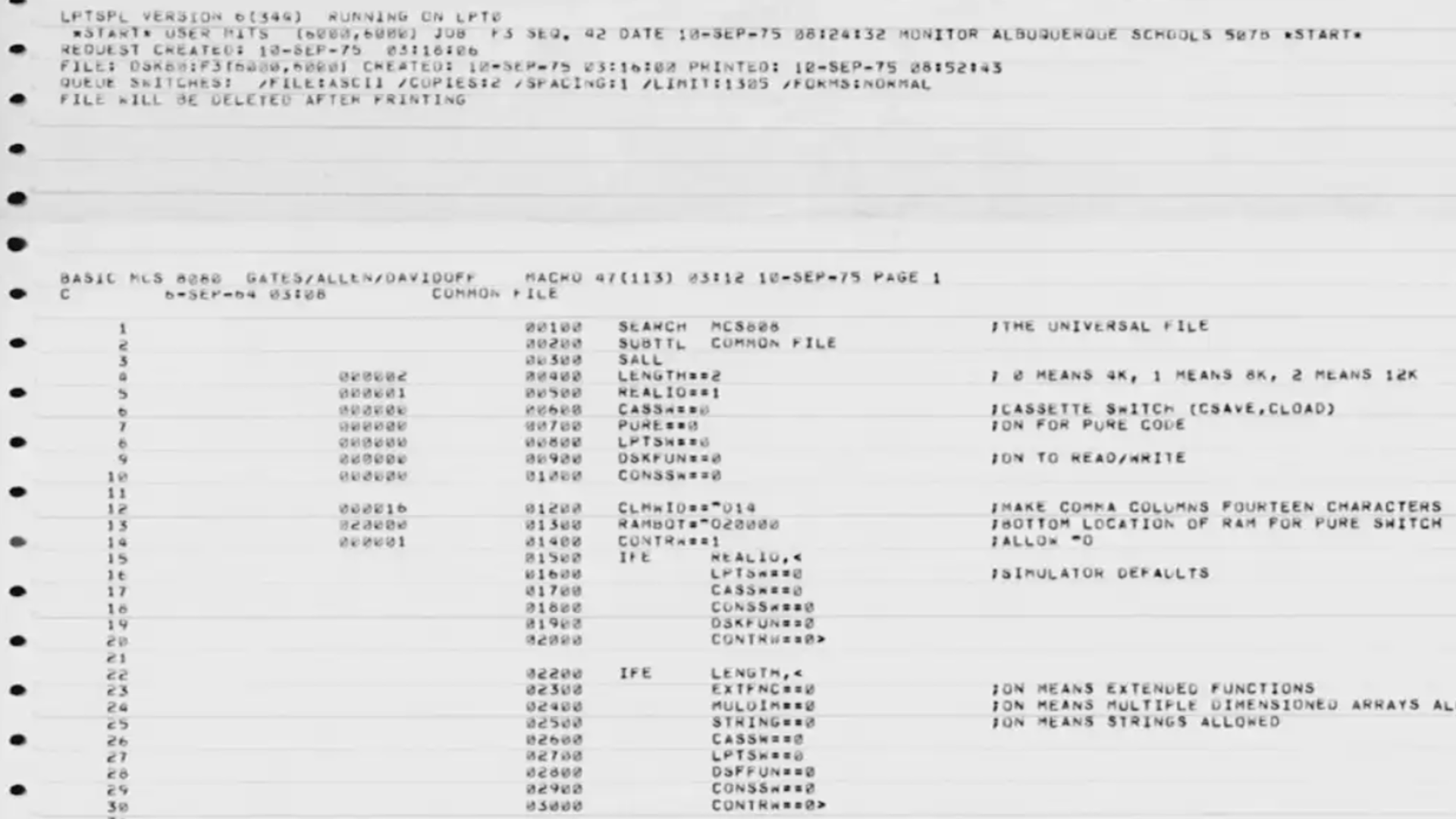
- Microsoft published 6,955 basic assembly code lines from 1976
- Bill Gates and Ric Weiland basic for MOS 6502
- Commodore under license Microsoft Basic in 1977 for $ 25,000 worldwide
Almost half a century after Bill Gates began writing software that is launching Microsoft, the company made this public code.
In early September, he placed the assembly source for its basic 6502 interpreter on Github, doing it as a historic stage.
The press release is the MIT license, which means that it can be studied freely, reused or even sold.
ALTAIR base tracing in Commodore
For long -standing observers, the gesture looks both like an act of preservation and a reminder of the place where the story of Microsoft began.
The interpreter 6502 dates back to 1976, when Gates and the second employee of Microsoft, Ric Weiland, adapted a work earlier on Basic for a new processor.
This adaptation was quickly recovered by Commodore, who authorized it at $ 25,000 in 1977 and sent it inside machines such as PET, VIC-20 and Commodore 64.
Millions of these systems found themselves in schools and houses, transporting Microsoft Basic in classrooms where personal IT was still a novelty.
The code now published is version 1.1, which includes garbage collection fixes contributed jointly by the Gates and the commodore engineer John Feagans in 1978.
On Commodore Pet, this update was known as Basic V2, a version still recalled by many early adopters.
In practical terms, Microsoft opened 6,955 assembly language lines, with validation horodatages “48 years ago”.
Beyond nostalgia, the source also shows how the first performers were built to maximize rare resources on 8-bit machines.
Microsoft notes that the version shows “Management of conditional compilation for several pioneering computer systems”, including Apple II, Commodore PET, Ohio Scientific and MOS KIM-1 technology.
For historians and amateurs, the most interesting elements are the techniques that have made the interpreter usable on the constrained equipment.
Among them, “the complete implementation of the basic language”, “floating comma arithmetic”, “manipulation and manipulation of strings” and “table support”.
The code also displays “the effective use of memory for 8 -bit systems” and introduces “chain garbage collection” and “storage of dynamic variables”, features that have given its basic reputation as flexible language for beginners.
The notes accompanying the assertion of the version that Microsoft positioned basic “as a dominant force in personal computer software before MS-DOS or Windows”.
It is true, but it omits the least flattering episodes that followed, as the way the company built MS-DOS with a strong inspiration from CP / M or how the aggressiveness of Windows licenses was later used against competitors.
Even with this context, the version remains notable. It provides transparency in a program that has shaped Microsoft’s first fortunes and defined what programming for beginners looked like in the late 1970s.
Via the register


