
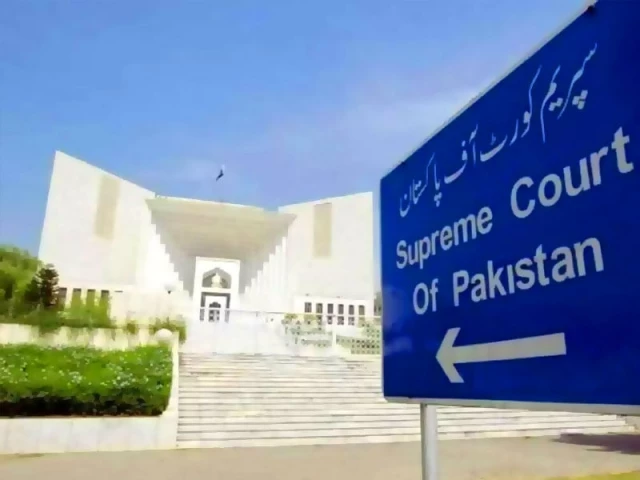
ISLAMABAD:
The Supreme Court on Monday resumed hearings in the super tax case, during which members of the larger constitutional bench made key observations regarding the imposition and timing of the tax.
A five-member bench, headed by Justice Aminuddin Khan, heard the case.
During the proceedings, Justice Jamal Khan Mandokhail observed that taxes other than sales tax can also be imposed under the National Finance Commission (NFC).
Justice Muhammad Ali Mazhar observed that “a tax cannot be imposed after the expiration of the prescribed period.” Appearing on behalf of several petitioner companies, advocate Farogh Naseem argued that the Sindh High Court had already declared the July 1, 2023 super tax null and void, ruling that a tax rate of 4% was applied instead of 10%.
He argued that the federal government could not legally impose a tax beyond the constitutionally defined period.
Another lawyer, Hafiz Ehsan Khokhar, said the lawyers presented their arguments with “patience and dignity” and expected a fair trial.
The case, which concerns the legality and constitutional limits of the government’s power to impose a super tax, will continue today (Tuesday) as the bench resumes its deliberations.
On April 4, 2024, a division bench of the Islamabad High Court comprising former Chief Justice Aamer Farooq and Justice Tariq Mehmood Jahangiri, while hearing intra-judicial appeals, ordered one of the respondents to continue paying tax payable under Section 4C as amended by the Finance Act, 2023.
The “super tax”, first introduced by the PML-N government in 2015, targets high-income individuals, associations of people and businesses earning more than 500 million rupees per year.
It imposes a levy of 4 percent on the income of banking companies and 3 percent on other sectors, with the income intended to finance the rehabilitation of temporarily displaced people.


