
ISLAMABAD:
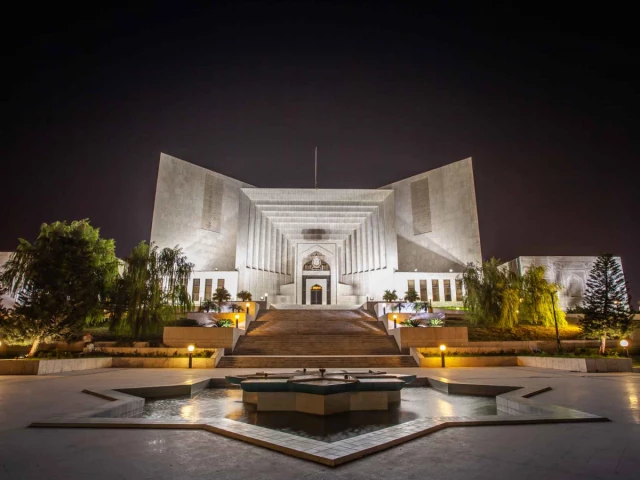
Public discord among Supreme Court justices intensified after the passage of the 26th constitutional amendment, sparking concerns that the growing divisions could further undermine the authority and independence of the nation’s highest court.
On Tuesday, a heated exchange between two members of the Constitutional Court – Justice Jamal Khan Mandokhail and Justice Ayesha Malik – laid bare the simmering tensions within the apex court during the hearing of the 26th Amendment case.
The disagreement was over the approval of the Supreme Court Rules, 2025. Justice Ayesha Malik was among the four judges who objected to the approval of the rules by way of circulation, while Justice Mandokhail insisted that the rules were duly approved at a full court meeting.
Observers say such public displays of discord among judges have eroded institutional cohesion and tarnished the moral authority of the judiciary.
After the restoration of the judiciary in March 2009, the apex court witnessed unprecedented unity under the leadership of the then Chief Justice Iftikhar Muhammad Chaudhry, becoming one of the most powerful institutions in the country.
However, this unity started to break down during the tenure of former CJP Mian Saqib Nisar, when an unpleasant confrontation broke out at the SC Peshawar registry after Saqib Nisar abruptly dissolved a bench mid-hearing, excluding Justice Qazi Faez Isa without his consent.
Subsequent chief justices Gulzar Ahmed and Umar Ata Bandial also presided over courts where visible divisions persisted, culminating in even sharper internal conflicts during the tenure of former CJP Qazi Faez Isa.
Legal analysts say the executive branch exploited these divisions, eventually introducing the 26th constitutional amendment last year, a move widely seen as an attempt to restrict judicial independence and place the judiciary under stricter executive control.
Since the adoption of the amendment, no concerted effort has been made to restore judicial autonomy. Judges considered resistant to executive influence would have been sidelined, thus reinforcing the feeling of internal polarization.
Senior lawyers are now pointing the finger at Chief Justice Yahya Afridi, arguing that the current state of affairs stems from his failure to act decisively. They argue that if the petitions challenging the 26th Amendment had been set for hearing on time, the judiciary could have avoided its current predicament.
They also say that instead of approving the SC 2025 rules through broadcast, the CJP could have convened a full court meeting to maintain transparency and unity.
Former Additional Attorney General Tariq Mahmood Khokhar said the 26th Amendment has “inevitably given rise to two factions in the Supreme Court, one resisting executive domination and the other willing to collaborate.”
“In such a state of affairs, conflicts within an institution are inherent,” he observed.
“The robe has slipped. The fault line inherent in the 26th Constitutional Amendment is now on display before the nation. The public clash between two judges in open court is not a matter of personal grudge; it is an outward symptom of a deeper institutional struggle over who defines Pakistan’s constitutional order.”
“In a supreme irony,” he continued, “the battlefield was the ‘Constitutional Chamber’ itself – a creation of an unrepresentative legislature, conceived and designed not for reform but for control. Its function was to substitute flexibility for independence.
Khokhar further warned that “whatever the final outcome, the political and constitutional cost is already evident: an increasingly weakened judiciary in the face of an increasingly powerful executive.”
He argued that although the amendment was formulated in the name of judicial reform, its “real objective was the consolidation of influence.” The composition of the constitutional judiciary reflected preference, not principle.
Khokhar stressed that the events currently unfolding in open court are a direct consequence of the 26th Amendment, which he said created a two-tiered judicial system – one oriented towards the executive and the other towards independence.


