Prime ministers, presidents and royals descended on Cairo on Saturday to attend the spectacle-filled inauguration of a sprawling new museum built near the pyramids to house one of the world’s richest collections of antiquities.
The inauguration of the billion-dollar Grand Egyptian Museum, or GEM, marks the end of two decades of construction efforts hampered by the Arab Spring uprisings, the pandemic and wars in neighboring countries.
“We all dreamed of this project and whether it would really come true,” Prime Minister Mostafa Madbouly said at a press conference, calling the museum “Egypt’s gift to the whole world from a country whose history dates back more than 7,000 years.”
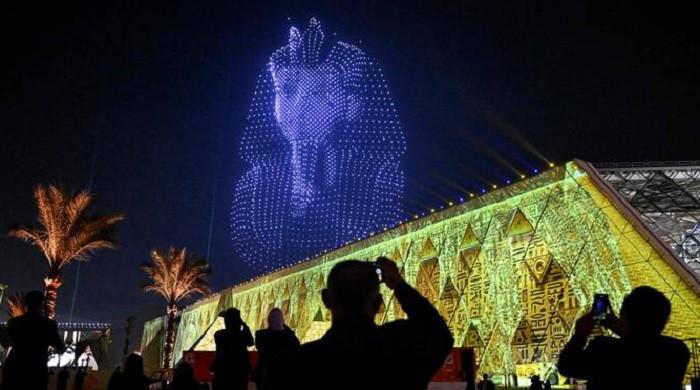
Spectators, including President Abdel Fattah al-Sisi, gathered Saturday evening in front of a giant screen outside the museum, which projected images of the country’s most famous cultural sites while dancers dressed in glittering pharaonic-style costumes waved luminous orbs and scepters.
“A new chapter for Egypt”
They were accompanied by Egyptian pop stars and an international orchestra dressed in white under a sky lit with lasers, fireworks and hovering lights forming moving hieroglyphs.
By opening the museum, Egypt was “writing a new chapter in the history of the present and future of this ancient nation,” Sissi said at the opening.
The audience included German President Frank-Walter Steinmeier, Dutch Prime Minister Dick Schoof, Hungarian Prime Minister Viktor Orban, Palestinian President Mahmoud Abbas, Democratic Republic of Congo President Félix Tshisekedi and the crown princes of Oman and Bahrain.
The museum’s most publicized attraction is the vast collection of treasures from Tutankhamun’s tomb, discovered in 1922, including the child king’s golden funerary mask, throne and sarcophagus, as well as thousands of other artifacts.
A colossal statue of Ramesses II, which stood for decades in a square in downtown Cairo and named after the pharaoh, now adorns the grand entrance hall.
The complex’s elegant design, reminiscent of pyramids, contrasts sharply with the dusty and often dated exhibits of the neoclassical Egyptian Museum opened more than a century ago in central Cairo, overlooking Tahrir Square.
An old looted museum
The ancient museum has suffered indignities in recent years, including the looting of several display cases during the 2011 Egyptian uprising, when antiquities thefts were commonplace.
In 2014, the beard on Tutankhamun’s funerary mask broke while workers were changing the lights in the display case, then was clumsily glued back together. The following year, the mask was better restored and put back on display.
Officials hope the new museum can end a perception fueled by such events that Egypt has neglected to care for its priceless treasures, and add weight to its demands for the return of Egyptian artifacts held in museums abroad.
“Is it a national sanctuary or a global showcase? A gesture of cultural sovereignty or a tool of soft power?” Read an article in a special edition of the public weekly Al-Ahram devoted to the museum, which he describes as “a philosophy as much as a building.”
“The GEM is not a replica of the Louvre or the British Museum. It is Egypt’s answer to both. These museums were born of empire; this one was born of authenticity.”
The cost of the museum, estimated at more than $1 billion, was financed largely by Japanese development loans. Designed by an Irish firm, Heneghan Peng Architects, it covers around 120 acres, making it roughly the same size as Vatican City.
Officials are also betting that the museum, the latest in a series of megaprojects launched or completed since 2014, can accelerate the recovery of tourism, a vital source of foreign currency for an economy battered by years of regional conflict and economic uncertainty.
A series of galleries were opened late last year, but many exhibitions were not accessible to the public.