
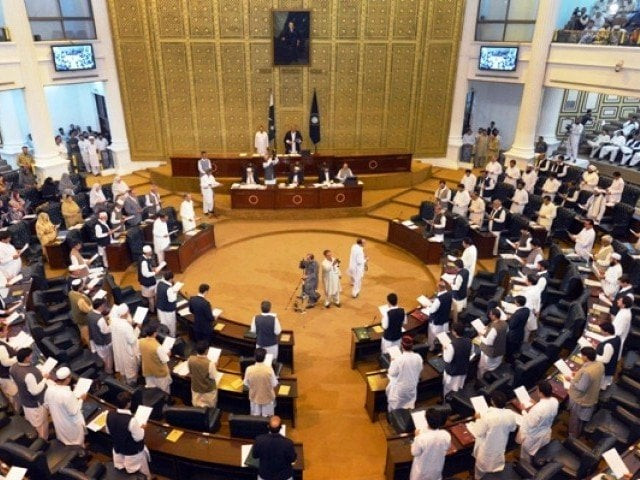
KP Assembly in session. PHOTO: AFP
PESHAWAR:
In a rare show of legislative unity, the Khyber-Pakhtunkhwa (KP) Assembly passed a unanimous resolution demanding bifurcation of the province and creation of a new Hazara province, which would include the Hazara region.
The opposition has given unconditional support to the provincial government in seeking the province’s “legitimate share” at the next meeting of the National Finance Commission (NFC), scheduled for Thursday in the federal capital.
During the session, under the chairmanship of President Babar Saleem Swati, Treasury Member Nazir Abbasi presented a joint resolution regarding the creation of Hazara province under Article 239 of the Constitution.
The resolution urged the provincial government to complete all necessary constitutional, legal and administrative processes for the new province and immediately submit its recommendations to the federal government.
He stressed that consultative and administrative measures should be implemented effectively to ensure the realization of the long-standing aspirations of the Hazara people. The resolution also asks the government to prepare a detailed plan regarding the administrative structure and boundaries of the new province to avoid any delay in the constitutional process.
The assembly also unanimously approved a resolution recognizing former prime minister and founder of the Pakistan People’s Party (PPP), Zulfikar Ali Bhutto, as a “national martyr”. The resolution praised his political, democratic and national contributions and recommended that a copy be sent to the federal government to officially recognize his services at the national level.
Another important resolution, presented by Awami National Party (ANP) member Nisar Baz Khan, called for curbing the use of public order enforcement (MPO) against political workers.
The resolution notes that the law has often been misused for political vendettas, particularly against members of the opposition. President Swati stressed that the police should not facilitate administrative actions under the MPO.
Provincial Minister Meena Khan Afridi reiterated the chief minister’s stand that no political worker, irrespective of party affiliation, should be subjected to punitive measures. Afridi added that the government is preparing amendments to ensure that the DFO is not used for political victimization.
The assembly also addressed farmers’ concerns when cabinet member Abdul Kabir presented a resolution demanding the reinstatement of the tobacco quota. The quota was reduced from 3 million tonnes last year to 1.5 million tonnes by the Pakistan Tobacco Board, causing widespread concern among growers. The resolution called for reinstating the previous year’s allocation and the House unanimously approved it.
A central point of the session was KP’s share under the NFC, which determines provincial allocation from federal resources. The Pakistan Tehreek-e-Insaf (PTI) government has formed a united front with opposition parties to demand KP’s “rightful share” in the NFC.
The province intends to demand an increase in the KP share from 14.6% to 19.4%. Opposition members expressed strong support for the government’s position, stressing that the issue transcends political lines and is essential for the development and well-being of the province.
During the debate on NFC, Treasury members including Abdul Karim Khan, Munir Hussain Laghmani, Dawood Shah and special advisor Shafi Jan highlighted that the issue of NFC is not only party specific but falls under the constitutional and financial rights of the province.
The KP is also seeking a higher allocation for counterterrorism funding, previously set at 1 percent. Lawmakers said revenues from electricity profits, water consumption and other pending dues under the NFC had not yet been released to the province.
Opposition legislators, including Arbab Usman, Nisar Baz Khan, Sardar Shahjahan, Ahmed Kundi, Ashbar Khan Jadoon and Amna Sardar, expressed their readiness to support the provincial government in pursuing these demands at the next NFC meeting on December 4. They pointed out that despite three PTI governments in KP, the province’s case had not been effectively presented to the federal government in previous years.
In response, Minister Afridi detailed the government’s position, noting that KP has already contributed Rs80 billion of the Rs130 billion required for the expenditure of the merged districts. He said that under Article 107, the share of NFC in KP is 14.62 per cent and additional allocations must be ensured for counter-terrorism efforts.
“Ensuring the province’s share is vital for the development and prosperity of the region,” Afridi told the House. He stressed that these resources belong to the people of KP and do not constitute charity or aid. The assembly agreed to include suggestions from all stakeholders to finalize a strong and unified provincial case for the NFC.


