
Justice Minister says option can be used if necessary, accuses PTI of fueling political instability
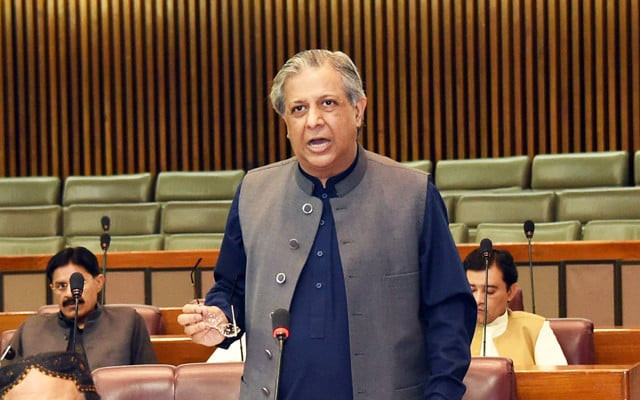
Federal Minister for Law and Justice, Senator Azam Nazeer Tarar, addressing a session of the National Assembly on Friday, April 19, 2024. PHOTO: FACEBOOK/NATIONAL ASSEMBLY
ISLAMABAD:
Law Minister Azam Nazeer Tarar on Monday said the provision for rule by a governor in a province was a constitutional option rather than a form of martial law, accusing the opposition Pakistan Tehreek-e-Insaf (PTI) party of fueling political disorder.
Amid speculation that the federal government was considering governor’s rule in Khyber-Pakhtunkhwa (KP), Tarar said Articles 232 to 234 of the Constitution explicitly allowed for the move if circumstances warranted it.
He warned against trying to score political points and argued that national stability must take priority over partisan agendas. “If Pakistan exists, we all exist,” he said, adding that the continuity of democratic order would allow even the PTI founder to hope for a political comeback.
He said the PTI had weakened its own position by abandoning Parliament after the 2022 no-confidence vote, calling it a strategic misstep that left the party without institutional leverage.
The Justice Minister warned that history was unforgiving of political miscalculations, insisting that democratic processes could not operate under duress, under threat or under any attempt to attack the Federation using state resources.
Referring to past injustices – including the execution of Zulfikar Ali Bhutto and the assassination of Benazir Bhutto – he stressed that political parties had not turned against the state even at those times, noting that “the lines were never crossed”, including when Nawaz Sharif was removed from office twice.
He pointed out that the PTI had filed more than 90 election petitions, most of which were decided by established legal forums, and warned that circumventing constitutional mechanisms undermined political credibility and sent harmful signals to younger generations.
Information Minister Attaullah Tarar echoed these criticisms in the House, saying the jail meetings were meant for legal consultations and not conspiracy against national institutions or slandering the Pakistan Army on foreign platforms.
He accused PTI leaders of selective memory, recalling past remarks targeting political opponents, and said political bitterness intensified during PTI’s tenure due to arrests, institutional confrontations and actions that “created an intolerable environment.”
He said earlier political rivalries survived because leaders such as Nawaz Sharif and Benazir Bhutto respected the Charter of Democracy. He insisted illegal demands would not be accepted and criticized former accounts executives for stirring up hostility before leaving the country.
Noor Alam Khan, a member of the National Assembly, warned that any attack on Parliament amounted to an attack on the country’s 240 million citizens, saying disagreements must not turn into attacks on the state. He said patriotism was not exclusive to any party and inciting enmity against Parliament did not serve the interests of Pakistan.
Outside the House, the ministers reiterated that the governor’s regime in KP remained under review. Attaullah Tarar told reporters that this option was constitutional and naturally arose when governance weakened.
Minister of State for Home Talal Chaudhary urged Chief Minister Sohail Afridi to avoid escalation of tensions with the Centre, saying the federal government had kept him informed on security issues and scoring political points would only complicate administrative challenges.
Parliamentary Affairs Minister Tariq Fazal Chaudhry said in a television interview that no final decision had been made, but confirmed the option remained on the table. Adviser to the Prime Minister, Rana Sanaullah, expressed the same view, pointing out that although the governor’s government was under consideration, no action had been approved and future developments depended on Afridi’s conduct.
PTI president’s lawyer Ali Gohar rejected the possibility of a governor’s rule, arguing that neither the grounds nor the conditions existed. He warned against rumors and said the province should operate strictly according to the Constitution.
PTI’s Asad Qaiser criticized the government’s tone, warning of serious political repercussions if the measure was imposed. The party’s parliamentary committee said such a move would fuel instability, weaken law and order and undermine public mandate.
Qaiser said any attempt to destabilize the provincial government would worsen the unrest, adding that the PTI continued to demand the release of its founder. He called blocking meetings with family members and party officials a violation of human rights.
(WITH THE CONCLUSION OF THE AGENCIES


