
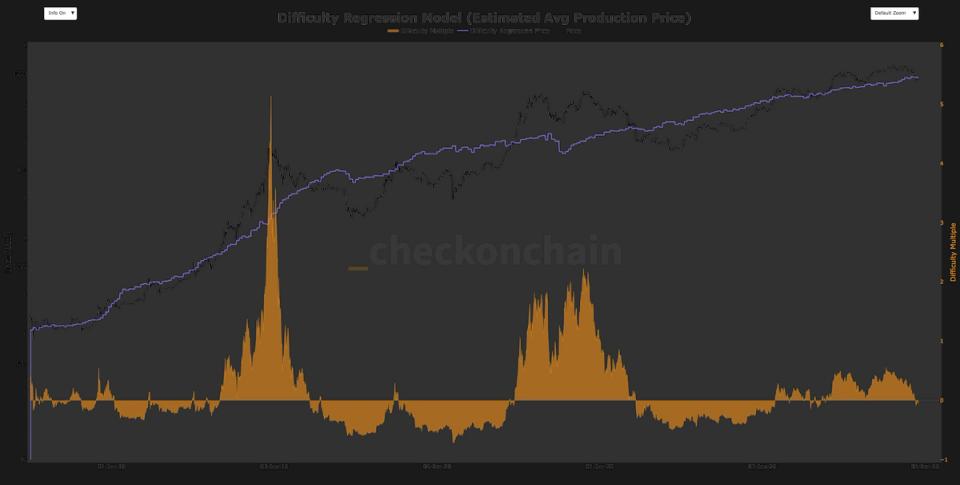
Bitcoin closely follows the difficulty regression model, according to checkonchain.
This model estimates the overall production cost of maintaining the network. The model treats mining difficulty as a distilled measure of mining price, as it incorporates all major operational variables into a single figure. This provides an industry-wide estimate of the average cost of producing one bitcoin without the need for detailed assumptions about hardware, energy costs, or logistics.
The pattern currently sits near $92,300, which is roughly the spot price of Bitcoin. It was briefly triggered lower when bitcoin fell to around $80,000, but has since regained the pattern valuation.
Price tends to stay in a bull market when trading above the pattern and often moves into a bear market regime when trading below it.
In April 2025, bitcoin fell to around $76,000 and rebounded precisely to the pattern value at the time, acting as an important support level. For much of 2025, it traded at a roughly 50% premium to the model, while for much of 2024 the price remained close to the model.
During the 2022 bear market, bitcoin traded at a discount of up to 50% to the pattern. Meanwhile, during previous bull markets, the multiple widened much further, with Bitcoin’s price doubling the pattern at the peak in 2021 and quintupling it in 2017.
As Bitcoin has become an asset, premiums near these levels appear to be a thing of the past.
Overall, the model suggests that the price of bitcoin is currently close to its cost of production, which can be interpreted as a fair value zone. Valuations based on the Metcalfe Act also place bitcoin at a fair value around $90,000, reinforcing this valuation.


