
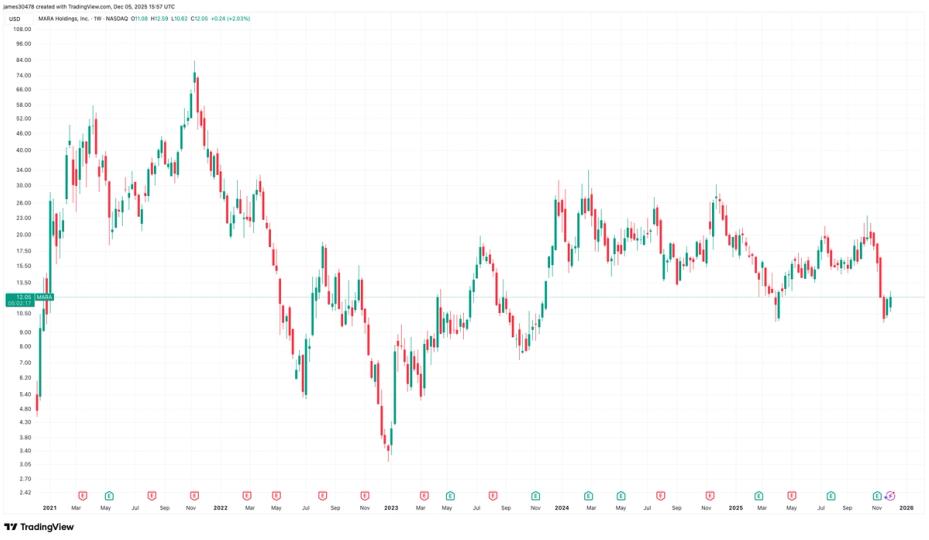
The two largest publicly traded companies holding bitcoin, Strategy (MSTR) and MARA Holdings (MARA), are each down about 40% over the past six weeks.
CoinDesk Research has covered the MSTR correction extensively, but MARA, which is down 55% year-over-year, is also drawing attention because some investors view it as inexpensive at current levels.
Matthew Sigel, head of digital assets research at VanEck, says the perception of MARA as cheap is not supported by the data. Sigel argues that the company is actually trading at a premium to its Bitcoin holdings and not at a discount.
Sigel highlights MARA’s outstanding convertible debt of $3.3 billion compared to its $4.9 billion in bitcoin assets. Accounting for convertible debt, only $1.6 billion of bitcoin’s net worth remains before accounting for additional debts incurred by the mining company.
That compares to a market cap of $4.7 billion, which Sigel says means MARA actually trades at a premium once debt is included, rather than at a discount to its bitcoin holdings.
Sigel also addresses MARA’s high short interest, which currently stands at 27%. After adjusting for the delta hedge tied to the company’s convertible notes, Sigel estimates that true short interest falls to about 15%, a reduction of 44%.
Sigel compares this to MSTR, which has more than $8 billion in convertible debt, compared to a market cap of $53 billion.
Once the short positions tied to the hedges are removed, MSTR’s short interest only decreases by 31%, or about 9 million shares. Sigel characterizes MARA’s short-term interests as more structural, compared to MSTR’s, which he sees as more fundamentally focused.
Sigel claims that more than half of MARA’s stock volatility comes from its capital structure and funding dynamics rather than pure Bitcoin beta. He concludes that MSTR provides much cleaner Bitcoin duration exposure, while MARA’s mining stock performance is dominated by what he describes as a problematic capital structure.


