
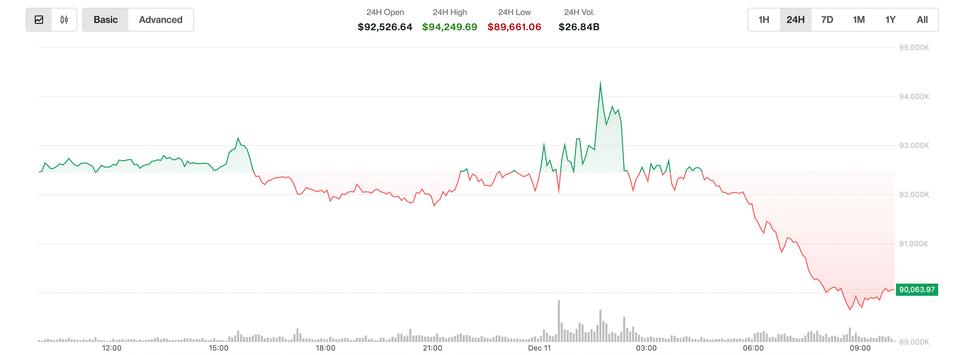
Bitcoin the leading cryptocurrency by market value, is falling following the Fed’s rate cut overnight. The reason likely lies in the Fed’s messaging, which made traders less enthusiastic about future easing.
The Fed on Wednesday lowered its benchmark interest rate by 25 basis points, to 3.25%, as expected, and said it would begin buying short-term Treasuries to manage liquidity in the banking system.
Still, BTC was trading below $90,000 at press time, representing a 2.4% decline since early trading hours in Asia, according to CoinDesk data. Ether was down 4% at $3,190, with the CoinDesk 20 Index down more than 4%.
This risk aversion is likely due to growing signs of internal divisions at the Fed over striking a balance between inflation control and employment goals, as well as signals of a tougher path for future rate cuts.
Two FOMC members voted Wednesday for no change, but individual forecasts found that six FOMC members believed a reduction was not “appropriate.”
Additionally, the central bank suggested only one additional rate cut in 2026, disappointing expectations of two to three rate cuts.
“The Fed is divided and the market has no real idea of where rates will move in the future between now and May 2026, when Chairman Jerome Powell will be replaced. Replacing Powell with a Trump loyalist (who will push to cut rates aggressively) is probably the most reliable signal for rates. Until then, however, there are still 6 months,” Greg Magadini, director of derivatives at Amberdata, told CoinDesk.
He added that the most likely event right now is a “deleveraging” or “market decline” to convince the Fed to decisively lower rates.
Shiliang Tang, managing partner of Monarq Asset Management, said that BTC was following the decline in the stock market.
“Cryptocurrency markets initially soared on the news but have gradually declined since, in conjunction with stock market futures, with BTC testing but unable to surpass the local high of $94,000 for the third time in two weeks,” Tang told CoinDesk.
He added that implied volatility continued to decline, with the last major market catalyst of the year behind us.
Liquidity management, not QE
Although the crypto community was quick to label the Fed’s reserve management program as a good old quantitative easing (QE) program that fueled unprecedented risk-taking in 2020-2021, this is not necessarily the case.
The reserve management program involves the Fed purchasing $40 billion of short-term Treasury bonds. While this measure does indeed expand its balance sheet, it is primarily intended to address liquidity strains in money markets, without engaging in balance sheet expansion or lasting suppression of yields.
Traditional QE targeted long-duration Treasuries and mortgage-backed securities to aggressively reduce long-term yields and inject trillions into the economy, directly increasing liquidity for speculative investments.
The founder of Steno Research, Andreas Steno Larsen, explained it best when talking about
According to some observers, the latest program implemented is a preemptive attack against possible instability in currency markets, similar to that of 2019.
“Instead of risking a run like 2019, the Fed is quietly buying a cushion now. It’s just about making sure the financial system has enough room to get through the spring without something breaking,” said pseudonymous EndGame Macro observer.


