
According to him, the right to privacy requires protecting people against any intrusion into private domains
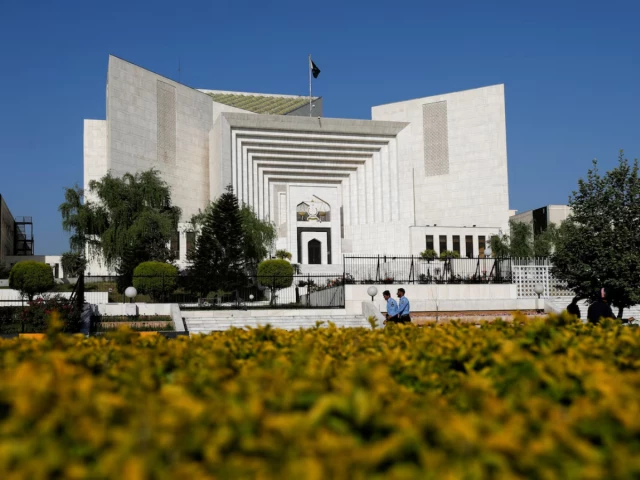
Police officers walk past the Supreme Court of Pakistan building, in Islamabad, Pakistan April 6, 2022. REUTERS
ISLAMABAD:
The Supreme Court has ruled that DNA testing without an individual’s consent is a gross violation of their fundamental rights to liberty and privacy, guaranteed under Articles 9 and 14 of the Constitution.
“Collecting an individual’s DNA without due process fundamentally violates the rights to privacy, autonomy and personal liberty, as it involves the extraction of highly sensitive personal information,” reads a 6-page judgment written by Justice Muhammad Hasham Khan Kakar.
By this order, an SC division bench headed by Justice Kakar set aside a judgment of the Lahore High Court (LHC) which had upheld the decision of a Sahiwal anti-graft court.
The anti-corruption court had ordered the petitioner to obtain his DNA to determine his parentage in a case related to forgery and corruption of educational documents with the aim of depriving him of his rightful inheritance.
The order noted with grave concern that the High Court, in its order, had upheld the DNA testing directive without citing any specific legal provision authorizing compulsory execution of DNA test on an individual without his express consent, in the context of a private complaint procedure.
“We are aware of certain provisions contained in Sections 53A, 164A and 164B of the Code of Criminal Procedure, 1898 requiring the conduct of such DNA and other related tests.
“However, they are conducted only in cases of charges of rape, unnatural offense or sexual abuse or attempted rape, unnatural offense or sexual abuse under Sections 376, 377 and 377B of the Pakistan Penal Code, 1860 and the facts and circumstances of the present case are totally different.”
The judgment notes that in the present case, the parentage of the petitioner was presumed to be disputed by the Special Judge of an anti-graft court without issuing proceedings under Section 202 of the Code of Criminal Procedure (CrPC).
“We are of the view that the order directing compulsory DNA testing without consent in such circumstances constitutes a gross violation of the petitioner’s fundamental rights to liberty and privacy as explicitly guaranteed under Articles 9 and 14 of the Constitution,” it said.
The judgment notes that the right to personal sanctuary, recognized as the right to privacy, requires protecting individuals against unjustified encroachment on their private domains.
“This protection extends to personal data, communications, family life and all facets of the personal sphere against any unjustified interference by the State or private entities.
“Although intrinsically linked to the rights to existence and autonomy, the right to privacy has achieved the status of a distinct and autonomous fundamental guarantee under Article 14 of our Constitution.
“Privacy represents the ultimate honor of the human person, representing a zone of choice and individuality. It guarantees determination, allowing individuals to make intimate decisions without fear of surveillance or unauthorized disclosure.”
The judgment further states that the encroachment creates a significant risk of misuse or unauthorized dissemination of the individual’s genetic model, which could have substantial negative consequences on their personal and professional situation.
“The right to liberty, anchored in Article 9 of the Constitution, goes beyond simple immunity from bodily detention; it guarantees freedom from arbitrary or unjustified restrictions on individual autonomy which are incompatible with the public interest and legislative texts.
“Requiring DNA testing by anyone at any time, especially to verify parentage, impinges on these rights because genetic information contains comprehensive data regarding lineage and physical characteristics.
“Furthermore, both fundamental rights protect bodily integrity, ensuring the individual’s power to manage their body and reject unsolicited medical procedures.”
The court also declared that the imposition of a court order for a DNA test, without legal basis or consent, constitutes an act which goes beyond a mere procedural irregularity, having far-reaching detrimental consequences on the life and dignity of the individual.
“Unnecessary public challenge to someone’s paternity inherently results in societal embarrassment, humiliation, and severe psychological stigma.
“The issue of contesting paternity can never be taken lightly, because the unnecessary coercion of subjecting an individual to DNA testing inherently raises serious allegations regarding the character and moral integrity of the mother, which this court finds to be inadmissible.
“Such a judicial act, lacking the required legal basis, constitutes an unjustified intrusion into the sanctity of family life and into the reputation of a woman, which must never be tolerated under the guise of legal proceedings.
“Such an invasive procedure, especially when it lacks legal basis, directly contravenes the fundamental guarantee of the inviolability of the dignity of the person enshrined in Article 14 of the Constitution.
“By subjecting an individual to public scrutiny over the intimate aspect of his parentage without due process, the courts are in effect sanctioning an arbitrary restriction of his personal sphere, thereby violating his right to liberty under Article 9 of the Constitution and causing irreparable harm to his reputation and standing in the community.”
The judgment held that the lower courts erred in ordering DNA tests on the petitioner. The SC ordered that the special judge of the anti-graft court should proceed with the case strictly in accordance with the law, without requiring any such DNA test.


