
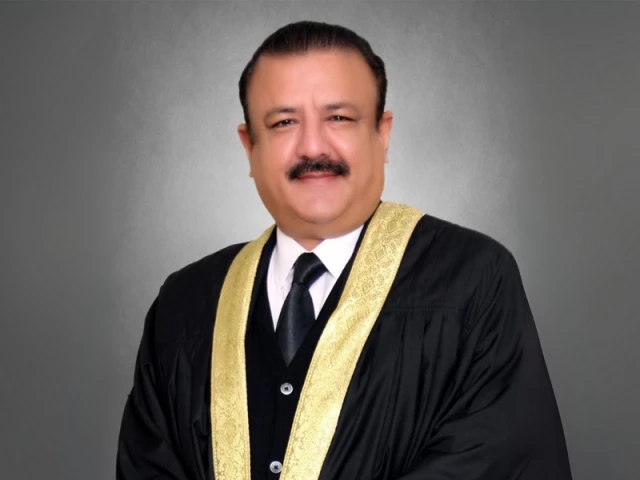
Judge Tariq Mehmood Jahangiri. Photo courtesy: IHC
ISLAMABAD:
In the upcoming hearing of a petition accusing Islamabad High Court (IHC) judge Tariq Mehmood Jahangiri of holding an invalid law degree, the judge is likely to appear in person before a division bench which asked him for a response on Tuesday.
According to a source, Justice Jahangiri will visit Courtroom 1 of the IHC where Chief Justice Sardar Muhammad Sarfraz Dogar and Justice Muhammad Azam Khan will resume proceedings tomorrow (Monday) on the quo warranto petition of advocate Mian Dawood.
Last week, on December 9, the bench declared the petition admissible. He had also sent notices to the judge and other respondents and requested written responses within three days.
During Tuesday’s hearing, Islamabad Advocate General Ayaz Shaukat told the bench that according to a report submitted by the University of Karachi (KU), Islamia Law College, an institute affiliated to KU, had declared Tariq Mahmood Jahangiri “an unknown individual”.
The petitioner, Mian Dawood Advocate, argued that under Article 193 of the Constitution, a judge of the High Court must be an advocate.
He said Justice Jahangiri was not even qualified to become a lawyer, let alone a judge. He added that whether the allegation is true or false, the onus is now on Justice Jahangiri to prove that his degree is genuine.
The lawyer representing the Islamabad Bar Association, Advocate Ahmed Hasan, argued that the petitioner – Mian Dawood – was not an aggrieved party.
He said that to become a High Court judge, ten years of legal practice is mandatory and the issuance of a license to practice law is within the jurisdiction of the concerned Bar Council.
“If there is any defect in the degree or eligibility to practice law, the matter should be brought before the Bar Council, not the court.”
He further warned that if a High Court judge initiates legal proceedings against another judge, it would harm the justice system.
He added that after practicing law, Justice Jahangiri was appointed as a judge by the Judicial Commission of Pakistan (JCP) and the matter should be referred to the Supreme Judicial Council (SJC) as a high court cannot investigate such cases.
Raja Aleem Abbasi, a member of the Islamabad Bar Council, argued that matters relating to judges should be handled by the JCP, while matters relating to defense fall under the Bar Council.
He also objected to CJ Dogar sitting on the bench, saying that since a petition against Dogar’s transfer to the IHC – filed by Justice Jahangiri – is pending before the Federal Constitutional Court, he should not hear that case.
Abbasi asked the court to transfer the case to another jurisdiction.
The court-appointed amicus curiae, lawyer Zafarullah Khan, also presented arguments on the upholding of the writ of quo warranto.
The Chief Justice noted that the university categorically stated that Justice Jahangiri was never a student of Islamia Law College.
The bench then issued notices to Justice Jahangiri, the Federal Government through the Ministry of Justice, the President through his Principal Secretary, the JCP Secretary and the Parliamentary Committee on Appointment of Judges, directing all respondents to submit their responses within 3 days.
Earlier, KU had submitted its report stating that Tariq Mehmood Jahangiri was found guilty in 1989 by the Unfair Means Committee of cheating in the LLB Part I examination and making threats to the examiner, resulting in a three-year ban.
Although he became eligible to reappear for the examinations in 1992, he allegedly used a fake 1990 registration form bearing a fake government Islamia Law College stamp to obtain his diploma, changing his name and registration number several times to acquire the mark sheets and diploma.


