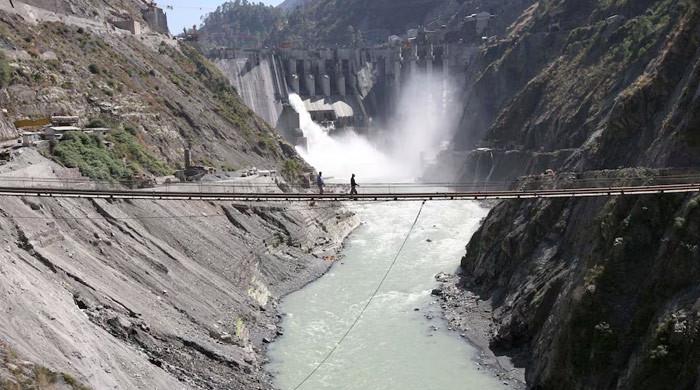
- India abruptly eases, then reduces the flows of the Chenab to 870 cusecs.
- The draining and filling of the Baglihar dam is termed as deliberate manipulation.
- The IWT remains binding despite India’s unilateral suspension.
India restarted a “water war” during the winter season by abruptly releasing a large volume of water into the Chenab River at Head Marala before sharply reducing the flow to between 870 and 1,000 cusecs for four consecutive days.
According to officials, the Modi administration abruptly released 58,000 cusecs of water during the midnight hours of December 7 and 8, 2025, News reported Thursday.
Subsequently, on December 13, India sharply reduced the releases to an alarming level of 870 cusecs, which remained between 870 and 1,000 cusecs till December 17. Historical data shows that the average flow of the Chenab River over the last 10 years ranged from a maximum of 10,000 cusecs to a minimum of 4,000 cusecs.
Pakistani authorities said India violated the Indus Waters Treaty (IWT) of 1960 by first draining the reservoir of the Baglihar hydroelectric project and then filling it, despite the fact that run-of-river projects on rivers allocated to Pakistan could not be arbitrarily drained and refilled.
The Court of Arbitration, in its decision of August 8, 2025, had already declared that India’s manipulation of water discharges – through the emptying and filling of dams on rivers allocated to Pakistan – constitutes militarization of water.
Talk to News correspondent, Pakistan’s Indus Waters Commissioner Syed Mehr Ali Shah confirmed the development and said he had written an official letter to his Indian counterpart, emphasizing that the Indus Waters Treaty remains in full force and effect, as affirmed by the Court of Arbitration.
He said the letter provided specific scientific evidence of India’s actions, demonstrating that the draining and then filling of the Baglihar Dam was not due to natural hydrometeorological factors but amounted to deliberate manipulation of water resources.
Shah said the letter was issued under Article VI(1)(a) and (b) of the IWT, requesting exchange of detailed water discharge data. Further, under Article VIII(1)(a) and (4)(b), Pakistan requested immediate consultations so that the implications of sudden variations in water discharges could be addressed expeditiously.
It is pertinent to note that on April 23, 2024, India unilaterally suspended the treaty. However, the Court of Arbitration later clarified that India could not suspend the treaty unilaterally and that it remained legally binding.
Pakistan’s National Security Committee, which met on April 24, 2024 under the chairmanship of Prime Minister Shehbaz Sharif, vehemently rejected India’s announcement to suspend the treaty and said any stoppage of water supply by India would be considered an act of war.