
ISLAMABAD:
Pakistan said Thursday that the latest United Nations Security Council report on Afghanistan confirmed its long-standing concerns about the presence of terrorist groups across the border.
The 16th report of the Analytical Support and Sanctions Monitoring Team has been submitted to the UN Security Council. “The de facto authorities continue to deny that any terrorist group has a footprint on or operates from its territory. This assertion is not credible,” the report said.
“A wide range of Member States consistently report that ISIL-K, Tehreek-i-Taliban Pakistan (TTP), Al-Qaeda, East Turkestan Islamic Movement, also known as Turkistan Islamic Party (ETIM/TIP), Jamaat Ansarullah, Ittihadul Mujahideen Pakistan and others are present in Afghanistan. Some groups have used or continue to use Afghanistan to plan and prepare for external attacks.
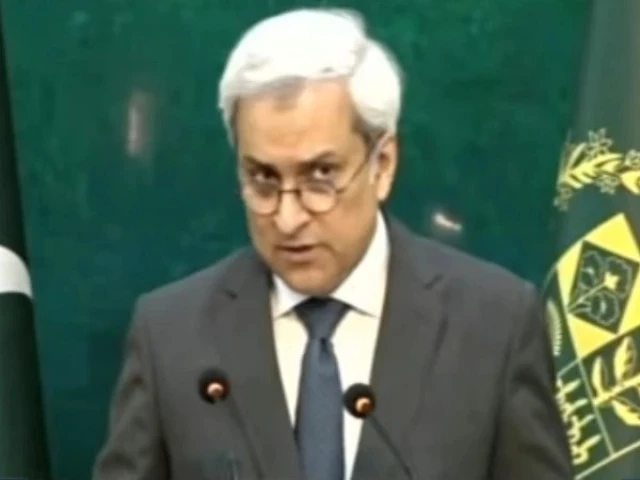
At his weekly press briefing, Foreign Ministry spokesperson Tahir Andrabi said the UN report had “corroborated what Pakistan has been saying all along” that terrorist sanctuaries in Afghanistan pose a serious threat to regional peace and stability and undermine prospects for normalization between Islamabad and Kabul.
The spokesperson noted that the Security Council report gave details of the configuration of various terrorist outfits operating from Afghan soil, with specific reference to the Tehreek-e-Taliban Pakistan (TTP), also referred to by Pakistan as Fitnah Al Khwarij. “These findings are in line with Pakistan’s official position and are now being heard loud and clear in international capitals.”
He added that the presence of such groups remained the main obstacle to improving bilateral relations, including progress in border management, trade normalization and a lasting ceasefire. Andrabi stressed that Pakistan has consistently raised these concerns with the Afghan Taliban authorities and at multilateral and regional forums, including recent talks hosted by Iran.
While declining to comment on the specific individuals named in the UN report or the alleged financial arrangements, the spokesperson said there was “sufficient evidence, including UN reports”, to establish that terrorist elements in Afghanistan benefited from support from the Taliban regime.
He reiterated that Pakistan remained supportive of continuing regional engagement mechanisms on Afghanistan, but stressed that Islamabad’s goodwill gestures had not been reciprocated.
Regarding issues related to a so-called ceasefire with Afghanistan, Andrabi clarified that the agreement should not be seen in conventional military terms. “Terrorist attacks emanating from Afghan soil constitute firing,” he said, adding that such attacks continued despite Pakistan’s good faith efforts. “Unfortunately, this ceasefire is not holding.”
Regarding Reuters reports of an impending visit by Chief of Army Staff and Chief of Defense Forces General Asim Munir to the United States, the spokesperson contradicted the story “in its essence.”
He said the report wrongly suggested the visit had been planned and finalized. “I have no information about the visit,” Andrabi said, adding that official announcements were always made when high-level visits were finalized. “In this case, no such announcement has been made.”
He stressed that political and military leaders regularly visit foreign capitals, but that speculation based on anonymous sources should not be taken as confirmation.
Responding to follow-up questions, the spokesperson rejected comparisons to past visits by former military leaders to Washington that resulted in large aid packages. He said any discussion of economic or strategic outcomes was premature and speculative. “We would wait for an official announcement from the government of Pakistan in the event of such a visit,” he said.
The briefing also addressed what Islamabad described as a sustained disinformation campaign against Pakistan, particularly following a recent terrorist attack at Bondi Beach in Australia.
Andrabi said Indian media, aided by news outlets and social media outlets in Israel and Afghanistan, falsely linked the attack to Pakistan before the perpetrator was identified as an Indian national. He said Pakistan had raised such cases at relevant international forums, warning that persistent disinformation was eroding the credibility of those propagating it.
The spokesperson also expressed Pakistan’s growing concern over sudden changes in the flow of the Chenab River earlier this month. Andrabi said Pakistan observed unusual fluctuations between December 7 and 15, indicating unilateral water releases by India without prior notification or data sharing, in violation of the Indus Water Treaty (IWT).
He said Pakistan’s Indus Water Commissioner had formally written to his Indian counterpart seeking clarification on the mechanics of the treaty. “Any manipulation of river flows by India, especially at a critical time in our agricultural cycle, directly threatens the lives, livelihoods, food security and economic security of our citizens,” the spokesperson warned.
Reiterating Pakistan’s commitment to the IWT, Andrabi described the treaty as a binding international agreement that has served as an instrument of regional peace and stability for decades. He warned that any violation would not only undermine international law and the sanctity of treaties, but also pose serious risks to regional peace and the principles of good neighborliness.
Asked whether Pakistan would invoke Article 9 of the IWT, which deals with dispute resolution, the spokesperson said Islamabad had “all available options” and would exercise them to safeguard its legitimate water rights. “We would also ensure that India does not weaponize water,” he said, linking access to water to the fundamental right to life.
“Pakistan remains committed to peacefully resolving its differences with India,” Andrabi concluded, “but will not compromise on the existential water rights of its people.”


