
Experts highlight harm caused to civilians by Indian missile strikes, call for compliance with international standards
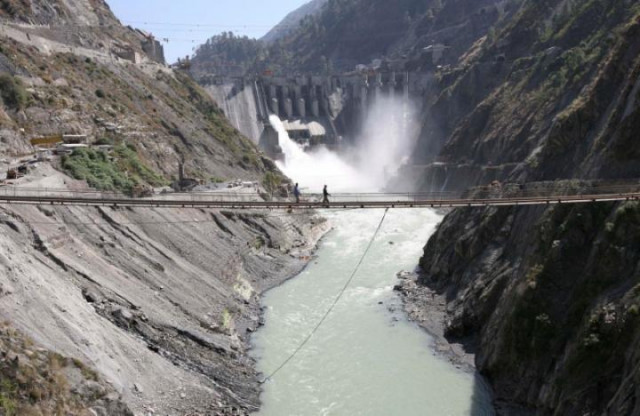
Workers walk on a bridge near the recently inaugurated 450 megawatt hydroelectric project, located at Baglihar Dam, on the Chenab River which flows from Indian Kashmir to Pakistan, in Chanderkote, about 145 km (90 miles) north of Jammu, October 10, 2008. PHOTO: REUTERS
United Nations special rapporteurs and independent experts have criticized India’s military actions during the May conflict with Pakistan, saying New Delhi may have violated international law and increased the risk of a broader confrontation. The report also expressed concerns over India’s announcement to keep the Indus Waters Treaty “on hold”.
The report, released Friday, focuses on May 7, when Indian forces reportedly carried out strikes inside Pakistani territory. U.N. experts said the unilateral use of force appeared to violate the U.N. Charter and noted that India had not formally notified the U.N. Security Council of its actions, which they said is required under international law.
The report said the strikes caused harm to civilians, saying populated areas were hit, causing casualties and injuries, and religious sites, including mosques, were damaged. Even as experts condemned the Pahalgam attack that preceded India’s response, they said there was insufficient evidence to support India’s claims of Pakistani state involvement.
The legal assessment is unequivocal; International law provides “no distinct and recognized right to use unilateral military force to combat terrorism,” the report said. He warns that such action could violate the right to life and increase the risk of a wider confrontation. Experts said that if India’s conduct amounted to an armed attack, Pakistan would retain its right to self-defense, and they called the strikes a serious violation of Pakistan’s sovereignty.
Regarding the Indus Waters Treaty, the report said any obstruction or threat to the flow of the river could affect the fundamental rights of millions of people in Pakistan, including access to water, food, livelihoods, health, environment and development.
Experts said interference with cross-border water flows should be avoided and water should not be used as political or economic leverage. They said the treaty cannot be suspended unilaterally and remains in force unless the two governments agree to end it through a new arrangement.
Read: Pakistan accuses India of manipulating Chenab river flow
Experts called India’s formulation of the treaty “held in abeyance” ambiguous and said New Delhi had not clearly invoked the suspension provisions under treaty law. The report describes any unilateral suspension as illegal because it circumvents established procedures.
The report says disputes should be resolved through the settlement mechanisms provided in the treaty. He described India’s references to a “material violation” and alleged cross-border terrorism as legally weak grounds for suspension, saying Pakistan had not been shown to have violated any clause of the treaty.
Experts said a fundamental change in circumstances requires a strict legal threshold and that demographic or energy demand alone is not enough to meet it. They added that India had not presented any evidence to justify the countermeasures and argued that restricting water flows or suspending the treaty would be a disproportionate measure affecting Pakistani civilians.
According to the report, the countermeasures do not remove human rights obligations and would require advance notice, negotiations and the completion of legal procedures. Experts have said such measures are temporary and reversible and do not warrant permanent suspension or dismissal.
Experts have placed blame for the deterioration of treaty commitment on India, noting that annual meetings of the Indus Commission have not been held since 2022 and citing obstacles to data exchange and disagreements over settlement clauses as being contrary to the intent of the treaty.
Learn more: Pak rejects India’s criticism of constitutional changes
In a statement issued by the President’s Secretariat, President Asif Ali Zardari welcomed the report, saying it “reinforces Pakistan’s long-standing position that the unilateral use of force across international borders constitutes a violation of the United Nations Charter and a grave attack on Pakistan’s sovereignty.”
Addressing the report’s assessment of violations of the Indus Waters Treaty, the President said circumvention of agreed dispute resolution mechanisms and actions affecting water flows violated Pakistan’s rights and risked creating serious human rights consequences.
Zardari expressed concern that the report clearly demonstrates the irresponsible behavior of the Indian state. “India has long stood in the way of its minorities and ignored its commitments to international forums such as the United Nations, but this pattern of rogue behavior cannot continue indefinitely,” he said, emphasizing that such conduct cannot continue.
Deputy Prime Minister and Foreign Minister Ishaq Dar, addressing foreign diplomats on Friday, said that in April 2025, India unilaterally suspended the Indus Waters Treaty and withheld critical data and information to which Pakistan was entitled under the agreement.
According to Dar, the UN special rapporteurs in the report confirmed Pakistan’s position on the treaty, emphasizing that the Indus Waters Treaty is the cornerstone of peace and stability in South Asia and any attempt to weaken it could destabilize the entire region.
He further reported that unusual fluctuations in the flow of the Chenab River had been recorded twice this year, from April 20 to May 21 and December 7 to 15, and that India had released water into the Chenab without warning, exposing Pakistan to risks of floods and drought.
Dar said these actions violated international law and Article 26 of the Vienna Convention, and accused India of systematically trying to undermine the treaty. Projects such as Kishanganga and Ratle have also been highlighted as being inconsistent with the technical provisions of the treaty.
Timeline of the May conflict
In Pahalgam, Indian-administered Jammu and Kashmir, five militants killed 26 civilian tourists on April 22, 2025. India held Pakistan responsible for the attack, causing a sharp escalation in diplomatic and military tensions. The next day, India suspended the Indus Waters Treaty, closed the Attari-Wagah border, expelled Pakistani military diplomats, reduced Pakistan’s diplomatic staff and canceled SAARC visas for Pakistani nationals. Border skirmishes were reported several times between April 23 and 30.
In response, Pakistan took countermeasures by canceling Indian visas, evacuating Indian nationals, closing its airspace to Indian aircraft and halting trade. Pakistani officials have also warned India against diverting water from the Indus, describing such actions as potentially constituting an act of war. Tensions continued to rise as India began violating the ceasefire along the Line of Control and its airspace restrictions affected Pakistani flights in late April.
The escalation continued in early May, with both countries preparing militarily. On May 4, India stopped the downflow of the Baglihar Dam on the Chenab River, while Pakistan shot down 29 Indian drones near the LoC and in Punjab on May 6.
Military operations (May 7-11)
India launched ‘Operation Sindoor’ on May 7, carrying out missile strikes on several locations across Punjab and Kashmir, including Bahawalpur, Muridke, Gulpur, Bhimber, Chak Amru, Bagh, Kotli, Sialkot and Muzaffarabad. Three days later, on May 10, the Indian Air Force targeted eight major Pakistani air bases, including the Nur Khan base in Rawalpindi. Pakistan retaliated early the same day with Operation Bunyan-un-Marsoos, striking 26 military sites in India and Indian-administered Kashmir using missiles and drones. A second wave of attacks included drones, stray munitions and Fatah missiles, targeting 26 locations along India’s western border.
The conflict subsided thanks to the mediation of former US President Donald Trump, who announced a ceasefire on May 10 through X. Pakistan claimed victory after the May 11 ceasefire.


