
Lawyers have criticized what they call the marginalization of the judiciary, while journalists have spoken out against the PECA law.
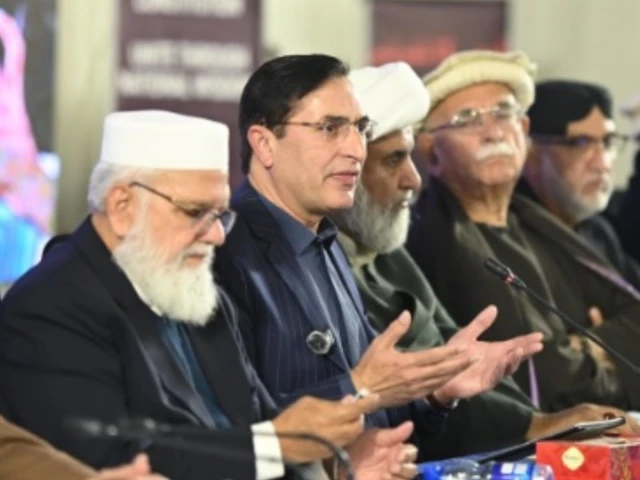
A national conference organized on Saturday under the banner of Tehreek Tahaffuz-e-Aain Pakistan agreed that Pakistan Tehreek-e-Insaf should adopt a path of resistance rather than reconciliation, pledging to support such a path.
According to Express Newsan opposition-led forum at the Khyber-Pakhtunkhwa (KP) House in the federal capital was attended by representatives of political parties, legal community, media and civil society. Speakers criticized recent constitutional amendments and denounced what they called the weakening of Parliament.
Lawyers have criticized what they call the marginalization of the judiciary, while journalists have spoken out against the PECA law. Conference participants collectively agreed that “resistance, not reconciliation” should be pursued against what they described as the role of the establishment, urging the PTI to take the lead and pledging its support.
Gohar calls Imran Khan and Bushra Bibi ‘murder of justice’
Speaking at the conference, PTI Chairman Barrister Gohar Khan said that Imran Khan and Bushra Bibi have been convicted again, terming the development a “murder of justice”.
He said the party believed that after May 2025, “the chapter of convictions and sentences would end” and the country would move towards “the supremacy of justice”. He added that the PTI had endured pressure without resorting to chaos or sit-ins, “without ever taking the law into its own hands”, and that it continued to hope that its leader would be released, allowing the Constitution, democracy and the rule of law to move forward.
However, he said the repeated verdicts “which go against the constitution and the law” are sowing despair among public opinion and raising questions about the future of democracy.
Read: ATC sentences Yasmin Rashid, Omar Cheema and other PTI leaders to 10 years in prison
Lawyer Gohar said that after the latest convictions, he published on X that the party leaders had “collectively been sentenced to 70 years in prison.” He added that Imran Khan and Bushra Bibi had already been sentenced together to 60 years in prison and seven other cases were pending against the leaders.
“If convictions are also handed down in these cases, the total sentence could reach 140 years,” he said, wondering “how long such sentences would last.”
He said judges were no longer safe, political leaders were no longer safe and even parliamentarians were no longer protected. Referring to Asad Qaiser’s repeated remarks, Gohar said that although he had advised against such statements, circumstances forced them to acknowledge that the country was “effectively under martial law”.
He said the two-day conference would serve as a platform to debate crucial issues, stressing that “neither extremism nor anti-democratic forces should be allowed to prevail.”
Gohar added that Imran Khan was not in prison for a crime but “for the freedom of the people”, saying that when the public got their freedom, “their leader would be released”. He called on political actors not to obstruct solutions. “When leaders fail to lead the way for the public, people end up being forced to find their own way,” he warned.
Learn more: Imran Khan and Bushra Bibi sentenced to 17 years in Toshakhana 2.0
He said electoral manipulation in by-elections and other developments had worsened the crisis. He added that he had sought Imran Khan’s permission for negotiations, saying Mahmood Khan Achakzai and Raja Nasir Abbas had been tasked with deciding whether to continue talks or resistance, “with the support of the PTI founder and millions of voters”.
Gohar said the movement was called Tehreek Tahaffuz-e-Aain Pakistan, adding that if the situation had been anticipated earlier, “it would have been called Movement for Restoration of Constitution”.
Achakzai calls for dialogue
Addressing the conference, Pakistan Tehreek Tahaffuz-e-Aain chief Mahmood Khan Achakzai called for reconciliation between political forces, saying differences should be put aside to bring the country out of the crisis.
He said democratic dialogue remained possible and added that if negotiations were to take place, permission should be granted for talks with PTI founder Imran Khan.
Achakzai said that while sentences were handed down, even basic rights such as “meetings with family and political leaders” were being violated. He called on Maulana Fazlur Rehman, Nawaz Sharif and Jamaat-e-Islami to sit together, saying the mandate of the February 8 elections should be recognized by recognizing “the winner”.
He also referred to a report of corruption worth Rs 5,309 billion and stressed that “state institutions should carry out their functions without interfering in politics.”
Call for street movement
PTI general secretary Salman Akram Raja said the party had approached the court expecting a hearing, but instead “received an unexpected verdict in the Toshakhana-II case”. He said the situation was “no longer about a single political party but about a broader system of injustice.”
Raja said Imran Khan had delivered a message for the nation to “prepare for a street movement”, saying “there is no alternative left”.
He said restrictions were being imposed under legal provisions to prevent mobilization, but stressed the need for collective action. He added that the PTI was fighting a “battle of principles, not for power”, alongside those “whose voices were not heard”.
Former National Assembly Speaker Asad Qaiser said “there were no options left” and the party would now take to the streets. He said “resistance is the only way forward”, rejecting any claims that the PTI could be intimidated and demanding “merit-based” justice for Imran Khan.
KP CM denounces political injustice
KP Chief Minister Sohail Afridi said an “unfair decision” had been announced against his leader. He said injustice existed even before the recent constitutional amendments and that democratic institutions had long been paralyzed.
Afridi said Imran Khan and Bushra Bibi were “innocent” and that “false complaints” had been filed. He said political parties should remain political and not “tools for others,” calling the fight a strengthening of democracy.
Senior politician Javed Hashmi said prisons and sacrifices had historically led nations to freedom, adding that rights were secured through “struggle and not withdrawal”. He emphasized unity and rejected divisive rhetoric, saying he opposed confrontation-oriented politics, but noted that “meaningful dialogue had repeatedly failed.”
Cancellation of requested amendments
Jamaat-e-Islami leader Liaquat Baloch said efforts should be made to strengthen voices calling for impartial elections. He said political parties, media and civil society must unite on a national agenda, where the minimum agreement should be “protecting the constitution”.
He called for the annulment of the constitutional amendments adopted, in his words, thanks to “artificial majorities and in bad faith”, arguing that they undermined judicial independence and fundamental rights.
Support for the resistance
Human rights lawyer Imaan Mazari said the PTI remained the most popular party because “the public had given Imran Khan their mandate”. She urged the PTI to decide whether it would pursue resistance or reconciliation, saying “compromise is not possible in the face of oppression.”
Mazari said the issue was now about “the rights and mandate of the people”, calling for collective condemnation of the alleged mistreatment of political figures and activists. She criticized what she described as “unprecedented actions against judges” and restrictions on journalists, saying telling the truth had become a crime and journalists risked arrest for doing their job.
Journalist Matiullah Jan said the country was under “a form of openly enforced martial law”, while former senator Mushtaq Ahmad called for resistance in “cities and public spaces”.
Read: Imran says avenues of justice are closed, calls on supporters to prepare for street movement
Journalist Habib Akram said restrictions on media had intensified under the PECA law, questioning whether there remained a “peaceful way forward.”
PTM leader Mohsin Dawar said Pakistan was stuck in the same cycle for decades, adding that the beliefs of political leaders were not new and “only the party concerned changes with time”.
The conference ended with a renewed call for resistance in favor of reconciliation, calling for collective action to protect constitutional and democratic rights.


