
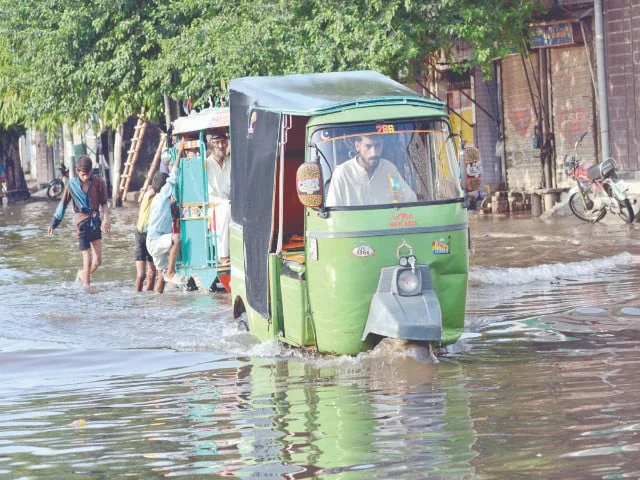
As monsoon rains flood the city, the meager network of roads and pipelines cannot keep up.
Rickshaws pass through accumulated rainwater on Makkah Road in Lahore after a downpour. Rain fell on the city for two and a half hours. photo: application
LAHORE:
The monsoon season, while bringing relief from the scorching summer heat and improving weather conditions, often becomes a source of distress for residents of Lahore, who have to maneuver around collapsing roads.
Over the past three years, more than 100 incidents have been reported in Lahore during the monsoon season, involving collapsed sewer and water pipes and sunken roads. These incidents left more than 50 people injured and damaged dozens of vehicles. The city’s aging and deteriorating sewage system, parts of which are 30 to 40 years old, was exposed during the heavy rains, exposing significant structural weaknesses.
Professor Asif Tanveer, a resident of Johar town, said that for many years, roads passing through different areas collapsed during the rainy season, forming large sinkholes. “Repeated complaints to the Lahore Development Authority (LDA) have not resolved the problem. The authorities are simply covering the damaged road with stones and gravel without repairing the underlying sewers or water pipes, which continue to leak and burst, damaging the roads again,” Tanveer revealed.
Another local resident, Khalid Javed, pointed out that 60 percent of Lahore’s roads were served by sewerage and water pipes.
“To reduce development costs, roads have been built directly above these pipelines. In some places, the pipelines even pass through residential neighborhoods. So the risk of damage increases significantly during the rainy season,” Javed explained.
According to documents obtained by The Express PK Press Club, numerous sinkholes were reported in Johar town, including Khayaban-e-Firdousi, where several vehicles fell into deep holes. Similar incidents occurred in Gowalmandi, where motorcyclists were injured after suddenly falling into potholes formed under the road. According to the internal survey of the Water and Sanitation Agency (WASA), this year alone, more than 25 areas of Lahore have experienced varying degrees of road subsidence and collapse, including Khayaban-e-Firdousi, Bostan Colony, Satu Katla, Faisal Town, Akbar Shaheed Chowk Road, Green Town, Gulshan Ravi, Islampura, Baba Azam Chowk, Ghore Shah Road, Shahdara, Farukh Abad and Kot. Khawaja Saeed.
According to Mian Sohail Hanif Bhandara, town planner, the main reason for road collapses was poor planning by WASA and LDA. “Sewerage and water pipes have a limited lifespan, but in Lahore, roads were built directly over decades-old pipes, without replacing them.
Roads and green belts have been built on these pipelines without any future consideration. Over time, the old pipes began to leak and crack, and under the pressure of heavy rains, they burst, causing sinkholes and leading to accidents. Instead of repairing these pipelines, the government should install entirely new ones to ensure safety of roads and citizens,” Bhandara said.
WASA Director General Ghufran Ahmed said Punjab Chief Minister Maryam Nawaz had approved the replacement of pipelines on 26 roads with funds worth billions of rupees. “This step is expected to significantly reduce the number of such incidents and improve infrastructure stability. Sanitation and water supply development projects are underway with government funding, aiming to provide permanent solutions to these problems,” Ahmed said.
“The government has approved a major project to protect Johar town and its surrounding areas from further damage. Under this project, a five-kilometer sewerage main will be laid along Khayaban-e-Firdousi from Shaukat Chowk to Shaukat Khanum Hospital,” WASA Lahore spokesperson Abu Zar said.


