
Army chief’s multiple alignment strategy allows Islamabad to engage with US, China without ideological constraints
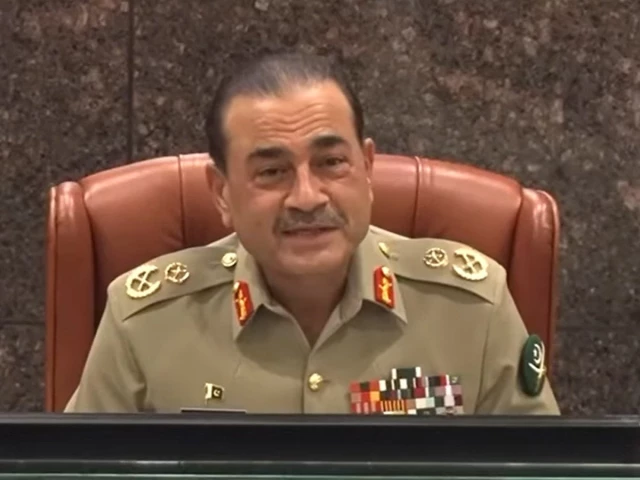
Field Marshal Asim Munir addressing participants of the 17th Balochistan National Workshop at GHQ. Photo: ISPR screenshot
As the United States abandons its long-standing role as global strategic overseer, the resulting vacuum has sparked a scramble among so-called “middle powers” to reposition themselves in a rapidly changing global order, and Army Chief of Staff Asim Munir has emerged as one of the most capable players, according to the Financial Times analysis.
In a wide-ranging commentary on the accelerating decline of US global authority under President Donald Trump, the FT says that while many countries were destabilized by the speed of Washington’s withdrawal, Pakistan’s military leadership adapted with remarkable agility.
The newspaper declares Chief of Defense Forces (CDF) and Chief of Army Staff Field Marshal Asim Munir the “top prize” among middle-power leaders recalibrating their foreign policies to match what it calls Trump’s “casual approach to the world.”
The FT situates Pakistan’s position within a broader historical shift, comparing America’s retreat from global leadership to times when old empires lost control after attempting managed reform.
Although China has not rushed to fill the void left by Washington, the FT says it has opened up space for what it calls “entrepreneurial middle powers”, and cites Pakistan as the most effective example.
Describing CDF Asim Munir as “the very model of a mid-power multi-aligner”, the newspaper highlights his ability to move with ease between Washington, Beijing, Riyadh and Tehran.
The FT observes that the reconfiguration has also allowed Islamabad to maintain its engagement with the US without being confronted with the democracy-focused rhetoric that once accompanied US diplomacy.
This ability to adapt has frustrated rivals such as India, which has been less willing to be complicit with Trump and has found balancing middle powers more difficult than expected, the commentary observes.


