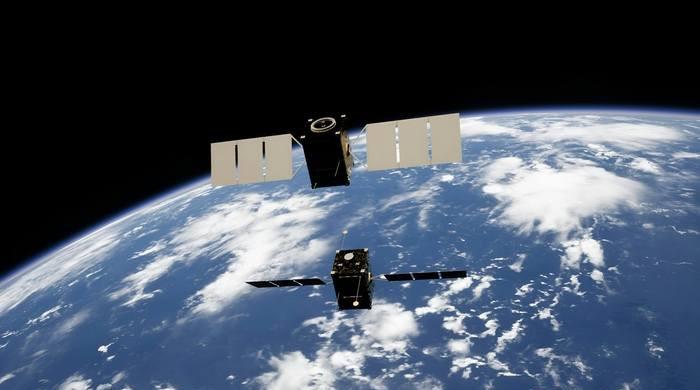
In a historic development in Tehran’s expanding space program, Iran successfully launched three domestically developed observation satellites into orbit using a Russian Soyuz rocket.
The Paya, Zafar-2 and Kowsar 1.5 satellites were launched from Russia’s Vostochny cosmodrome and are now circling the Earth at an altitude of around 500 kilometers, according to Iranian state media IRNA.
Similarly, Iranian officials reportedly said the mission was conducted for civilian and research purposes.
Informed sources added that the satellites were designed by the Iranian private sector and academic institutions, with the aim of observing the Earth, monitoring the environment and managing resources.
What are the Iranian Paya, Zafar-2 and Kowsar 1.5 satellites?
Weighing around 150 kilograms, Paya is the most advanced and heaviest imaging satellite built to date by Iran. It features artificial intelligence (AI) capabilities to improve image resolution and will be used for water resources monitoring, mapping and environmental analysis.
On the other hand, Zafar-2 was developed by university researchers, while Kowsar 1.5 is an upgraded high-resolution satellite produced by a private Iranian company.
The Soyuz rocket was chosen for its reliability in carrying sensitive payloads, Fars news agency reported, adding that Iran had carried out ten satellite launches in the past two years, including a previous mission from the same Russian launch facility in July.
Officials further explained that the satellites will be used for civilian applications such as agricultural planning, disaster response during floods and earthquakes, and monitoring environmental changes.