
ISLAMABAD:
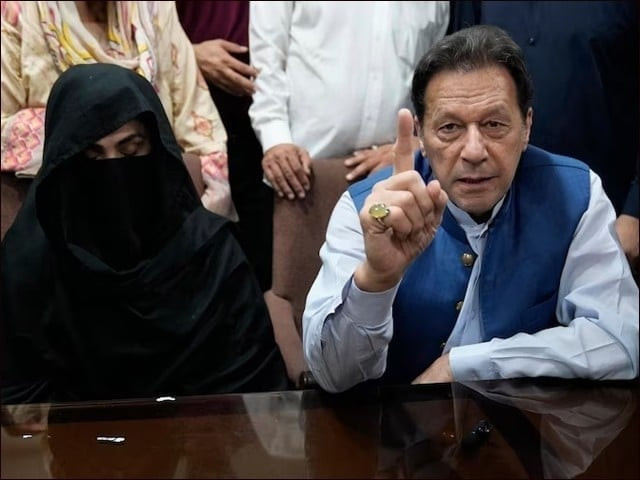
Former Prime Minister Imran Khan and his wife Bushra Bibi have challenged their convictions in the Toshakhana-II case in the Islamabad High Court.
Pakistan Tehreek-e-Insaf’s lawyer Khalid Yousaf Chaudhry appealed on their behalf on Monday.
The separate appeals were filed by advocate Salman Safdar on Friday and assigned journal numbers 24560 and 24561.
The petitions argue that the trial was politically motivated and legally flawed.
Imran Khan and Bushra Bibi were sentenced on December 20, 2025 to 17 years in prison. They were convicted under Section 409 of the Pakistan Penal Code and Section 5(2) of the Prevention of Corruption Act.
The court also imposed a fine of Rs164.25 million on each of them.
The appeals challenge the verdict on several grounds, including double criminality, illegal bifurcation of a single offense and procedural defects.
Read: Imran Khan and Bushra Bibi sentenced to 17 years in prison in Toshakhana 2.0
They say the convictions are “unjust, unjust and appear to be a direct manifestation of political victimization.”
The petitions claim that the affair was orchestrated by Imran Khan’s political adversaries.
The appeals also challenge the trial court’s reliance on the testimony of Syed Inamullah Shah and Sohaib Abbasi. Shah is described as a dismissed employee, while Abbasi is accused of being appointed as an approver without fulfilling legal requirements.
The defense questions Shah’s credibility, citing his dismissal for allegedly receiving a double salary and his alleged political ties to Imran Khan’s opponents.
The petitions argue that Imran Khan is not considered a “public servant” within the meaning of Section 21 of the Pakistan Penal Code. They cite a 2024 Supreme Court ruling that elected representatives do not fall within the definition of civil servants in this context.
Learn more: Toshakhana verdict is a “parody of the law”
The appeals also oppose the conviction of Khan and Bushra Bibi under both the PPC and the Prevention of Corruption Act. They argue that this amounts to multiple punishments for the same offense, which is prohibited by law.
According to the appeals, the Bulgari ornament in the center of the case was preserved in accordance with Toshakhana rules. They claim that 50% of the taxable value above the exemption limit of Rs30,000 was paid, as required.
The defense maintains that no criminal offense was committed and that all procedures were legally followed.
The PTI lawyer requested the Islamabad High Court to declare the Toshakhana-II verdict null and void. The appeals also requested that the hearing of the case be scheduled as soon as possible.


