
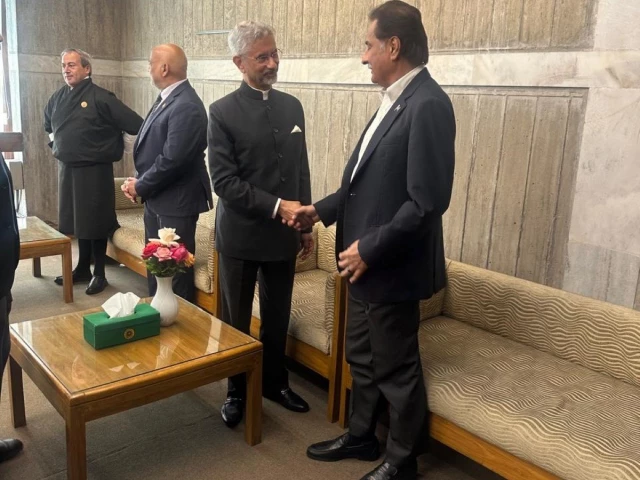
Indian Foreign Minister Subrahmanyan Jaishankar met Speaker National Assembly of Pakistan Sardar Ayaz Sadiq at the residence of former Bangladesh Prime Minister Khaleda Zia today, December 31, 2025.
ISLAMABAD:
Indian Foreign Minister Subrahmanyan Jaishankar briefly met Pakistani National Assembly Speaker Sardar Ayaz Sadiq in Dhaka on Wednesday on the sidelines of the funeral ceremonies of former Bangladeshi Prime Minister Khaleda Zia, marking the first such interaction between senior officials of the two rivals since their military conflict in May.
The meeting took place at the residence of Khaleda Zia, who died on Tuesday at the age of 80. Zia was the first female Prime Minister of Bangladesh and one of the country’s most influential political figures. His death was marked by a state funeral, with flags at half-mast and thousands of security personnel deployed as his body was carried through the streets of the capital in a vehicle draped in the national flag.
World leaders and senior officials from several countries, including India and Pakistan, visited Dhaka to attend the funeral ceremonies.
اسپیکر قومی اسمبلی سردار ایاز صادق کی سابق وزیراعظم بنگلہ دیش خالدہ ضیاء کی رہائش گاہ پر آمد
اسپیکر قومی اسمبلی سردار ایاز صادق کی مرحومہ بیگم خالدہ ضیاء کے صاحبزادے طارق رحمان اور صاحبزادی سے ملاقات
اس موقع پر بنگلہ دیش کے قومی سلامتی کے مشیر خلیل الرحمٰن اور مشیر قانون… pic.twitter.com/wYrjGBkW2q
— National Assembly 🇵🇰 (@NAofPakistan) December 31, 2025
According to the officials present, Jaishankar walked towards Sadiq’s seat and greeted him with a handshake, to which the Pakistani speaker responded with a smile. The two men exchanged brief pleasantries and inquired about each other’s well-being. No formal discussions have been reported.
The interaction was the first direct engagement between senior Indian and Pakistani officials since the four-day conflict between the two nuclear-armed neighbors in May 2025.
Relations between Pakistan and India deteriorated sharply after an attack in Pehalgam in April 2025. India accused Pakistan of being involved, an allegation denied by Islamabad. New Delhi then suspended the Indus Waters Treaty and expelled Pakistani diplomats.
On May 7, India launched what it called Operation Sindoor, firing missiles at several locations in Pakistan and Azad Jammu Kashmir. The strikes caused civilian casualties and damaged civilian infrastructure, while India said it was targeting militant camps.
Read: Pahalgam attack: US issues travel advisory to India
The conflict escalated into four days of fighting, with both sides using warplanes, missiles, artillery and drones. Dozens of people were killed before a ceasefire was announced on May 10, negotiated with the help of the United States.
After the fighting ended, Pakistan said it had shot down seven Indian fighter jets, including French-made Rafales. India acknowledged “some losses” but rejected Pakistan’s claim about the number of planes shot down.
Despite the ceasefire, relations remained frozen, with no substantial dialogue between the two countries. Wednesday’s brief, informal exchange in Dhaka underscored the continued absence of formal engagement, even as the two sides share space at international and regional events.


