
.
ISLAMABAD:
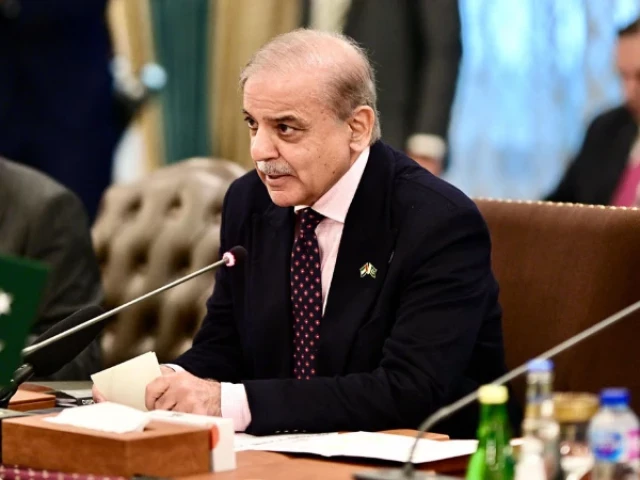
Prime Minister Shehbaz Sharif on Wednesday launched economic governance reforms to address vulnerabilities identified in the International Monetary Fund (IMF) report on governance and corruption, while taking ownership of a 142-point agenda for institution-building and the rule of law.
The plan envisages undertaking a national corruption risk assessment, making rules-based appointments in key institutions, including the National Accountability Bureau (NAB), and improving its credibility in the eyes of the public.
Addressing the launch ceremony, Shehbaz said recommendations from international institutions have been incorporated into his reform plan, but the government’s national agenda is fundamentally to “move from crisis management to institution building”.
Under a condition of the IMF’s $7 billion bailout package, Pakistan was required to publish by December 31 a “governance action plan based on the recommendations of the Diagnostic Governance Assessment” to address critical governance vulnerabilities.
After the ceremony at the Prime Minister’s House, the Ministry of Finance released the 240-page report on economic governance reforms, detailing all aspects that could help improve poor governance and address critical corruption-related vulnerabilities.
Earlier, the ministry had released the 186-page governance and corruption diagnostic report to meet the IMF condition.
Shehbaz said that under his governance plan, there are 59 priority actions and 83 complementary actions. This brings the total number of these required actions to 142 which are to be implemented over a period of the next three years.
The Prime Minister said the government’s focus would now shift from crisis management to institution building. He said the people of Pakistan have paid a heavy price over the past two years and “we cannot return to business as usual.”
Speaking on the occasion, Finance Minister Muhammad Aurangzeb said the governance plan has three main thrusts: growth-oriented fiscal and public investment governance, strengthening market confidence and simplification of regulations and building confidence in legal processes.
The Ministry of Finance will act as the secretariat for the implementation of the action plan, while the UK Foreign and Commonwealth Development Office (FCDO) will provide technical support.
The ministry issued a report stating that, where applicable, the alignment (of the plan) with the IMF’s Extended Financing Facility will be strengthened through the IMF’s participation in these dialogues for the implementation of the plan.
Major actions
Pakistan has committed to the IMF to publish the ITFC annual report by June 2027. The draft annual report will be submitted in December 2026 and the final report will be submitted in March 2027.
The objective of the report is to improve transparency regarding strategic investments by producing and making public the first annual report of the Special Investment Facilitation Council (SIFC), including information on all investments it has facilitated, including concessions granted as well as detailed justification of the concessions and the estimated value of the concessions.
By June 2026, the government will also conduct a national corruption risk assessment and form the National Anti-Corruption Task Force within three months. The government will also identify the top 10 agencies with high corruption risks by June 2027. And by June 2028, it will publish annual reports on the top 10 identified agencies at highest risk and report on demonstrated risk reduction.
The IMF report cited the NAB report, which showed that the anti-corruption watchdog had recovered 5.3 trillion rupees of embezzled money in the last two years alone.
According to the new action plan, by June 2026, the government will carry out a legislative review of the Anti-Money Laundering Law (AML) in order to remove ambiguities. It will also finalize and submit the amended anti-money laundering bill for consideration by Parliament. By June 2027, these changes will be notified.
Within a year and a half, Pakistan will also build the capacity of judges by implementing training plans regarding AMLA.
The IMF also gave a deadline of one and a half years to strengthen the accountability and integrity of officials. It will deploy a computerized system to generate risk-based audit cases.
The verification will be carried out by the FBR and other relevant agencies. Using the risk factor model, cases receiving red flags will be reviewed by a committee of the Establishment Division, FBR, FIA and NAB to decide whether the case should be formally investigated; and if so, by which agency.
By June 2027, the government will notify the SECP rules which are expected to codify the entire process of appointment of the SECP chairman, commissioners and policy council members.
The government will ensure the timely initiation of appointment processes, at least three months before the end of the term and will also make public an annual report on governance and transparency approved by the SECP policy board.
It would also revise the process of appointing the NAB chairman by June 2027 and increase NAB’s public credibility as an anti-corruption agency, according to the released plan.
In six months, Pakistan will form a methodological working group that will be tasked with carrying out a diagnosis to efficiently and effectively resolve economic disputes, monitor judicial and judicial performance, reduce waiting times and supervise the implementation of recommendations. By June 2027, Pakistan will publish an annual performance report with recommendations on economic disputes.
To increase the efficiency, integrity and performance culture of the tax administration, the government will establish by June next year several executive committees and subsequently prepare and implement plans over a two-year period to strengthen the capacity and integrity of tax officials.
The government will formulate a time-bound tax simplification strategy with draft tax policy provisions aimed at: reducing rate schedules, reducing special regimes, reducing excessive withholding taxes, reducing withholding taxes, rationalizing tax exemptions and harmonizing federal and provincial taxes. These measures will aim for revenue neutrality in the medium term.
The government will impose a 10% cap on new PSDP projects and prioritize high-impact PSDP projects by June 2027. Within a year and a half, it will prevent mid-year cuts in development spending and develop a mechanism to link constituency demands to resource allocations. However, unforeseen revenue shortfalls will need to be addressed in PSDP financing, according to the plan.
The new public procurement rules 2025 will be prepared in accordance with international best practices and will be subject to cabinet approval. They will not explicitly contain any preferential treatment for public companies.


