After months of threats and pressure tactics, the United States bombed Venezuela on Saturday and overthrew left-wing authoritarian leader Nicolas Maduro, who was arrested for trial in New York.
How did it start?
The first explosions were heard in and around the capital Caracas shortly before 2:00 a.m. (06:00 GMT), and continued until around 3:15 a.m.
Images on social media showed helicopters silhouetted against the night sky and missiles hitting targets, creating fireballs and huge plumes of smoke.
Trump said at 09:21 GMT on his Truth Social platform that the United States had “successfully carried out a large-scale strike against Venezuela” and that Maduro and his wife had been “captured and expelled from the country.”
US General Dan Caine said the aim of “Operation Absolute Resolve” was solely to seize Maduro, with airstrikes paving the way for helicopters used in the capture raid.
Caine said the operation, involving more than 150 planes, followed months of preparation.
What was affected?
Fort Tiuna, Venezuela’s largest military complex, was among the targets.
The sprawling base in southern Caracas is home to the Defense Ministry, a military academy and housing for thousands of troops and their families.
AFP reporters saw flames and huge plumes of smoke rising from the complex.
At one of the entrances, still guarded, an armored vehicle and a truck were riddled with bullets.
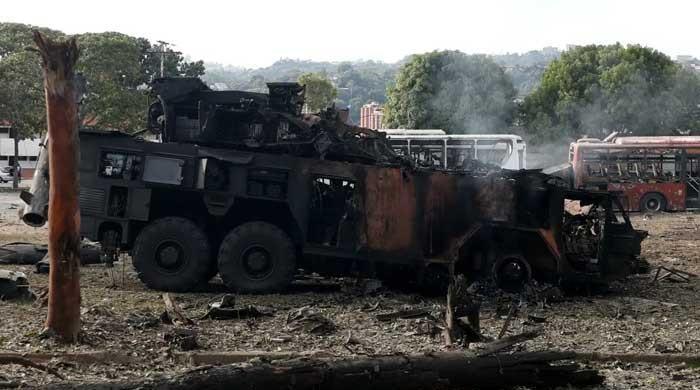
The La Carlota air base, east of Caracas, was also targeted. AFP journalists saw an armored vehicle in flames and a bus burned at the base.
Explosions were also reported in La Guaira, north of Caracas, which is home to a port and international airport; the north-central city of Maracay; and Higuerote on the Caribbean coast, all within 100 kilometers (60 miles) of Caracas.
Are there any victims?
Defense Minister Vladimir Padrino Lopez accused US forces of firing missiles and rockets at residential areas.
As of Saturday evening, Venezuelan authorities had not yet published the number of victims.
Trump, speaking on Fox News The show “Fox and Friends” boasted that no American soldiers were killed. He later told the New York Post that “many Cubans” who protected Maduro had died, the first indication of casualties from U.S. strikes.
What happened to Maduro?
The operation ended 12 years of increasingly authoritarian rule by Maduro, who had a US$50 million price on his head.
Trump posted a photo on Truth Social of the Venezuelan leader handcuffed and blindfolded aboard a U.S. Navy ship in the Caribbean.
From there, he and his wife Cilia Flores were flown to New York to face drug and weapons charges.
Trump said he followed the operation to capture Maduro live at his Mar-a-Lago estate “like I was watching a TV show.”
“It was in a very heavily guarded place…like a fortress actually,” he said.
He said Maduro tried unsuccessfully to escape to a safe space.
Caine said intelligence agents spent months studying how Maduro “moved, where he lived, where he traveled, what he ate, what he wore, what his pets were.”
He said the 63-year-old socialist and his wife surrendered without resistance.
What future for Venezuela?
Trump stunned U.S. allies and enemies by asserting that the United States would “run” Venezuela during an indefinite transition period.
He indicated that this could involve the deployment of American troops on the ground.
Venezuela’s opposition leader, Nobel Peace Prize laureate Maria Corina Machado, proclaimed on social media that “the hour of freedom has arrived” for her country.
Machado, considered a hero by many Venezuelans for her fierce resistance to Maduro, called on the opposition candidate in the 2024 elections to “immediately” assume the presidency.
Trump dismissed any expectations that Machado herself would become leader, saying she had no “support or respect” in Venezuela.