
- Razer Introduces Local AI Hardware Focused on Developers and On-Premises Work
- Tenstorrent Accelerator Adds Wearable AI Compute via Thunderbolt Connected Devices
- AI device supports daisy-chained units for local multi-accelerator workloads
Razer has revealed an expansion beyond gaming hardware with an external AI accelerator and a new workstation platform aimed at developers working locally on advanced models.
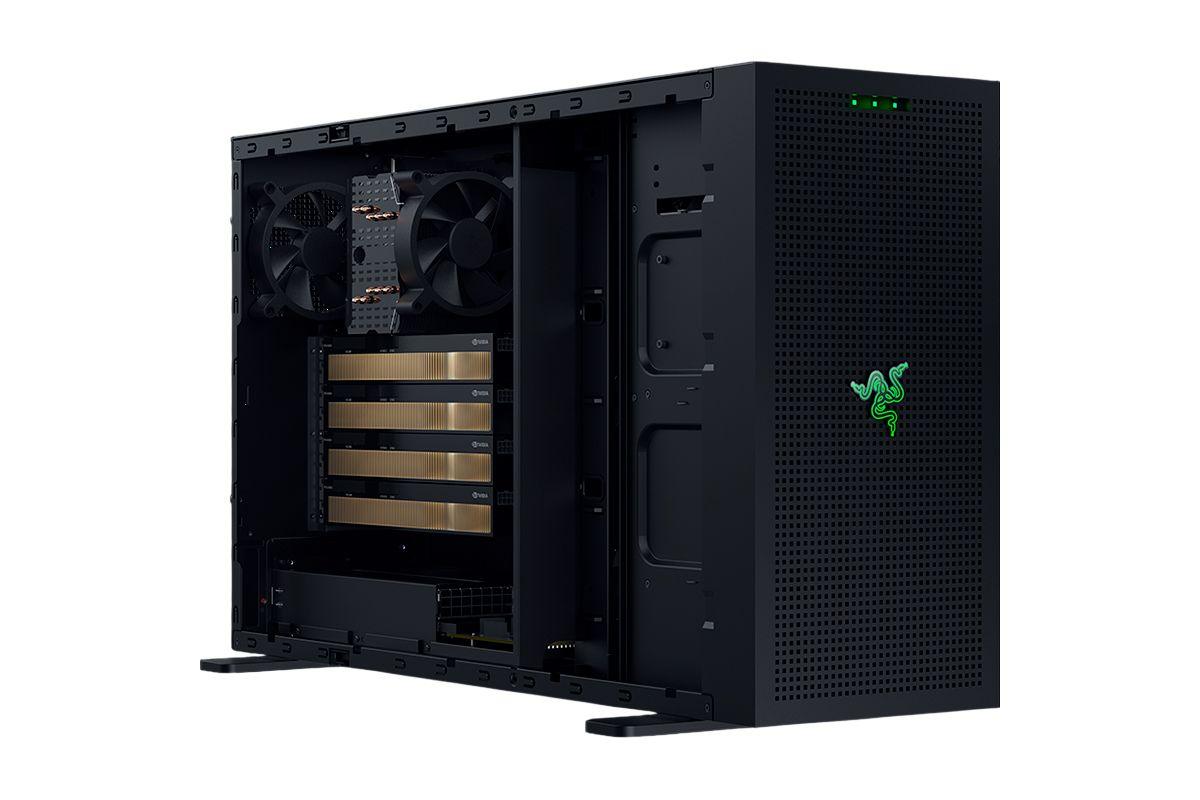
Launched at CES 2026, the Razer Forge AI Dev Workstation is a high-performance system designed for training, inference, and simulation workloads without relying on cloud services.
The on-premises solution is intended for developers who want direct control over datasets, models, and experiments while avoiding subscription fees.
Tenstorrent External AI Accelerator
The Razer Forge AI Dev Workstation supports up to four professional graphics cards from Nvidia or AMD, enabling large pooled VRAM configurations for multi-GPU workloads.
Processor options include AMD Ryzen Threadripper PRO and Intel Xeon W chips, coupled with support for eight DDR5 RDIMM slots for ample memory capacity.
Networking is handled via two 10Gb Ethernet ports, while storage includes up to four PCIe Gen5 M.2 NVMe drives and eight SATA bays.
Cooling is designed for sustained loads, with multiple high-pressure fans intended to maintain airflow through the dense internal components.
The workstation can operate as a standalone tower or move into rack environments, allowing it to scale from individual desktops to cluster deployments.
Alongside the workstation, Razer has worked with Tenstorrent on a compact external AI accelerator aimed at portable development workflows. Tenstorrent is led by Jim Keller, best known for his work on AMD’s Zen CPU architecture and early self-driving silicon at Tesla.
The accelerator connects via Thunderbolt 4 or Thunderbolt 5 and is designed to add local AI computing to laptops and other compatible systems.
It is based on Tenstorrent’s Wormhole architecture and supports the company’s open source software stack for running LLMs, image generation models, and other AI workloads.
Multiple units can be connected together, with up to four devices forming a small local cluster for larger models.
“A device that anyone can plug into their laptop paves the way for the next generation of developers who build on our open platform,” said Christine Blizzard, Chief Experience Officer at Tenstorrent. “Our goal is to make AI more accessible and we trust Razer to deliver products that developers love.”
“Cutting-edge AI developers demand power, flexibility and mobility – and this collaboration delivers all three,” said Travis Furst, head of laptops and accessories at Razer. “Our partnership with Tenstorrent combines their cutting-edge AI acceleration technology with Razer’s expertise in high-performance engineering and external enclosure design. Together, we advance the development of cutting-edge AI as part of Razer’s broader AI vision: bringing portable, uncompromised computing to developers.”
Pricing and availability of the external AI accelerator have not yet been announced.
TechRadar will cover this year’s events extensively THESEand will bring you all the big announcements as they happen. Visit our CES 2026 News for the latest stories and our hands-on verdicts on everything from wireless TVs and foldable displays to new phones, laptops, smart home gadgets and the latest in AI. You can also ask us a question about the show in our Live Q&A from CES 2026 and we will do our best to answer them.
And don’t forget to follow us on TikTok And WhatsApp for the latest news from the CES show!


