
Political harmony marks PM’s visit to Quetta; Prime Minister links fight against terrorism to lasting stability
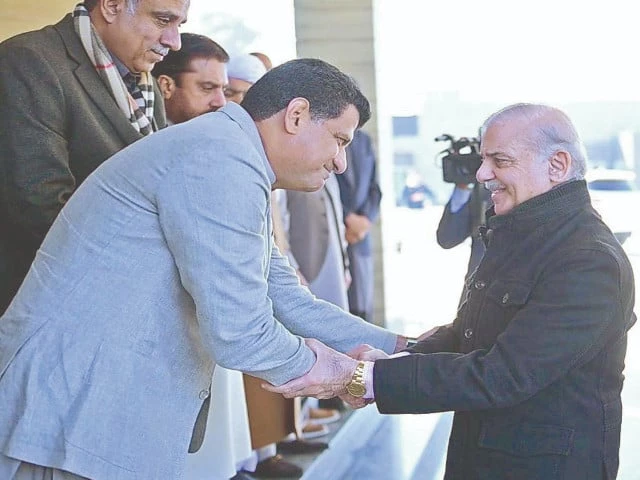
Political leaders greet Prime Minister Shehbaz Sharif on his arrival at the Chief Minister’s Secretariat in Quetta. Photo: PPI
QUETTA:
Prime Minister Shehbaz Sharif on Thursday reaffirmed the federal government’s resolve to ensure lasting peace, stability and prosperity in Balochistan, combining effective counter-terrorism, inclusive development and strong federal-provincial cooperation as essential pillars for strengthening national cohesion and long-term security of Pakistan.
Addressing political leaders, parliamentarians and officials in Quetta, the Prime Minister said the fight against terrorism remained a collective national responsibility, recognizing the persistent threats from outlaw groups exploiting regional instability, while emphasizing that the state’s resolve to defeat these elements remained firm.
He paid tribute to the sacrifices of the armed forces, police, Frontier Corps (FC) and civilians, condemning Fitna-al-Khawarij and deploring the support given to the militants by some neighboring countries, while commending the professionalism and leadership of the Chief of Defense Force and Chief of Army Staff, Field Marshal Syed Asim Munir.
Shehbaz said intelligence-led operations and close coordination between civilian authorities and security institutions disrupted terrorist activity and improved public security, recalling Pakistan’s responsible response to regional tensions last year to safeguard sovereignty without compromising broader regional stability.
The Prime Minister highlighted development initiatives, laying the foundation stone for a Rs300 billion expansion of the Karachi-Quetta-Chaman highway into a four-lane road, funded by savings from fluctuations in global oil prices, to improve safety on the notorious ‘killer highway’.
He also announced the establishment of five Danish schools, from Killa Saifullah to Turbat, for disadvantaged children, welcomed the solarization of agricultural wells and said $400 million in World Bank funds would finance housing for flood-affected families across the province.
Recalling the NFC Award 2010, Shehbaz highlighted Punjab’s voluntary contribution of Rs 175 billion to Balochistan, said work on a new award was underway and reaffirmed federal support for governance reforms outlined by Chief Secretary Shakeel Qadir Khan and Chief Minister Mir Sarfraz Bugti, concluding with a renewed commitment to inclusive development and lasting peace.
Earlier, the Prime Minister was briefed by Chief Secretary Khan on reforms in governance, development planning and service delivery in the province. The briefing covered progress made in key sectors such as education, health, administration and handling public grievances, despite financial and logistical constraints.
Prime Minister Shehbaz praised the provincial government led by Chief Minister Mir Sarfraz Bugti for its emphasis on development, policy coordination and public welfare. He reiterated that the federal government would continue to work closely with the province, ensuring support for development projects, institutional reforms and initiatives aimed at improving the lives of the people of Balochistan.
Meanwhile, in a rare and positive example of political harmony that developed in Balochistan during the Prime Minister’s visit, the opposition stood in solidarity with the provincial government on issues of national interest and key decisions.
Political observers noted the spirit of cooperation visibly demonstrated by Opposition Leader Mir Younas Aziz Zehri and former Chief Minister Dr Abdul Malik Baloch when they warmly welcomed Shehbaz at a function at the Chief Minister’s House.
During the Prime Minister’s meeting with opposition leaders, Zehri openly praised the role of Chief Minister Bugti, saying that Balochistan’s strong political traditions are rooted in inclusion and respect. He noted that despite political disagreements, Bugti took into account the opposition on important issues.
The move was widely seen as a reflection of democratic maturity, political pragmatism and a shared commitment to prioritizing the national interest over partisan considerations, political observers said, adding that this tradition of consensus offers a valuable model for other provinces.
(WITH INPUT FROM THE APPLICATION)


