
Cancels the second wave of attacks against Venezuela; Neighbors and allies strongly criticize American measures
NEW YORK:
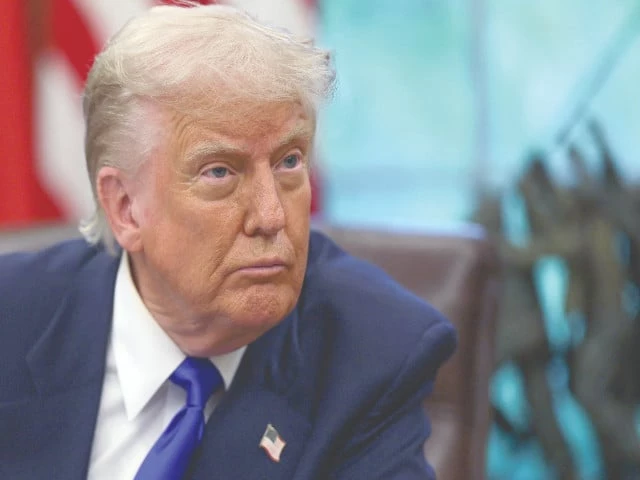
President Donald Trump’s increasingly expansive view of American power, openly contemptuous of international law and rooted instead in what he calls his “own morality,” is sending shockwaves through capitals as Washington deepens its military, economic and political interventions from Latin America to Europe and the Arctic.
In an interview with The New York Times published Thursday, Trump said his authority as commander in chief was limited only by his personal moral judgment. “Yes, there is one thing. My own morality. My own mind. That’s the only thing that can stop me,” he said, adding bluntly: “I don’t need international law. I’m not looking to hurt people.”
Asked whether his administration was bound by international law, Trump replied, “Yes,” before qualifying his remark by saying, “It depends on your definition of international law.” His comments come as the United States acknowledges carrying out strikes or military operations during the first year of his second term in Venezuela, Yemen, Syria, Somalia, Nigeria, Iraq and Iran.
Trump also appeared dismissive of the latest U.S.-Russia nuclear arms control deal, New START, which expires on February 5. “If it expires, it will expire,” he told the newspaper, adding, “We will just make a better deal,” and insisting that China should be included in any future deal.
The remarks coincided with dramatic developments in Venezuela, where Trump said Friday he had abandoned a second wave of U.S. attacks after the new rulers in Caracas began releasing political prisoners.
“Venezuela is releasing large numbers of political prisoners as a ‘search for peace,’” he wrote on his Truth Social platform. “Thanks to this cooperation, I canceled the long-awaited second wave of attacks.”
The prisoner releases follow a deadly Jan. 3 U.S. special forces raid, accompanied by airstrikes, in which Washington captured left-wing President Nicolas Maduro and his wife, Cilia Flores, and flew them to New York to face drug charges. Caracas says around 100 people were killed during the operation.
Maduro’s deputy, Delcy Rodriguez, assumed interim leadership, while his brother, Parliament Speaker Jorge Rodriguez, said a “large number of Venezuelan and foreign nationals” were being released in the interest of “peaceful coexistence.”
Rights group Foro Penal previously estimated that more than 800 political prisoners were being held. The White House quickly took credit for the releases, even as Trump downplayed democracy as a motivation for the intervention, despite years of U.S. claims that Maduro’s election was fraudulent.
Trump said U.S. oil companies had pledged $100 billion in investment, as Washington moves to “lead” Venezuela through a transition period and exploit its vast oil reserves. The United States also announced it had seized another tanker, the Olina, which was trying to break the U.S. naval blockade on Venezuelan oil, the fifth vessel arrested in recent weeks.
The international reaction was very critical. Canadian Prime Minister Mark Carney and Brazilian President Luiz Inacio Lula da Silva said they support a “peaceful transition process, negotiated and led by Venezuela” that respects sovereignty and international law. Lula condemned Washington’s actions, calling them crossing an “unacceptable line”, while the UN human rights office said the intervention violated international law and made the world less safe.
Trump’s comments also unsettled neighboring Mexico, after he suggested the United States could carry out ground attacks to combat drug cartels. Mexican President Claudia Sheinbaum said she had ordered her foreign minister to step up communication with Washington, asking him to contact the US secretary of state and, if necessary, speak directly with Trump.
In Europe, concern is growing about Washington’s position, particularly in the face of Trump’s renewed threats to bring Greenland under US control, potentially by force. NATO’s top commander in Europe, General Alexus Grynkewich, said the alliance was “far from crisis” and ready to defend “every inch” of its territory, but acknowledged that Trump’s comments had raised concerns.
Italian Prime Minister Giorgia Meloni said she did not believe the United States would launch military action against Greenland, warning that such action would have serious consequences for NATO and emphasizing the need for a strong allied presence in the Arctic.
France adopted a sharper tone. Foreign Minister Jean-Noël Barrot said the European political order was “in danger” and insisted Paris had the right to say “no” to Washington when proposals were unacceptable. “In a few months, the new American administration has decided to rethink the ties that unite us,” he said. “It is also our right to say ‘no’ to a historic ally, however historic it may be.”
Barrot rejected U.S. claims that Europe was facing “civilizational erasure,” warning of threats from external adversaries, democratic fatigue at home, and the erosion of arms control frameworks, including the looming expiration of New START, which he said increases the risk of nuclear proliferation.
Germany, meanwhile, announced its foreign and finance ministers would visit Washington next week amid tensions over Greenland, Ukraine, transatlantic security and access to critical raw materials, underscoring Europe’s growing unease as Trump continues to redefine the limits of American power on his own terms.


