
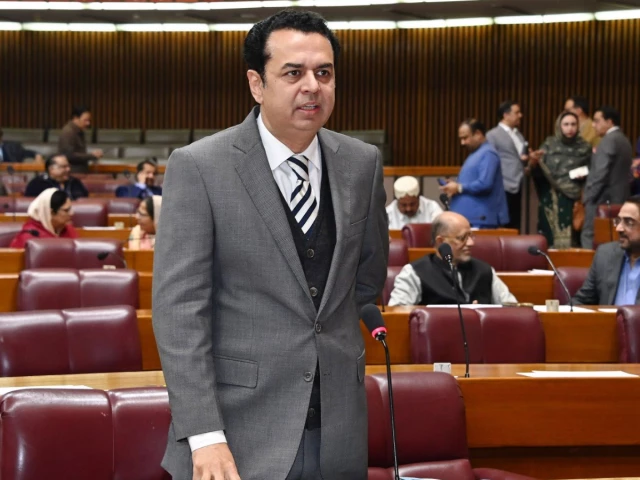
Minister of State for Interior Talal Chaudhry speaks at a session of the National Assembly on Tuesday. Photo:X
Minister of State for Interior Talal Chaudhry on Tuesday dismissed criticism over alleged large-scale tree felling in the federal capital, saying only allergy-causing paper mulberry trees had been cut down and asserting that Islamabad was now “greener than before”.
Responding to a notice of appeal moved by MP Muhammad Riaz Fatyana regarding gratuitous cutting of trees in Islamabad, Chaudhry told the National Assembly that the issue had been widely discussed without the facts being properly established.
“The issue was widely debated on social and electronic media, but the facts established that only specific categories of trees were felled, mainly paper mulberry, long identified as a source of serious allergies and health problems,” he said.
Learn more: Who cut down Islamabad’s trees – and why?
Explaining the reasons for these removals, the minister said tree cutting in Islamabad occurs under three specific circumstances, including infrastructure development and removal of dangerous species. “Tree felling in Islamabad generally occurs under three circumstances: developmental activities carried out under the city’s original master plan where brownfields remained undeveloped; infrastructure needs such as new roads, underpasses and overhead structures; and the removal of dangerous species, particularly paper mulberry,” he added.
Chaudhry said areas commonly perceived as green spaces were actually designated as brown areas in the original master plan. He maintained that no infrastructure project undertaken in the last 18 months had removed trees without following due process.
During the NA session, Mr. Muhammad Riaz Fatyana, MP, drew the attention of the Minister of Interior and Narcotics Control to a matter of public importance regarding wanton felling of trees in Islamabad.
Minister of State for the Interior and Narcotics Control, Mr. Talal Chaudhry… pic.twitter.com/hr0XA4gJP5
— National Assembly 🇵🇰 (@NAofPakistan) January 13, 2026
“Each project underwent mandatory public hearings, Environmental Protection Agency (EPA) review, certification and mapping using SPARCO imagery and the NDVI (Normalized Difference Vegetation Index), an internationally recognized method for assessing green cover,” he said.
Referring to the expansion of Embassy Road in 2016-17, the minister said trees temporarily planted on the unbuilt road space were later removed and replaced with four times more trees once construction was completed, as per the approved plan.
He said more than 40,000 mature trees, each between eight and ten feet tall, had already been planted, while another 60,000 would be planted by March.
Read also: Achakzai prepares to become leader of the opposition when NA nominations close
The minister added that the paper mulberry issue had been under consideration for years, starting with the orders of the Islamabad High Court in 2009, followed by the formation of an environmental committee in 2010, a public hearing in 2023 and a decision by the Supreme Court in 2024.
According to Chaudhry, 2,915 trees were felled only after comprehensive survey, marking and examination by experts. He said the Supreme Court-appointed committees confirmed that only paper mulberry trees were felled and no healthy native species were affected.
He said SPARCO images, Google Maps data and NDVI analysis showed that Islamabad’s green cover increased between 2023 and 2025, contradicting claims that greenery was decreasing.
The minister invited parliamentarians and journalists to attend a technical briefing on the ground to verify the data. He also stressed that felling paper mulberry trees did not generate revenue, saying resources were instead spent on completely uprooting the species to prevent its regrowth.
“Islamabad was now safer, more modern and greener than before,” Chaudhry said, insisting that criticism based on misinformation should not overshadow concrete environmental improvements.
The matter was referred to the relevant committee for further examination.
Scientific basis behind felling mulberry trees: Musadik Malik
Federal Minister for Climate Change and Environmental Coordination Dr Musadik Malik on Tuesday said the recent removal of wild mulberry (paper mulberry) trees in Shakarparian was carried out based on scientific assessments, noting that pollen from the species affects 30 to 37 percent of Islamabad’s population.
The minister made the remarks during a field visit to Shakarparian, where he reviewed tree felling and replanting efforts. He said environmental protection remained a serious and ongoing priority for the government, adding that amendments were being made to existing laws to increase penalties for environmental violations.
Dr. Malik personally inspected the cutting of paper mulberry trees as well as the replanting of native species. “The removal of paper mulberry trees in Shakarparian followed a scientific identification process. Any negligence or violation of law at any time will be addressed,” he said. He added that studies examining the impact of paper mulberry pollen were being carried out internationally.
Referring to the public consultation, the minister said hearings were held at F-9 Park and other areas of Islamabad, and records and minutes of these sessions were sought. “Public hearings are a fundamental right of the people, and full details are being obtained wherever such hearings have been held in Islamabad,” he said.
Read: Karachi Mayor announces plans to close fire hydrants and end water tanker supply
Dr Malik said the Capital Development Authority (CDA) had been instructed to plant three new trees for every tree felled, while the Ministry of Climate Change would also undertake additional afforestation initiatives in the federal capital.
He added that the Environmental Protection Agency (EPA) had been tasked with counting the trees and compiling associated data to ensure all actions complied with the law. Construction projects found to be in violation of environmental requirements will be issued show-cause notices, he said.
Talking about legal reforms, Dr Malik said, “Amendments are being made to increase penalties for environmental violations. Currently, fines are capped at Rs 1 million, but this limit will be increased.” He clarified that although the ministry did not directly carry out the felling or planting of trees, it was responsible for monitoring and monitoring.
“There will be no compromise on protecting the greenery of Islamabad. Protection of environment is a serious and ongoing priority of the government,” the minister said.


