
PPP chairman says development in Tharparkar is strongest response to ‘deliberate conspiracy’
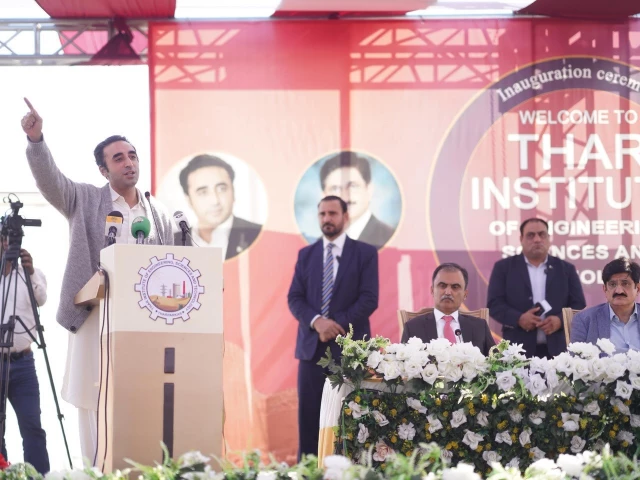
Pakistan People’s Party Chairman Bilawal Bhutto Zardari addresses the inauguration ceremony of NED University-affiliated Thar Institute of Engineering, Science and Technology and School of Modern Sciences in Tharparkar district on January 14, 2026. Photo: Express
Pakistan People’s Party Chairman Bilawal Bhutto Zardari on Wednesday accused “certain forces” of deliberately promoting a narrative that Sindh and smaller provinces had failed to implement, warning that the campaign was aimed at justifying the withdrawal of provincial powers and resources to Islamabad.
Speaking at the inauguration of the Thar Institute of Engineering, Science and Technology – affiliated to NED University of Engineering and Technology – on the Mithi-Islamkot road in Tharparkar, Bilawal said the development in Tharparkar is the strongest response to what he described as a “deliberate conspiracy” to roll back the constitutional rights, authority and resources of the provinces.
“The biggest rebuttal to this false narrative is Tharparkar himself,” he said, highlighting the contrast between the conditions of the district before 2008 and the situation after the 18th constitutional amendment.
Bilawal said Pakistan People’s Party believed in pro-poor and people-centered governance, adding that his party was ready to compete with other provinces and governments in the areas of education, health and development. “No one can defeat the people of Sindh in this competition,” he said.
He stressed that the development of Tharparkar and the four provinces was essential to Pakistan’s overall progress, rejecting the notion that provincial development could only flow from the federal capital.
2019 میں تھرپارکر کے نوجوانوں نے مطالبہ کیا تھا کہ تھر جائے۔ اس کے بعد این ای ڈی یونیورسٹی نے تھر میں انجینئرنگ کی تعلیم فراہم کرنا شروع کی۔ آج این ای ڈی یونیورسٹی سے الحاق شدہ تھر انسٹی ٹیوٹ آف انجینئرنگ سائنس اینڈ ٹیکنالوجی کا افتتاح اسی وعدے کی تکمیل ہے۔… pic.twitter.com/LBbX8Eu4Ez
– PPP (@MediaCellPPP) January 14, 2026
Referring to Thar coal, Bilawal said the resource belonged to the people of Tharparkar and described it as an asset comparable in scale to Saudi Arabia’s oil reserves. He said repeated attempts by former Prime Minister Benazir Bhutto to use coal reserves had been thwarted, delaying economic benefits for decades.
He said the use of Thar coal after 2008 had not only brought economic change to the region but also brought electricity to the national grid, thereby benefiting industrial centers such as Faisalabad. “This is how a strong federation works,” he said.
Bilawal said economic activity in Thar had led to a parallel social transformation, with investments in healthcare resulting in the creation of a network of dispensaries, basic health units and hospitals across the district. He cited the role of Thar Foundation and a public-private partnership with Indus Hospital as examples of improving health services.
On education, he said the inauguration of the NED-affiliated institute was in response to a long-standing demand of the local youth. He noted that classes began in 2019 in a government building and the Sindh government had now inaugurated a dedicated campus, with a commitment to transform it into a full-fledged university before the end of its tenure.
Sindh Chief Minister Murad Ali Shah, Provincial Minister for Universities and Boards Muhammad Ismail Rahoo and NED University Vice-Chancellor Tufail Ahmed also spoke at the ceremony.
Bilawal said the PPP government had doubled the number of universities in Sindh since 2008, adding that the figure was even higher when campuses were included. He said the party would continue to invest in education and health in the public interest.
Expressing satisfaction over the high number of female students at the institute, Bilawal said it reflected Benazir Bhutto’s vision of equal access to education for women. He also welcomed students from Gilgit-Baltistan studying on the campus, calling it a sign of national integration.


