
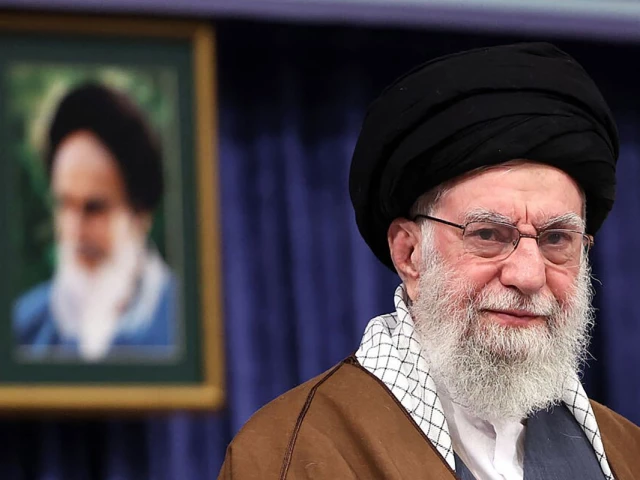
A photo provided by the office of Iran’s Supreme Leader Ayatollah Ali Khamenei shows him addressing a meeting with local champions and medalists of global sports and science awards in Tehran on October 20, 2025. PHOTO: AFP
ISLAMABAD:
When Field Marshal General Syed Asim Munir met US President Donald Trump at the White House in June last year, the situation in Iran was still terribly precarious.
There were still rumors that Israel, supported by the United States, would push for regime change in Iran. But days after the meeting between the marshal and Trump, the situation deteriorated after Iran carried out largely symbolic airstrikes on the US military base in Qatar.
The Iranian government survived. If sources and circumstantial evidence are to be believed, it was the Pakistani army chief’s advice to Trump that led the US not to pull the trigger.
Today, as protests once again rock Iran and Trump issues new warnings of military action, Islamabad’s position remains unchanged. Pakistan doesn’t want regime change in Iran because costs would be catastrophic, some experts and officials say
Iran is not a distant concern for Pakistan, it is a neighbor 900 kilometers away, sharing a sensitive border with Balochistan, the country’s most fragile province. Any upheaval in Iran immediately threatens cross-border militancy, arms trafficking, refugee flows and economic disruption.
“Any change in Iran, whether as a result of internal developments or external intervention, will have a direct impact on Pakistan,” said Asif Durrani, former Pakistani ambassador to Iran.
“Pakistan has played a role in the past in helping reduce tensions between Iran and the West and it should not be forgotten that Pakistan’s diplomatic mission in Washington also looks after Iran’s interests,” he added, referring to Islamabad’s possible role in defusing the crisis.
This underscores Islamabad’s dual role, managing its own security while subtly advising world powers on the consequences of aggressive action against Tehran.
One of Pakistan’s immediate concerns is the impact on Balochistan. Iran’s Sistan-Baluchestan province shares ethnic, tribal and linguistic ties with the Baloch regions of Pakistan.
Instability in states on either side of the border would energize militant networks, allowing them to exploit safe havens and expand their cross-border operations. Security analysts note that Pakistan’s previous gains in fighting terrorism in Balochistan could quickly collapse if Iran descends into chaos.
Johar Saleem, former foreign minister, said that during a conflict between Iran and Israel last time, Pakistan very categorically supported Iran’s territorial integrity and sovereignty.
“But I was one of the few commentators in Pakistan who thought that the military conflict had actually weakened Iran. So the situation we are seeing today is partly because Iran is facing a huge crisis of political instability.”
Johar stressed that external intervention now, whether economic, cyber or military, would aggravate the situation, further destabilizing a country already weakened by internal and external pressures.
Pakistan already hosts millions of Afghan refugees. A collapse or military intervention in Iran could trigger another massive influx of people, upending border management, urban centers and social services.
The economic toll alone would be heavy, at a time when Pakistan is subject to IMF programs and faces domestic budgetary constraints.
Forced regime change in Tehran would have repercussions far beyond Pakistan. This could reinforce fault lines in the Middle East, provoke proxy conflicts and attract regional powers such as China, Russia and Turkey.
For Pakistan, which relies heavily on the stability of the Gulf for its energy, trade and remittances, the consequences could be serious.
“In situations like these, it is always dialogue and amicable solutions that not only people within the country but also people outside the country want, especially those who are sympathizers of Iran. And Pakistanis are big sympathizers of Iran,” Johar said.
This underlines that Pakistan’s approach is rooted in realism: it seeks to manage regional dynamics without getting drawn into risky external adventures.
“Besides economic sanctions, there are other options that the Americans are talking about, for example military strikes or cyberattacks.
“Technologically speaking, there is a wide range of possibilities, so any type of intervention by the United States or the West would exacerbate the situation in Iran,” Johar warned. Pakistan’s position is clear: Iran must remain stable, sovereign and intact.
Although Islamabad does not always agree with Tehran’s domestic policies, it recognizes that a collapse of the Iranian state would be a strategic disaster for Pakistan, affecting border security, refugee flows, regional power dynamics and long-term diplomatic credibility.
As protests continue in Tehran and Trump hints at intervention, Pakistan will likely continue to quietly advise restraint, emphasize dialogue, and promote solutions that preserve both Iran’s territorial integrity and regional stability.


