
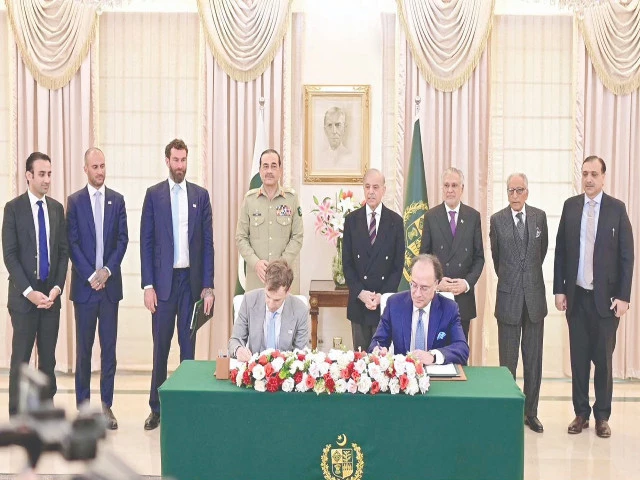
Prime Minister Shehbaz Sharif and CDF Marshal Asim Munir attend the signing of a Memorandum of Understanding between the Government of Pakistan and SC Financial Technologies in Islamabad. Photo: PPI
ISLAMABAD:
Pakistan signed a deal on Wednesday with a company linked to US President Donald Trump’s family to explore integrating a dollar-pegged stablecoin into its national payments system to enable faster and cheaper cross-border transactions.
The Ministry of Finance and SC Financial Technologies LLC – an entity affiliated with World Liberty Financial – have signed a memorandum of understanding (MoU) to evaluate the potential use of World Liberty’s $1 stablecoin for cross-border payments, according to an announcement from the ministry.
The non-binding one-year memorandum of understanding aims to explore possibilities for stablecoin transactions pegged to the US dollar. The government plans to introduce a comprehensive legal framework within a year, before declaring digital currencies legal tender in Pakistan.
Stablecoins are regulated in Pakistan by the Virtual Assets Ordinance and are called “Asset-Referenced Tokes”. The order will expire in the next two months and the government will soon begin the process of converting the order into law.
Finance Minister Muhammad Aurangzeb and World Liberty Financial CEO Zachary Witkoff, son of US Special Envoy Steve Witkoff, signed the MoU in a ceremony attended by Prime Minister Shehbaz Sharif and Chief of Defense Forces (CDF) Field Marshal Syed Asim Munir.
Pakistan is emerging as one of the most attractive frontier markets for digital payments and financial innovation, driven by more than $38 billion in annual remittances and a rapidly growing digital economy, the Ministry of Finance said.
According to the ministry, an estimated 40 million cryptocurrency users and an estimated annual trading volume of $300 billion place the country among those with the largest digital asset user base in the world.
This announcement represents one of the first publicly announced tie-ups between World Liberty, a crypto-based financial platform launching in September 2024, and a sovereign state. This also comes amid warming relations between Pakistan and the United States.
Stablecoin is a type of cryptocurrency designed to maintain a stable value by pegging its market value to a less volatile external asset, most commonly a traditional fiat currency like the US dollar.
The Ministry of Finance said the agreement will enable structured dialogue and technical understanding around emerging digital payment architectures, including the exploration of World Liberty Financial’s stablecoin, USD1, for cross-border transactions.
The delegation was led by Zachary Witkoff, Managing Director of SC Financial Technologies LLC, who also met with senior Pakistani officials to discuss how the countries are approaching secure, compliant and transparent digital payments infrastructure, including innovations in cross-border settlements and foreign exchange processes.
The use of digital currencies as a means of payment is still illegal in Pakistan and the central bank, and federal government entities are finalizing the new legal framework.
In September last year, the central bank said restrictions imposed by the Foreign Exchange Regulation Act (FERA), including the maximum annual limit of $100,000, would apply to foreign transfers of digital currencies. The SBP also said it was working on launching a new digital currency.
The Ministry of Finance said Pakistan is quickly positioning itself as a serious competitor in the global digital finance landscape, as World Liberty Financial deepens its engagement with the country to explore innovations in digital payments and next-generation cross-border finance.
Industry observers view World Liberty Financial’s second engagement with Pakistan as a strong indication that the country is being actively evaluated as a potential early-stage partner jurisdiction to explore new digital payment models, including its stablecoin, USD1, at a time when stable, regulation-sensitive markets are increasingly sought after by global fintech players.
Speaking on the occasion, Senator Muhammad Aurangzeb, Federal Minister for Finance and Revenue, said that “Pakistan recognizes that the future of finance is being shaped today. Our goal is to stay ahead of the curve by engaging with credible global players, understanding new financial models and ensuring that innovation, when explored, is aligned with regulation, stability and the national interest.
This momentum builds on previous engagement between World Liberty Financial and Pakistan, including the signing of a Letter of Intent (LoI) in April with the Pakistan Crypto Council, led by CEO Bilal Bin Saqib, which laid the foundation for knowledge sharing and ecosystem-level dialogue around emerging financial technologies.
It also follows recent regulatory developments in the digital assets sector in Pakistan. On December 12, Pakistan’s new Virtual Assets Regulatory Authority issued no-objection certificates (NOCs) to Binance and HTX, allowing the two platforms to launch local incorporation in Pakistan.
These NOCs were issued in less than five months, faster than comparable timelines observed in other jurisdictions globally. As part of this engagement, Binance founder Changpeng Zhao and TRON founder Justin Sun also visited Pakistan, meeting with key stakeholders from the public and private sectors as part of a broader engagement around the evolution of digital assets and the country’s regulatory framework.
With sustained international interest and a structured regulatory-focused approach, Pakistan is increasingly seen as a market to watch in the evolution of global digital finance.
Meanwhile, the World Liberty Financial delegation, led by Zachary Witkoff, visited Field Marshal Syed Asim Munir, the Inter-Services Public Relations (ISPR) said. He added that the meeting reflected the growing interest of international private investment groups in the evolving economic landscape of Pakistan.
During the meeting, Witkoff highlighted Pakistan’s immense economic potential and praised the efforts of Pakistani leaders to embrace futuristic technologies to realize the full possibilities of their economic prowess.
Marshal Asim welcomed the exchange of views and highlighted Pakistan’s commitment to economic stability, investor confidence and creating an enabling environment for responsible private sector participation in national development.


