
.
WASHINGTON:
The United States on Thursday imposed sanctions on five Iranian officials it accused of being behind the crackdown on protests and said it was monitoring Iranian leaders’ funds transferred to international banks, as President Donald Trump maintains pressure on Tehran.
The US Treasury Department said in a statement it had imposed sanctions on the secretary of the Supreme National Security Council as well as the commanders of the Islamic Revolutionary Guard Corps and law enforcement agencies, accusing them of being the architects of the crackdown.
The United States also imposed sanctions on Fardis prison, where the State Department said women had “endured cruel, inhumane, and degrading treatment.”
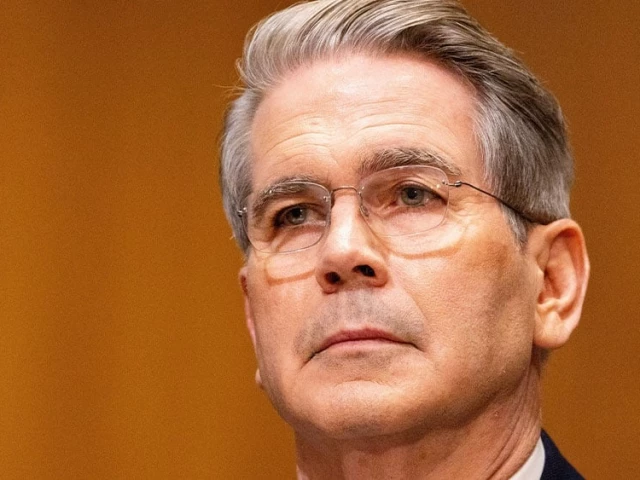
Treasury Secretary Scott Bessent said in a video Thursday that Washington’s message to Iranian leaders was clear: “The U.S. Treasury knows that, like rats on a sinking ship, you are frantically moving funds stolen from Iranian families to banks and financial institutions around the world.
“But there is still time, if you choose to join us. As President Trump said, stop the violence and stand with the Iranian people.”
Separately, U.S. President Donald Trump said Wednesday that Iranian opponent Reza Pahlavi “seems very nice” but expressed uncertainty about Pahlavi’s ability to gather support in Iran to eventually take power.
In an exclusive interview with Reuters in the Oval Office, Trump said there was a chance Iran’s government could collapse and blamed Ukrainian President Volodymyr Zelensky for the impasse in negotiations with Russia over the Ukraine war.
Trump has repeatedly threatened to intervene in support of protesters in Iran. But he was reluctant on Wednesday to give his full support to Pahlavi, the son of the late Shah of Iran, ousted from power in 1979.
“He seems very nice, but I don’t know how he would play in his own country,” Trump said. “And we’re not really there yet. I don’t know whether or not his country would accept his leadership, and certainly if it did, I would be fine with that.”
Trump’s comments went further in questioning Pahlavi’s ability to lead Iran, after saying last week that he had no plans to meet with him.
The fragmented opposition
Trump said it was possible the government in Tehran could fall because of the protests, but in reality “any regime can fail.”
“Whether it goes down or not, it’s going to be an interesting time,” he said.
Trump, closing out the first year of his second term, sat behind his massive Resolute desk and sipped a Diet Coke during the 30-minute interview. At one point, he held up a thick binder of papers that he said contained his accomplishments since taking office on January 20, 2025.
But he sought to manage Republican expectations during the midterm congressional elections in November, noting that the ruling party frequently loses seats two years after a presidential election.
“When you win the presidency, you don’t win the midterm elections,” he said. “But we are going to do our best to win the midterm elections.”
“Zelensky”, main obstacle to an agreement
Trump, who has struggled throughout his presidency to end Russia’s war in Ukraine despite his campaign’s boasts that he could end it in a day, said Zelensky was the main obstacle to resolving the four-year-old war.
Trump has frequently criticized Russian President Vladimir Putin and Zelensky, but was once again more pessimistic toward the Ukrainian president.
Trump said Putin was “ready to make a deal.” When asked what the problem was, Trump simply replied: “Zelensky.” “We have to convince President Zelensky to accept it,” he said.
Trump is scheduled to meet with Venezuelan opposition leader Maria Corina Machado at the White House on Thursday, their first in-person meeting since Trump ordered the arrest of Venezuelan President Nicolas Maduro and took control of the country earlier this month.
“She’s a very nice woman,” Trump said of Machado. “I saw her on TV. I think we’ll just talk about the basics.”
Machado won the Nobel Peace Prize last year and dedicated it to Trump. She offered to give him his prize, but the Nobel Committee said the peace prize could not be transferred.
He praised Venezuela’s interim president, Delcy Rodriguez, who was Maduro’s vice president when he was ousted. Trump said he had a “fascinating discussion” with Rodriguez earlier Wednesday and “was very pleasant to deal with.”
Trump frequently touted the strength of the U.S. economy during the interview, despite Americans’ lingering concerns about prices. He said he would take that message with him next week to the World Economic Forum in Davos, Switzerland, where he would highlight “how great our economy is, how strong our employment numbers are, how well we are doing.”


