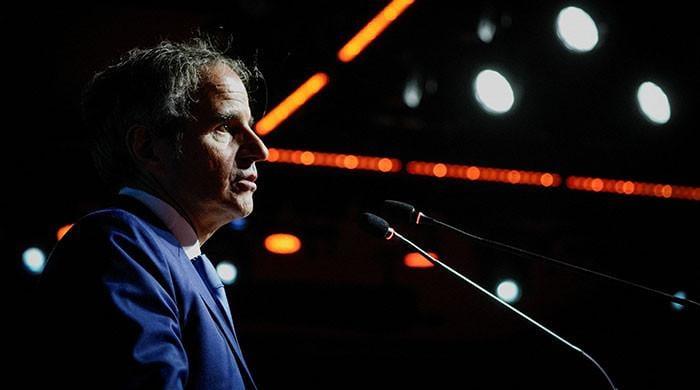
- Grossi says the IAEA inspected all sites, not those that were bombed.
- Said it is not possible to inspect during social unrest.
- Stresses that Iran must respect its nuclear obligations.
DAVOS: The conflict with Iran over accounting for its stockpiles of highly enriched uranium and inspection of nuclear facilities bombed by the United States and Israel cannot last forever, the head of the U.N. nuclear watchdog, Rafael Grossi, said Tuesday.
The International Atomic Energy Agency inspected all 13 declared nuclear facilities in Iran that were not bombed, but was unable to inspect any of the three key sites that were bombed in June – Natanz, Fordow or Isfahan – Grossi said. Reuters in an interview at the World Economic Forum in Davos.
Iran must first submit a report to the IAEA on what happened to those sites and materials, including about 1,000 pounds of uranium enriched to 60 percent purity, close to the weapons-grade level of about 90 percent. That’s enough material, if further enriched, to make 10 nuclear bombs, according to IAEA criteria.
No “à la carte” option
Iran has not submitted this special report to the IAEA.
“This can’t go on forever because at some point I’ll have to say, ‘Well, I have no idea where these documents are,'” which would mean there was no guarantee those documents hadn’t been misappropriated or hidden, Grossi said.
“I don’t have that conviction or that conclusion at the moment, but what we are saying to Iran is that they need to engage. »
Iran says it is fully cooperating with the IAEA. His government could not immediately be reached for comment.
It has now been at least seven months since the IAEA last checked Iran’s stockpiles of highly enriched uranium. His own guideline is that this should be done monthly.
Grossi said he was exercising “diplomatic caution” but that Iran must respect its obligations as a party to the Nuclear Non-Proliferation Treaty.
“This cannot continue like this for long without unfortunately having to declare them non-compliant,” he said, emphasizing that NPT parties do not have an “à la carte” option allowing them to choose what they must comply with.
Asked if the problem could be resolved this spring, he said, “That’s a reasonable time frame.”
The last inspections took place in December
One of the “real world” realities Grossi says he must face is the influence of diplomatic efforts to reach a broader agreement between Iran and the United States, led by U.S. special envoy Steve Witkoff.
“I can’t ignore it, and I want there to be an agreement without the imminent threat of further military activity there or something like that,” he said.
The IAEA said in November that it had inspected most of Iran’s nuclear facilities that had not been hit by U.S. and Israeli attacks. Since then, it has carried out additional inspections until the end of December, Grossi said.
However, it was not possible to carry out inspections during the civil unrest, he said, referring to recent protests. Iranian officials indicated the unrest had stopped, he said.
“They said things were calm and they were in control and so on,” Grossi said. “If this is the situation, shouldn’t we resume (inspections)?
Grossi said he would meet Iranian Foreign Minister Abbas Araqchi in “a few days, maybe weeks.”