
MQM, PPP and PTI clash over fire response; Lawmakers debate negligence, chemical use
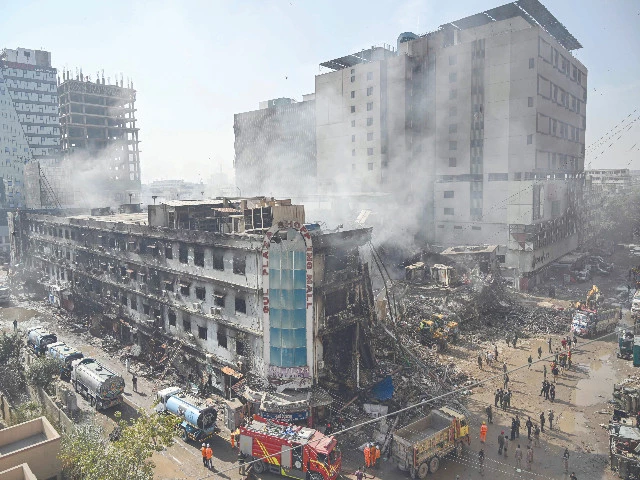
Rescue workers sift through debris using excavators after a massive fire at a Karachi shopping mall. Photo: AFP
ISLAMABAD:
The National Assembly on Tuesday witnessed a fiery session as government allies clashed over the Gul Plaza fire in Karachi, exchanging bitter accusations and verbal barbs while pointing fingers at institutional failures, governance and past policies.
The session, chaired by Vice President Syed Ghulam Mustafa Shah, saw Defense Minister Khawaja Asif raise two points for the upcoming constitutional amendment: the need for a uniform curriculum and a functional local government system.
Tensions quickly flared between the parties. Members of the Muttahida Qaumi Movement (MQM) and the Pakistan People’s Party (PPP) exchanged pointed remarks during the debate on the tragedy. The allied parties also targeted the Pakistan Tehreek-e-Insaf (PTI), thereby intensifying the confrontation.
MQM lawmakers sought permission to discuss the Gul Plaza fire, insisting that regular proceedings be suspended for a focused debate. At first, the government resisted, but protests by MQM and PTI members forced the suspension of the regular agenda.
Opening the debate, MQM MP Dr Farooq Sattar sharply criticized the handling of the fire, highlighting the institutional failures and inadequate response of the PPP-led provincial government. In turn, PPP members countered the criticism.
Shehla Raza questioned why several places in the square caught fire and why chemicals were allegedly used to hamper firefighting efforts. She added that such incidents often reveal underlying frustrations, thereby revealing weaknesses in the local governance system.
PPP member Abdul Qadir Patel accused Goga, the bodyguard of MQM founder Altaf Hussain, of overseeing the unauthorized construction of Gul Plaza. MQM’s Wasim Hussain refuted the claim, saying Patel had already been involved in the construction of the square.
Defense Minister Khawaja Asif placed the debate in the context of broader governance issues, pointing out that past military governments had strengthened local government systems, while political administrations historically eschewed them.
He stressed that for the National Assembly to function effectively, representation must extend to neighborhoods and local governance must be fully operational. Without it, he argued, the 18th Amendment would remain largely symbolic. He added that the next constitutional amendment should ensure a uniform curriculum and a functional local government system nationwide.
On the situation in the erstwhile tribal areas, PTI lawmakers including Iqbal Afridi called for a debate on the displacement of people in Khyber, Bajaur and Mohmand districts due to the ongoing operations. Jamiat Ulema-e-Islam (JUI) supported this demand.
Afridi said internally displaced persons (IDPs) were left without adequate support as the federal government failed to properly monitor the situation, while provincial authorities tried to manage the crisis.
Asad Qaiser, former Speaker of the National Assembly and senior PTI member, highlighted a recent jirga organized by the Khyber Pakhtunkhwa Assembly (KP), whose declaration was signed by 21 parties, including the PPP, Pakistan Muslim League-Nawaz (PML-N) and the Awami National Party (ANP). Qaiser proposed that the provincial assembly be consulted on provincial issues and called for a joint parliamentary session to formulate a national strategy against terrorism.
State Minister for Interior Talal Chaudhry defended the operations in KP, noting that the National Action Plan (NAP), formulated during the previous PTI government, was being implemented. He alleged that the KP chief minister was politicizing the operations.
As the heated debate continued, the proceedings of the National Assembly were adjourned and postponed until 11am on Wednesday (today).


