
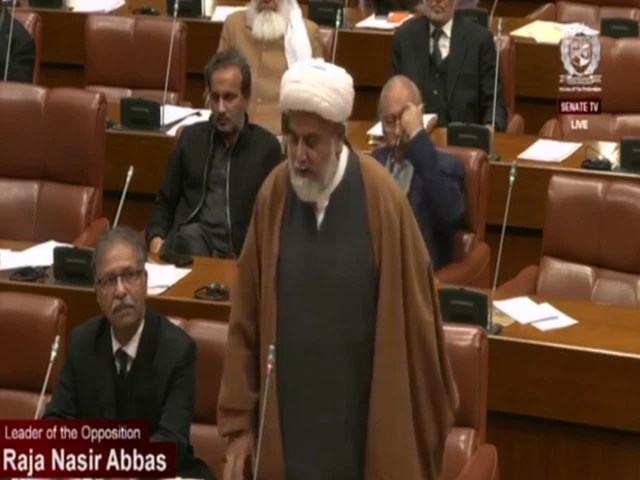
Raja Nasir Abbas, new leader of the opposition in the Senate. Photo: YouTube screenshot/Senate of Pakistan.
ISLAMABAD:
Days after the nomination of the opposition leader in the National Assembly, the process was also completed on Tuesday in the Senate, where Majlis Wahdat-e-Muslimeen (MWM) Chairman Allama Raja Nasir Abbas was formally nominated for the post.
With opposition leaders now sitting in the National Assembly and Senate after a five-month hiatus, political analysts see the development as a “potential icebreaker” between the Treasury and opposition benches.
The opposition led by Tehreek-e-Insaf (PTI) wants to use Parliament to press its demands, while the ruling coalition hopes the appointments will prompt the opposition to abandon its strategy of agitation and disruption.
Abbas, a PTI-backed senator and vice-president of Tehreek Tahafuz Aain-e-Pakistan (TTAP), had been appointed to the post by incarcerated PTI founder Imran Khan in August. Abbas received 22 votes out of 32 opposition members in the upper house.
“Pursuant to paragraph (3) of Rule 16 of the Senate Rules of Procedure and Conduct of Business, 2012, the President of the Senate has been pleased to declare Senator Raja Nasir Abbas as the Leader of Opposition in the Senate, with immediate effect,” read a notification issued by the Senate Secretariat.
The post of Leader of Opposition in the Senate had remained vacant since August 2025, when the incumbent PTI’s Shibli Faraz was disqualified by the Election Commission of Pakistan (ECP) following his conviction in cases related to the May 9, 2023 violence.
Faraz had challenged the ECP notice in the Peshawar High Court (PHC), which had initially granted a stay order, ending proceedings over his disqualification and appointment of a new opposition leader.
Explaining the delay, Senate President Syed Yousuf Raza Gilani told the House that the appointment was blocked on grounds of procedure, institutional prudence and deference to judicial authority and the rule of law.
During the session, Senator Nasir Butt of the Pakistan Muslim League-Nawaz (PML-N) raised questions over Abbas’s party affiliation, noting that he was not a member of the PTI. “Let the party [PTI] it lacked an eligible candidate from its own ranks,” he asked.
Despite the objection, the President proceeded with the declaration and directed the Senate Secretariat to immediately issue the notification. PTI Parliamentary Leader Ali Zafar welcomed the decision and thanked the treasury benches for their support, terming it a positive parliamentary gesture.
“This is how parliamentary behavior should be. At the very least, we must preserve and uphold parliamentary authority and powers,” he said. From the Treasury benches, Justice Minister Azam Nazeer Tarar and Prime Minister’s Advisor Rana Sanaullah also welcomed the appointment.
In his first speech as opposition leader, Raja Nasir Abbas credited Imran Khan for his presence in the house, describing himself as a “faithful companion” of Khan, who would never compromise on principles or his oath. He claimed Khan enjoyed 90% public support.
“The country cannot progress if you keep a popular leader in prison,” Abbas said, stressing that resolving Khan’s case and releasing him was the only solution to the political crisis. He also called on the opposition to gain access to what he called “political prisoners” in order to restore stability.
Describing the Constitution as a sacred social contract, Abbas said it binds the pillars of the state to non-interference. Without respect for the law, he warned, society risks descending into a “jungle” marked by anarchy and the erosion of public trust.
He said national strength stems from justice and unity, attributing political instability to allegations of fraud in the February 8, 2024 elections, repression of peaceful protests, violence against TTAP members in Punjab and displacement in the Tirah region of Khyber-Pakhtunkhwa state.
Questioning whether terrorism could be eradicated without justice and local support, Abbas said economic and security challenges could not be resolved without ending the political deadlock and urged Parliament to “exercise collective wisdom.”
He also called on Pakistan to oppose US President Donald Trump’s threats against Iran, proposing an Organization of Islamic Cooperation (OIC) session and regional dialogue to avoid any escalation.
Speaking after Abbas, Rana Sanaullah said the allegations surrounding the February 8 elections were not unprecedented, recalling similar claims after previous polls, including the 2018 general elections. Remaining locked into past grievances, he said, would hinder national progress.
Sanaullah acknowledged that Pakistan’s electoral system lacked complete credibility and needed reforms. “If we accept that free and fair elections remain a challenge, the solution lies in coming together to improve electoral laws, procedures and the role of institutions like the ECP,” he said.
Citing the “Charter of Democracy”, he urged all political parties to work towards a “Charter of Stability”, stressing that political, electoral and institutional challenges could only be resolved through dialogue and consensus within Parliament.
He added that with the appointment of opposition leaders in both the National Assembly and the Senate, there is an opportunity to steer policy towards stability through parliamentary debate on judicial independence, political affairs, electoral reforms and democratic standards.
These appointments came after more than five months of delay, with the positions having remained vacant since August 2025, when Shibli Faraz and his National Assembly counterpart Omar Ayub were convicted and disqualified.


