
FO says decision supports Palestinian cause; Hopes new framework will lead to lasting truce
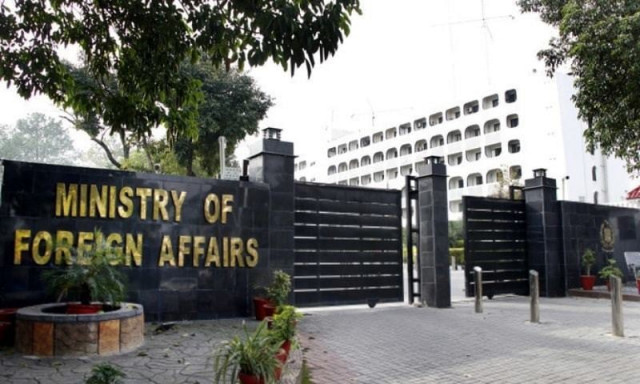
Ministry of Foreign Affairs. Photo: File
ISLAMABAD:
In a move that could have far-reaching consequences, Pakistan on Wednesday accepted an invitation to serve on the US-led Peace Council and joined the ranks of Egypt, Jordan, the United Arab Emirates, Indonesia, Turkey, Saudi Arabia and Qatar in welcoming the initiative to bring peace to Gaza.
In a joint statement issued by the Ministry of Foreign Affairs on Wednesday, the foreign ministers of Pakistan and seven other Muslim countries announced their countries’ joint decision to participate in the board established by US President Donald Trump.
“Each country will sign the accession documents in accordance with their respective legal and other necessary procedures, including Egypt, Pakistan and the United Arab Emirates, which have already announced their decision to join,” the joint statement said.
The foreign ministers reiterated their support for Trump’s peace efforts and pledged to fully cooperate in implementing the board’s mission as a transitional administration within the framework of the “Comprehensive Plan to End the Conflict in Gaza,” approved by United Nations Security Council Resolution 2803.
The declaration outlines the Council’s objectives: “To consolidate a permanent ceasefire, support the reconstruction of Gaza and advance a just and lasting peace based on the Palestinians’ right to self-determination and statehood in accordance with international law, thereby paving the way for security and stability for all countries and peoples in the region.” »
The Foreign Ministry’s announcement comes just ahead of the signing ceremony scheduled for Thursday (today) in Davos on the sidelines of the World Economic Forum (WEF) to formally establish the Peace Council. Trump will chair the event in the presence of several world leaders, including Prime Minister Shehbaz Sharif.
The Foreign Ministry said Pakistan’s participation reflects its long-standing commitment to international peace and security, as well as its consistent support for the Palestinian cause.
“Pakistan hopes that with the creation of this framework, concrete steps will be taken towards the implementation of a permanent ceasefire, increased humanitarian assistance to the Palestinians, as well as the reconstruction of Gaza,” the statement said.
The government stressed that an immediate and lasting ceasefire remains essential to alleviate the humanitarian crisis in Gaza, where months of conflict have left thousands dead and displaced much of the population. Islamabad also highlighted the urgent need for unhindered humanitarian access to ensure delivery of food, medicine and essential supplies to civilians.
The Foreign Ministry said Pakistan hopes that efforts under the Peace Council will lead to the realization of the Palestinian people’s right to self-determination through a “credible and time-bound political process” consistent with international law and relevant United Nations resolutions.
“Pakistan hopes to continue playing a constructive role in the Peace Council to achieve these goals and end the suffering of our Palestinian brothers and sisters,” the foreign ministry said.
Diplomatic sources said Pakistan’s inclusion in the Peace Council was likely to boost the body’s legitimacy, particularly among Muslim-majority countries, and could help bridge gaps between different international stakeholders involved in peace efforts in Gaza.
Officials, familiar with the developing situation, justified Pakistan’s decision to join the board, underscoring Islamabad’s growing importance in an increasingly polarized world order. They said the initiative has the support of several influential countries, including a number of Muslim-majority states.
“The objective of the Peace Council is clear: to resolve the Gaza crisis in strict accordance with the resolutions of the United Nations Security Council,” a senior government official told the Express PK Press Club. “It aims to achieve a permanent ceasefire and facilitate the reconstruction of Gaza.”
Sources said the council would also ensure the protection of the legitimate rights of the Palestinian people, including statehood and self-determination. “This is not a token participation,” a source said. “This reflects recognition of Pakistan’s diplomatic weight and its importance in the international comity of nations.”
Responding to domestic criticism, officials rejected comparisons between the Peace Council and the proposed International Security Force (ISF) for Gaza. They highlighted that Pakistan’s position towards the ISF has been clearly expressed at several levels.
“Any engagement in the ISF, if any, would only be in line with Pakistan’s national interest, a clear UN mandate and the aspirations of the people of Pakistan and Palestine,” a foreign ministry source said. “Assimilating the Peace Council to the ISF is illogical and inappropriate. »
Officials further argued that in a rapidly changing geopolitical environment, disengagement carries its own risks. “As fault lines harden, neutrality can easily become irrelevant,” one source noted.
“For the Muslim world’s most important military power, abstention is not a prudential measure; it is a strategic confiscation,” the source added, pointing to Pakistan’s long history of contributions to UN peacekeeping missions as proof of its credibility.


