
.
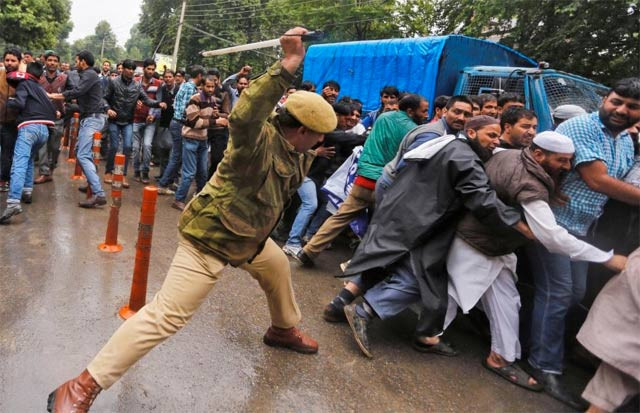
In a right of reply to the UNHRC in Geneva, Pakistan questions India’s incessant atrocities against defenseless Kashmiris. PHOTO: REUTERS
THE UNITED NATIONS:
As UN member states begin preparations to draft an international treaty to prevent crimes against humanity, Pakistan on Tuesday drew attention to criminal offenses committed against innocent people in occupied Kashmir and Palestine.
“Crimes against humanity are one of the most serious crimes,” Pakistani delegate Zulfiqar Ali told a meeting of the preparatory committee for the United Nations conference on the prevention and suppression of such crimes.
“No act is more sacrilegious than committing criminal offenses against innocent people,” he stressed.
“It is with great sadness and outrage that we see these crimes committed against innocent people in different parts of the world, including occupied Jammu and Kashmir and the occupied Palestinian territories,” said Zulfiqar Ali, first secretary of Pakistan’s mission to the UN.
“Instead of addressing the historical injustices inflicted on oppressed peoples, their dreams and hopes for a dignified future are being trampled by brutal force and violence,” he added.
Pakistan, Ali said, unequivocally condemns these crimes and supports calls to end their impunity.
“Indeed, it is only by holding the perpetrators of these acts accountable that we can take meaningful and concrete steps to restore the honor and dignity of the victims.”
He described the International Law Commission’s draft articles for the treaty as a “useful starting point”, but stressed that those on the prevention and punishment of crimes against humanity – particularly for crimes such as slavery, torture and enforced disappearances – must align with those enshrined in the corresponding UN conventions.
Pakistan, he added, hopes that the Preparatory Committee will be able to harmonize different perspectives to ensure that the next Convention is widely adopted by the international community, especially by States that are not parties to the Rome Statute of the International Criminal Court (ICC).
The Pakistani delegate’s sharp remarks on the situation in Indian occupied Kashmir drew a response from an Indian representative.
Luther Rangerji, legal advisor to the Indian Ministry of Foreign Affairs, said Pakistan did not have locus standi over Kashmir because it was part of India.
He also claimed that Pakistan is using the Jammu and Kashmir issue to divert attention from its treatment of minorities.
Zulifiqar Ali, the Pakistani delegate, responded, saying India had violated Pakistan’s sovereignty by attacking civilians, including children blinded by pellet guns. New Delhi is also failing to implement Security Council resolutions on Jammu and Kashmir and is violating the Indus Water Treaty.
“The world does not need lessons on crimes against humanity from a country that serially violates international law and the United Nations Charter and is a perpetrator of atrocity crimes – in occupied Jammu and Kashmir, against minorities in India, against civilians it targets by sponsoring cross-border terrorist attacks.”
India, he said, is colluding with terrorist organizations to overthrow and sow chaos in neighboring countries and is waging international assassination campaigns against political dissidents with impunity.
“Due to an unholy nexus between extremist Hindutva ideology and the ruling elite, India’s minorities, especially Muslims, face an imminent threat of ghettoization.”
Rejecting the claim that Jammu and Kashmir is an integral part of India, he said the state is a disputed territory under UN Security Council resolutions pending a final solution.
“The right to self-determination is a birthright of Kashmiris, in accordance with the United Nations Charter – a right that India has solemnly promised to Kashmiris and yet stubbornly denies, in blatant violation of UN Security Council resolutions.”
Pakistan, he said, will continue to extend political and moral support to the freedom struggle of the Kashmiri people and call for a UN-supervised plebiscite in Jammu and Kashmir.


