
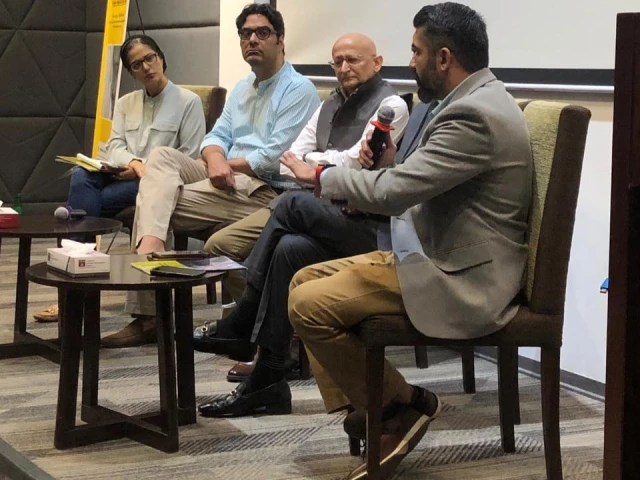
IBA-CEJ organizes the screening of a documentary highlighting the legal gaps in the murder of journalist Zakir Hussain Dahar
Shahzeb Ahmed, IBA faculty member and senior journalist, speaks during the screening of a documentary highlighting legal flaws in the murder of journalist Zakir Hussain Dahar, during an event at CEJ-IBA on Wednesday. Photo: Express
On January 1, 2014, journalist Zakir Hussain Dahar, known as Shan Dahar, was shot in the back in Badah town in Larkana district of Sindh. He was leaning against the counter of a small medical store, caught in an argument between patients of a nearby basic health center (CHB) and the pharmacist, a little after midnight, when the bullet struck his upper back.
Dahar, then head of office at AbbTak Newswas in the narrow alley that night because he was investigating an interruption in the supply of medicines from a non-governmental organization marked as free. Twelve years and blatant procedural irregularities later, police maintain that Dahar’s killing was an accident, caused by a stray bullet fired from 60 meters away, another casualty of the incessant New Year’s celebration aerial fire.
A report released on Wednesday by Safe Journalism at the Center for Excellence in Journalism (CEJ), as part of a global initiative led by Free Press Unlimited (FPU) and the Committee to Protect Journalists (CPJ), at IBA Karachi, highlighted the findings of the case, eyewitness accounts, autopsy report, family testimonies and the police investigation. The facts of the case and the investigation do not match.
Before breathing his last at Chandka Hospital, Dahar accused the influential Zehri tribe of putting a target on his back. Amir Zehri, the main accused in this case, was declared a fugitive in this case, which was not the subject of any “criminal” investigation for a full nine hours after the murder. His bloodstained clothes were scattered on the ground, thrown away by police, and a handy little camera on him at the time of his death was recovered by his sister. The murder took place near the Badah Press Club. The journalists were outraged.
Read: In the crosshairs: another year full of violence for journalists in Pakistan
The police never recorded the statements of medical storekeeper Zulfikar Kokar and BHC watchman Munna Qadir, recalls senior investigative journalist Adil Jawad. Instead, the Sindh Police submitted 15-16 identical testimonies from different investigators, when the police’s performance was questioned.
A press release accompanying the event said at least 98 journalists killed in Pakistan since 1992 have yet to receive justice.
The report, titled Truth denied: how the Pakistani authorities constructed an insoluble case, documents procedural flaws, omissions and inconsistencies in the Sindh Police investigation and progress of the case over the past 12 years. The CEJ’s findings support the allegations of complacency and willful neglect on the part of the investigating authorities made by Dahar’s family and his colleagues.
Lawyer Salahuddin Ahmed, a member of the panel, observed during the launch of the report that Pakistan had a low conviction rate, around 16%. He said the effective rate should be around 70 to 80 percent, showing that the country takes investigations seriously, but also has leeway to acquit the innocent.
“At every step, we faced local pressure, police failures and legal obstacles,” said Salahuddin Panhwar, a human rights lawyer with experience seeking justice for murdered journalists in Sindh. He stressed the need for convictions in cases of serious human rights violations.
Learn more: Journalism remains the most perilous vocation in Sindh
“As a community, we are also guilty of forgetting our colleagues who died in the line of duty. Our first duty is not to forget them. If we do not stand up for them, who will?” Shahzeb Jillani, fellow seconded panelist and CEJ Director.
Earlier, in his opening speech, Sindh Minister Saeed Ghani appreciated the research behind the report. “If there are flaws in police investigations, we must clearly identify them. Only then can we start to fix what is wrong,” Ghani said.
Except that the family notes, in the documentary released by the FPU based on the findings of the report, that the Sindh government has failed to keep its promises not only to ensure justice but also to provide education to the girls of Dahar.
The murdered journalist’s eldest daughter recalls that although she had once wanted to become a journalist like her father, the events following his assassination and the apparent investigation convinced her to become a lawyer.
Speaking at the launch, IBA Professor and Senior Journalist Shahzeb Ahmed stressed that who we identify as a journalist needs to be questioned.
The first question when a journalist is attacked is often: is he really a journalist? In our eyes, it is anyone who transmits information. We cannot discriminate against someone who lives in a remote area like Barkhan, just because he never had the opportunity to speak to mainstream media.”
According to CPJ, Dahar’s unsolved murder is a prime example of Pakistan’s systemic failure to investigate crimes against journalists. Their investigation, which lasted 18 months, used video and photographic evidence to prove that the official account was “highly improbable” and found that police had used the case to extort individuals and coerce witnesses into giving false information.
The IBA’s opening statements were followed by a video tribute to journalists murdered in Pakistan since 1992, including Daniel Pearl, Saleem Shehzad and Nasrullah Gadani.
The report concluded that authorities ignored an obvious motive: Dahar’s investigation into the illegal resale of donated drugs. Although he filmed the operation just before he was shot and blamed the clinic director – who was later suspended for medical negligence leading to Dahar’s death – no official investigation into the doctor’s involvement was conducted.
“If we look at Shan Dahar’s case, we can see how this case has never been solved. Lack of evidence is not the problem, and as we said earlier (during the panel discussion after the screening), this case can still be solved. We will also work with government authorities. The families of these journalists deserve closure,” said Mehmal Sarfraz, co-founder of Safe Journalism.


