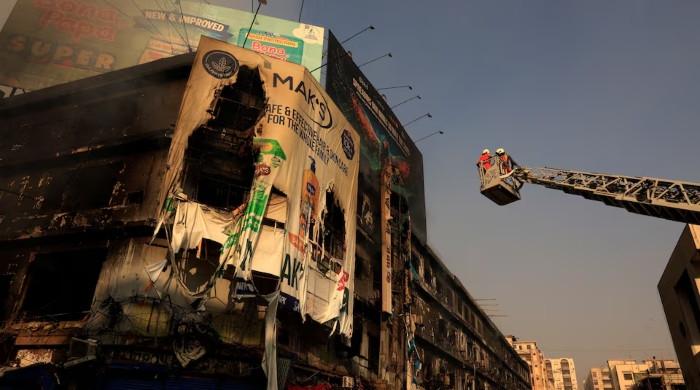
The inferno that swept through Gul Plaza in Karachi this weekend was not a bolt from the blue but the grim and predictable result of long-standing neglect, regulatory apathy and institutional failure.
As flames tore through Saddar’s commercial building, killing at least 21 people and leaving many others missing or injured, Karachi was forced to face a reality it has refused to face for decades: This city doesn’t take fire safety seriously — and its residents are paying the price.
The shock affected the entire country, but in Karachi the reaction was painfully familiar. There is grief, outrage and disbelief, followed closely by a weary sense of inevitability. For those who live and work here, tragedies like this seem less like accidents and more like delayed consequences.
Gul Plaza was a bustling and thriving market where hundreds of people worked daily in shops filled with clothing, plastics, cosmetics and other combustible products. Like so many of the city’s commercial buildings, it operated on the assumption that disaster would not strike. This assumption proved fatal. Although early indications suggested an electrical short caused the spark, it was the environment – crowded, poorly designed and largely unregulated – that allowed the fire to grow uncontrolled and deadly.
As smoke quickly filled the structure, escape became nearly impossible. Narrow passages became choke points, exits were inaccessible or poorly marked, and basic security systems failed to provide meaningful protection. If fire alarms or sprinklers existed, they offered no effective warning or suppression.
Many of those stuck inside had no clear path to safety. Firefighters arrived to deal with an already fierce fire, battling the flames in grueling conditions, slowed by traffic jams, limited access and the dangerous layout of the building. By the time the fire was brought under control, lives had already been lost and livelihoods destroyed.
Karachi has been here before. Industrial fires, market infernos and building collapses dot the city’s recent history. Each incident follows the same scenario: condolences are offered, committees are formed, compensation is announced, and then attention drifts elsewhere.
Structural reform is postponed, its enforcement weakens again and dangerous buildings continue to operate as if nothing had happened. Gul Plaza is not an anomaly; this is another entry in a long and shameful file.
At the root of this cycle is a deep-rooted culture of contempt. Fire safety regulations exist in theory but are rarely strictly enforced. Buildings are approved without thorough inspections and, once operational, are repeatedly modified to maximize commercial space at the expense of safety.
Power grids are overloaded, emergency exits are sacrificed to storage or exposure, and hazardous materials are piled up in confined spaces. When inspections do take place, they are often treated as procedural exercises rather than life-saving interventions.
The city’s emergency response capacity is hardly reassuring. Karachi’s firefighters are overworked, under-resourced and ill-equipped for a city of this size and complexity. Fire stations are insufficiently distributed, response times are weakened by traffic jams and encroachments, and much of the equipment is obsolete.
Firefighters are regularly sent into perilous situations with limited protective equipment and inadequate training to deal with large commercial or high-rise fires. Expecting them to compensate for decades of poor urban management is neither reasonable nor fair.
Poor urban planning further amplifies the danger. Commercial districts like Saddar are crowded beyond capacity, with roads narrowed by illegal construction, vendors and uncontrolled development. Emergency access is treated as a luxury rather than a necessity. Under such conditions, even a small fire can escalate into a mass casualty event within minutes.
None of this is inevitable. Around the world, cities with comparable density and risk profiles have reduced fire-related deaths through strong enforcement, professional oversight and political will. Karachi can do the same, but only if it chooses to value human life over opportunity and profit. Fire safety should be seen as an essential civic responsibility and not an optional add-on to urban growth.
Commercial buildings must be forced to meet contemporary safety standards in practice, not just in documentation. Functional detection systems, working sprinklers, clearly accessible exits and fire-resistant construction materials should be non-negotiable requirements. Inspections must be carried out regularly by independent bodies and violations must have real consequences, including closure where justified. No building should be allowed to operate if it poses a known risk to human life.
At the same time, serious investments are needed in fire and rescue services. Increasing the number of fire stations, upgrading equipment, improving water infrastructure and providing specialized training are essential steps for a city that continues to grow vertically and commercially. Emergency vehicles must benefit from priority passage and urban developments must guarantee access in the event of a crisis.
Public awareness is equally crucial. Building owners, business owners and workers must be trained in fire prevention and emergency response. Regular exercises should become a routine rather than token gestures. A safety culture cannot be imposed solely from above; it must be reinforced by shared responsibility.
Most importantly, accountability must go beyond rhetoric. Investigations into the Gul Plaza fire must be transparent, their findings made public and responsibilities clearly assigned. Whether the negligence is attributable to private owners, regulators or public officials, it must be addressed openly. Without consequences, there will be no deterrence – and without deterrence, this cycle will continue.
The Gul Plaza fire should disturb the collective conscience of Karachi. It’s a reminder that disasters are often man-made, born of indifference, ignored warnings and compromised norms. Those who lost their lives deserve to be protected. Those who remain deserve assurance that their city will finally learn from this loss.
If Karachi continues to treat each tragedy as an isolated event rather than a symptom of systemic failure, the next fire is only a matter of time. The knowledge needed to prevent such disasters already exists. The question that remains is whether the resolution will be effective.
The writer is a Karachi-based journalist. He tweets/posts @omar_quraishi and can be contacted at: [email protected]
Disclaimer: The views expressed in this article are those of the author and do not necessarily reflect the editorial policies of PK Press Club.tv.
Originally published in The News