
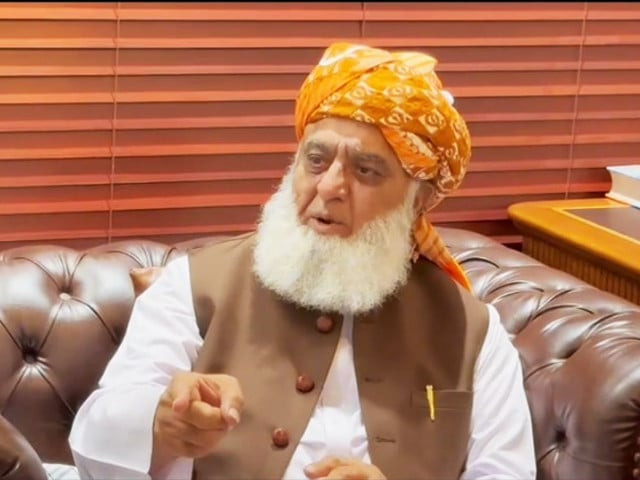
JUI-F chief Maulana Fazlur Rehman appears for an interview with a private digital media platform. SCREENSHOT
ISLAMABAD:
Pakistan’s decision to join the Gaza Peace Council led by US President Donald Trump sparked a heated debate in the National Assembly on Thursday, with opposition parties accusing the government of bypassing parliament and questioning the credibility of a forum that includes Israeli Prime Minister Benjamin Netanyahu.
Lawmakers demanded disclosure of the board’s mandates and greater parliamentary oversight over foreign policy decisions, while the government defended the move as consistent with United Nations resolutions and Pakistan’s long-standing support for Palestinian rights.
Jamiat Ulema-e-Islam Fazl (JUI-F) chief Maulana Fazlur Rehman slammed the government’s decision, while Pakistan Tehreek-e-Insaf (PTI) leaders demanded that the terms of the deal be made public and Parliament be considered confidential.
However, the government defended the move as rooted in national interest and solidarity with the Palestinian people, saying Pakistan’s role would be aligned with United Nations resolutions on the ceasefire and reconstruction in Gaza.
Addressing the House, the Maulana said several countries, including European states and France, had refused to join the Peace Council, questioning how the Pakistani prime minister could sit “shoulder to shoulder” with Netanyahu, responsible for tens of thousands of Palestinian deaths.
He warned that “expecting peace from Trump is like living in a fool’s paradise,” saying Trump himself chairs the board and retains the power to appoint or remove members at will.
He said the very actors who had fueled the Palestinian crisis were now presenting themselves as the arbiters of peace.
Recalling the historical roots of the Palestinian question, he said that the State of Israel was created under British patronage despite the recommendations of the League of Nations against Jewish settlement in that country.
“The same forces that created the problem are now judging,” he said, adding that Netanyahu, responsible for more than 70,000 Palestinian deaths during Israel’s two-year assault on Gaza, was included in the peace forum.
He lamented that Gaza continued to be bombed even as Pakistani leaders joined the initiative.
The JUI-F leader also criticized foreign policy decisions shaped by international pressure, invoking Quaid-e-Azam Muhammad Ali Jinnah’s stance towards Israel and questioning whether the current leadership reflected that legacy.
Commenting on the problems of terrorism in Pakistan, he added that peace could not be exported abroad when it was absent at home. He said armed groups were effectively in control of several districts, security forces were leaving their posts and extortion was rampant in areas such as Tank, Bannu, Lakki Marwat and Dera Ismail Khan.
“Without the agreement of Parliament”
Similarly, Barrister Gohar Ali Khan, Chairman of PTI, said Palestine and Gaza were of deep importance to Pakistan, emphasizing that Islamabad should only accept solutions approved by the Muslim world.
He questioned why the government agreed to the Peace Council without Parliament’s approval and pointed out that a press release from the Ministry of Foreign Affairs had announced Pakistan’s participation without any debate in the House.
He asked whether Pakistani forces would be expected to play a role in disarming Hamas and stressed that since the board was not a United Nations body, the government could not act unilaterally. “Before joining such a forum, it was necessary to table a resolution in Parliament,” he said.
Outside the House, the PTI issued an official statement rejecting the government’s decision, saying international decisions of such magnitude must be taken transparently and through broad consultations.
The party stressed that Pakistan’s participation in peace initiatives should strengthen, not weaken, the UN multilateral system.
Reaffirming its support for Palestinian self-determination and an independent state with Al-Quds Sharif as its capital, the PTI called on Pakistan to withdraw from the Peace Council until a parliamentary review, multi-party consultation, including with party founder Imran Khan, and even a referendum are held to ensure public trust.
PTI senator’s lawyer Ali Zafar also criticized the decision on social media, calling the haste “beyond comprehension”. He said his party would not support any deal that violates Palestinian rights or goes against the will of the Palestinian people.
“National Significance”
However, defending the government’s stand, Parliamentary Affairs Minister Tariq Fazal Chaudhry told the House that Pakistan’s participation was a matter of national importance transcending politics, like issues such as Kashmir and Palestine.
He said the Peace Council would operate in accordance with UN Security Council resolutions, focusing on the reconstruction of Gaza and a permanent ceasefire.
He stressed that Pakistan had consistently championed the Palestinian cause at the international level and its membership in the board was aimed at serving the interests of the Palestinian people and the Muslim Ummah as a whole.
He assured lawmakers that Parliament would be taken into confidence and called for consensus rather than “political branding”.


