
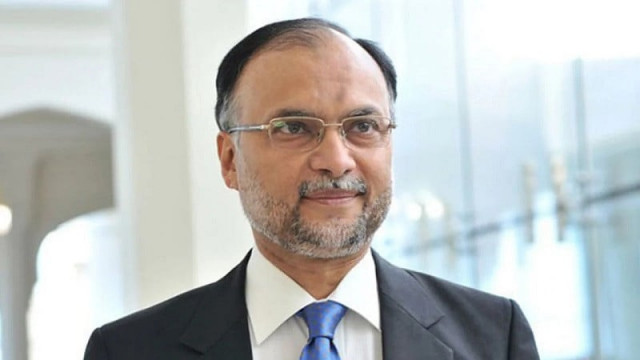
Minister of Planning, Development and Special Initiatives Ahsan Iqbal. PHOTO: APPLICATION
ISLAMABAD:
The government on Friday stood by its decision to join the US-led Peace Council, selling Pakistan’s participation as a diplomatic opening on Gaza as controversy over the move refused to die down and spilled onto the floor of Parliament again.
Opposition parties have questioned both the credibility of the forum and the process by which Islamabad signed on.
Addressing a joint session, Planning Minister Ahsan Iqbal defended Pakistan’s presence “at center stage” alongside brotherly Muslim countries, saying it was a “diplomatic victory”.
The minister explained that staying away would have left Islamabad behind at a critical time for the Palestinian cause.
He maintained that Pakistan had a long track record of independent decision-making in foreign policy and insisted that membership in the Peace Council did not compromise national sovereignty or cross any red lines on fundamental principles.
However, the government’s defense did little to calm tempers on the other side. Jamiat Ulema-e-Islam (JUI-F) leader Maulana Fazlur Rehman has categorically rejected the forum, denouncing it as an instrument of coercion rather than peace and warning that participation under its current framework would amount to subjugation rather than diplomacy.
Addressing the House, Ahsan Iqbal recalled that Pakistan had resisted intense international pressure even at defining moments in its history. He said that when the United States made repeated calls to stop Pakistan’s nuclear testing, the country chose sovereignty over submission.
“We are the guardians of security and independence of Pakistan,” he said, adding that no one could accuse the government of cowardice or negligence. “If anyone casts an evil eye on Pakistan, we will remove it,” he said.
Iqbal acknowledged the deep anguish caused by the devastation in Gaza, saying the hearts of Pakistanis were “torn apart” by the suffering of Palestinians. He argued that if Pakistan had stayed away from the forum, critics would have accused it of abandoning Gaza.
“By standing with brotherly Muslim countries, Pakistan can contribute to peace efforts,” he said, citing Saudi Arabia, Turkey, Qatar and the United Arab Emirates as Muslim allies participating in the initiative.
“Aren’t these Muslim countries? Are these not friends of Pakistan?” he asked.
“Peace under threat”
Addressing the joint session, the JUI-F chief further said that if Nawaz Sharif and Prime Minister Shehbaz Sharif wanted to accept “slavery”, they were free to do so, but his party was not.
“If I can stand against General Pervez Musharraf, I can also stand against them,” he said, adding that “bringing 250 million people together is not acceptable.”
He questioned why Pakistan had joined the forum when its basic points had already been changed. He accused Trump of strengthening Israeli aggression and openly threatening Hamas.
“This is a forum that begins with threats,” he said, recalling the destruction of Afghanistan, Iraq and Libya. He warned that after Israel’s actions against Iran, the region, including Pakistan, could be drawn into future conflict.
Fazl said Pakistan was rushing to appease “an idol in Donald Trump,” arguing that the United States had failed Pakistan in the past and would do it again.
He questioned the government’s logic in sitting alongside Israel on the grounds that it was present at the United Nations, wondering why Pakistani passports still banned travel to Israel if such engagement was justified.
The Maulana also criticized the prime minister for not taking Parliament or even the cabinet into confidence before joining the board and questioned whether the government had signed the charter without reading it fully.
He recalled that even the foreign minister admitted that Trump’s initial points were not the same as those ultimately agreed upon.
The JUI-F leader warned that disarming Hamas would mean dismantling the Palestinian resistance.
“The Palestinians are waging a war of liberation,” he said, accusing the Muslim world of advancing Trump’s agenda in the name of peace. He urged the House to reject the Peace Council on its current terms, calling on Parliament to pass a resolution against it.
Opposition Leader in the Senate Allama Raja Nasir Abbas also slammed Pakistan’s participation, saying the world was going through a sensitive moment.
He said the people of Gaza were fighting for freedom and noted that the International Court of Justice had declared Israeli Prime Minister Benjamin Netanyahu a terrorist. “What Netanyahu could not achieve by force is now being attempted through the so-called peace council,” he said.
He pointed out that Palestinians were not represented on the board and said Pakistan’s honor would be enhanced by openly declaring Netanyahu a terrorist.
“We don’t even know what the goals of this council are,” he said, adding that it should be called an “occupation council” rather than a peace initiative.
He urged the House to pass a resolution against the measure, calling it a matter of national dignity, honor and conscience.
Outside Parliament, Maulana reiterated his position while speaking to journalists, saying that Muslim countries were facilitating Israel under US pressure.
“It’s called peace, but the threats that accompany it reveal the true intentions,” he said, adding that disarming Hamas would deprive Palestinians of their right to resist the occupation.
During his speech, Fazl also criticized recent legislation, particularly laws relating to underage marriage, declaring them un-Islamic.
He said such laws should have been referred to the Council of Islamic Ideology and warned that he would openly defy them, including solemnizing marriages below the stipulated age.
“Either honor the oath taken in the name of the Islamic Republic or remove the word ‘Islamic’,” he said, daring the state to act against him.


