
Defense minister expresses support for creating new provinces, saying there is no harm in doing so and no one should fear it
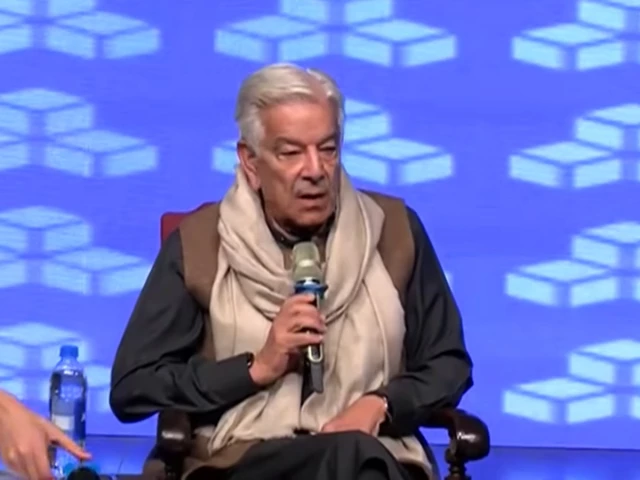
Defense Minister Khawaja Asif speaking at a session at Think Fest in Lahore on Saturday. Photo: screenshot
LAHORE:
Defense Minister Khawaja Asif on Saturday stressed that Pakistan’s stability relies on a strong local government and no one should view it as a threat.
“When powers are not brought down to the local level, it amounts to misleading the people. Local government should not be seen as a threat but as a nursery. The world knows New York Mayor Zohran Mamdani and he is the best example,” Asif said while speaking at the Devolution for Revolution session at Think Fest in Lahore.
He said politicians could only secure their authority legally and constitutionally by seeking the direct approval of the people. “If politicians want their power to be legitimate, they must address the country’s 250 million inhabitants,” he said.
The defense minister said the local government posed no threat to any institution and instead guaranteed stability. “All institutions remain safe under a local government system. I don’t understand why my own fraternity does not feel safe,” he remarked.
He recalled that the three military rulers – Ayub Khan, General Ziaul Haq and Pervez Musharraf – relied on local governments, which allowed them to maintain their power by delegating power to the grassroots while retaining central control.
Asif identified the influence of bureaucracy on politicians as a major reason for the country’s political failure. “First comes influence, then dependence. Once dependence sets in, politicians lose the ability to see long-term realities,” he said, adding that an artificially created environment blurs the political vision and distances leaders from ground realities.
Expressing regret, the Defense Minister said politicians continued to avoid giving power to local institutions, although the model was easy to understand. “It pains me to see that even after decades of politics, we have failed to bring about meaningful change,” he said, adding that many current parliamentarians were themselves products of the local government system introduced during General Zia’s era.
The minister pointed out that political power could be strengthened by strengthening institutions by granting local governments fiscal powers, administrative powers including police powers, and financial independence at city and tehsil levels. He said this decentralization would also help ease budgetary pressures at the federal and provincial levels.
Highlighting international examples, Asif recalled a recent visit to Morocco, where he observed clean, well-managed neighborhoods despite the narrow streets of historic city centers. He said an effective local government system had instilled a sense of participation among citizens, ensuring cleanliness, sanitation and basic services through local taxation.
“In Pakistan, only a few hundred thousand people are politically engaged out of 250 million,” he lamented. “The majority have never felt like they are part of the system or that their will and choices matter. »
Clarifying his stance, Asif said he was not criticizing others but himself. “I have been in Parliament for many years, but we have failed to introduce transformative reforms,” he admitted.
He said the most pressing issue facing the country was the empowerment of local governments, adding that the only segment feeling threatened by this change was the civil bureaucracy, whose authority would be transferred to elected representatives. “When power shifts from deputy commissioners to local governments and mayors, real stability will begin,” he said.
Referring to history, the Defense Minister noted that the local government system was institutionalized by colonial rulers 150 to 200 years ago, who did not feel threatened by the delegation of authority despite their small numbers. “But today we fear diversity – different winning parties in different cities or union councils,” he said.
“It is this diversity, these differences and this colorful political landscape from which democracy truly flourishes,” Asif concluded.
He also expressed support for the creation of new provinces in Pakistan, saying that there is nothing wrong with the move and no one should fear it.
The debate on issues of governance and local government has seen a resurgence since the Gul Plaza tragedy in a Karachi shopping mall, which has claimed 71 lives so far.


