
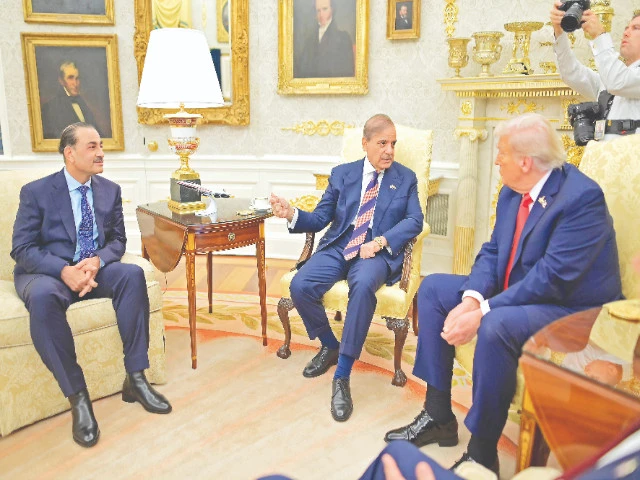
Prime Minister Shehbaz Sharif speaks with US President Donald Trump at the White House as Field Marshal Asim Munir looks on. PHOTO: EXPRESS
ISLAMABAD:
A year after US President Donald Trump returned to the White House, Pakistan appears to be one of the quiet beneficiaries of a significant shift in Washington’s strategic thinking.
The new U.S. National Defense Strategy (NDS) for 2026 marks a departure from the decades-long stance Washington has taken that views China as the primary global threat, a recalibration that Pakistani officials and analysts say eases Islamabad’s foreign policy challenges.
When Trump took office for his second term, unease was visible in Pakistan. With U.S. forces already withdrawing from Afghanistan and Trump’s “America First” doctrine back in force, many in Islamabad feared further marginalization.
Prevailing assessments suggest that Washington would further deepen its strategic ties with India, step up pressure on Pakistan, and pursue a more confrontational approach toward China, a scenario that would have complicated Pakistan’s delicate regional balancing act.
However, developments over the past year have unfolded differently. Pakistan has seen an improvement in its relations with the Trump administration, while relations between India and the United States have shown signs of strain.
The release of Defense Strategy 2026 has further reinforced this trend, providing what officials describe as “strategic breathing space” for Islamabad.
At the heart of the new policy is a redefinition of America’s perception of threat. Unlike previous strategies, particularly the 2022 Defense Strategy released under the Biden administration, which explicitly called China its “most important strategic competitor,” the 2026 document avoids presenting Beijing as an existential enemy.
The strategy makes clear that Washington does not seek to confront China, nor to weaken or isolate it.
He said the United States did not seek to dominate, humiliate or strangle China, but “to ensure that neither China nor anyone else can dominate us or our allies.”
Instead, the United States wants “a decent peace, on terms favorable to Americans but that China can also accept and respect,” the plan says, adding that, therefore, the United States would deter China through “force, not confrontation.”
For Pakistan, this change is particularly significant. Islamabad has always sought to avoid getting drawn into great power rivalries, particularly the competition between the United States and China, given its close strategic partnership with Beijing.
The United States’ confrontational posture toward China has historically placed Pakistan in a difficult position, forcing it to navigate its relationship with Washington and its long-standing ties with Beijing.
“Diplomatic space”
A senior Pakistani official, speaking on condition of anonymity, said the new US approach made Pakistan’s foreign policy “less stressful”.
“If the United States no longer seeks confrontation with China, it will reduce pressure on countries like Pakistan that have close relations with Beijing. This approach gives us greater diplomatic space,” the official said.
“For me, the US strategy is basically to wait for the moment to find ways to counter China and maintain its supremacy. Trump is playing smart. China understands the game,” said Abdul Basit, a former diplomat, who served as Pakistan’s ambassador to India and Germany.
“So, for now, we would not see the two countries stoking bilateral tensions to an irremediable point. It is good for Pakistan while it lasts,” he told The Express PK Press Club.
Another notable aspect of Defense Strategy 2026 is what it doesn’t mention. India, frequently highlighted in previous US policy documents, is completely absent from the 24-page strategy. The document also makes no reference to the Quadrilateral Security Dialogue (Quad), a group that includes the United States, India, Japan and Australia, and which featured prominently in previous Indo-Pacific frameworks.
This omission attracted attention in Islamabad. Under the Biden administration, India has repeatedly been described as a major defense partner and a key pillar of US strategy in Asia. India’s absence from the latest strategy suggests a recalibration of Washington’s regional priorities.
Pakistani officials see this as another positive development. An unnamed senior official said the lack of focus on India was reducing the regional imbalance.
“The fact that India does not feature even once in the defense strategy is significant. This indicates that Washington no longer considers India a central part of its China policy. This is a welcome development for Pakistan,” the official said.
Analysts believe that this change is directly linked to Washington’s more flexible framework towards China. While Beijing is no longer presented as the main threat, the strategic utility of India, previously positioned as a counterweight, appears diminished.
Despite these positive signals, observers warn against permanence. Trump’s approach to foreign policy is widely seen as transactional and personality-driven, raising questions about the sustainability of this shift once his term ends.
Security analysts note that U.S. strategic doctrine has historically evolved with changes in administration. A future White House could return to a more traditional posture that once again makes China the central adversary, potentially reviving old alliance-based containment strategies.
“This strategy reflects Trump’s worldview rather than a permanent transformation of American grand strategy,” another official noted. “Pakistan stands to benefit from the current environment but remains cautious about long-term assumptions.”
For now, however, America’s defense strategy for 2026 appears to align with Pakistan’s long-standing preference for strategic neutrality amid great power competition. By reducing the emphasis on confrontation with China and avoiding explicit alignment with India, Washington has inadvertently made Pakistan’s regional diplomacy more manageable, at least for the duration of Trump’s term.
“It remains imperative for us to continue to nurture our strategic partnership with China. The United States will likely experience many internal and external transitions as completion becomes fierce and pressures build everywhere,” Ambassador Basit concluded.
An emerging diplomatic role
Jalil Abbas Jilani, former foreign minister, who also served as foreign minister under an interim government, said that although the US defense strategy announced in 2022 explicitly mentions China as the main threat, the latest strategy does not put China in the same category.
However, the new strategy continues to view China as the main competitor. It also emphasizes defending U.S. interests in the Indo-Pacific region and deterring China through force, not confrontation.
He noted that he calls for maintaining a military balance in the region to prevent China’s domination of the United States or its allies.
He further observed that, interestingly, while in the past senior US officials constantly expressed concerns over the developing Pakistan-China relations, CPEC and related issues, these concerns have somewhat diminished over the last year.
“We should obviously take a lot of satisfaction from this change. It will allow Pakistan to pursue its strategic interests vis-à-vis China while building a strong partnership with the United States.”
“In the Chinese context, pressure on Pakistan appears to be easing due to the Trump administration’s desire to reduce tensions with China. The United States also realizes that Pakistan could be a useful partner in defusing tensions not only with China, but also with Iran and the Middle East.”
“As you know, in the past, Pakistan-US relations have been negatively affected by four factors: Pakistan’s relations with China, the development of US-India relations since the mid-1990s, Afghanistan and the nuclear factor.”
He observed that the deepening India-US strategic partnership – marked by increasing convergence of interests vis-à-vis China, the India-US civil nuclear deal, logistics and intelligence-sharing frameworks such as BECA and COMCASA, India’s designation as an Internet security provider and its incorporation into groupings like QUAD and I2U2 – has generated great insecurity not only in Pakistan but also in smaller states of South Asia.
However, under the Trump administration, there seems to be a slight shift away from India. The US administration has openly declared that the “strategic altruism” that India has long enjoyed will be replaced by “strategic reciprocity”.
“Many in the United States have questioned India’s credibility as a partner due to its opposition to US-sponsored resolutions against Russia following its invasion of Ukraine, failure to recognize the US role in de-escalating tensions between Pakistan and India in May last year, as well as tariff issues and India’s ability to act as a security provider in the region,” he added.


