
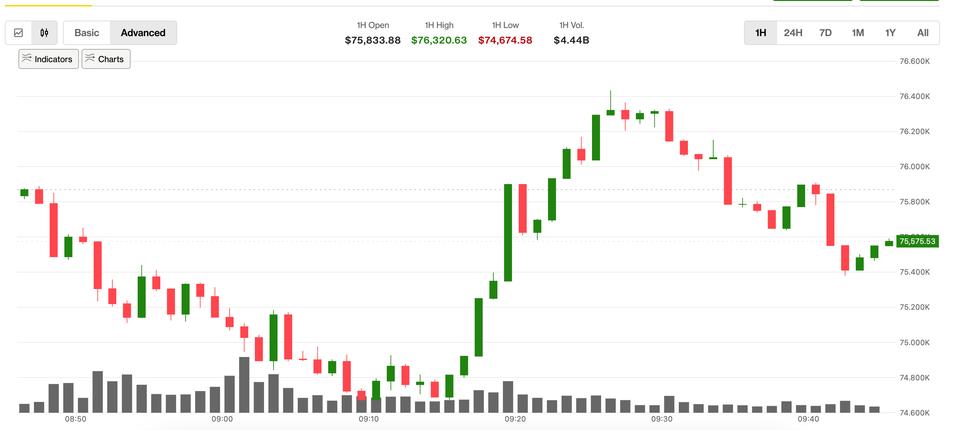
Bitcoin traded above $76,000 after a short-lived break of support, where it tested $74,000, highlighting the delicate balance between declining buyers and forced sellers in a market still short of “depth.”
This rapid V-shaped movement stems from order book dynamics where liquidity has dried up, allowing buy/sell transactions to have an outsized impact on the prevailing market rate. This shallow market depth allowed a relatively small wave of selling to break $75,000 support and trigger surges in leverage, but equally shallow bids allowed dip buyers and short covering orders to drive prices up just as quickly.
China, for its part, provides context but not acceleration. A private manufacturing survey in January showed factory activity expanding slightly, while the official indicator slipped toward contraction, underscoring uneven momentum in the world’s second-largest economy.
Beijing’s tightly managed yuan policy means the country’s influence over bitcoin is less through direct capital flows than through global dollar liquidity cycles. Slightly better industrial data may ease recession fears at the periphery, but without a stimulus-driven increase in currency volatility or liquidity, it acts, in theory, more as a bottom-line stabilizer than a catalyst for crypto markets.
The weekend trading window added another layer to BTC’s fragility. With traditional markets closed and large institutional desks largely inactive, order books tend to shrink further, reducing the amount of capital required to push prices to key technical levels.
Under these conditions, bitcoin often behaves less like a macro asset and more like a leveraged derivative of its own positioning, where funding imbalances and clustered stop orders can dictate direction for hours.
For now, the bounce above the $70,000 mark suggests the selloff functioned more as a leverage reset than a structural revaluation.
Depth remains shallow relative to the start of the cycle, indicating that bearish and bullish effects may extend further than fundamentals alone would warrant.
Until greater liquidity returns or macroeconomic factors, such as dollar strength and real yields, change more forcefully, bitcoin price action will likely remain driven by market positioning and plumbing rather than decisive economic catalysts.


