
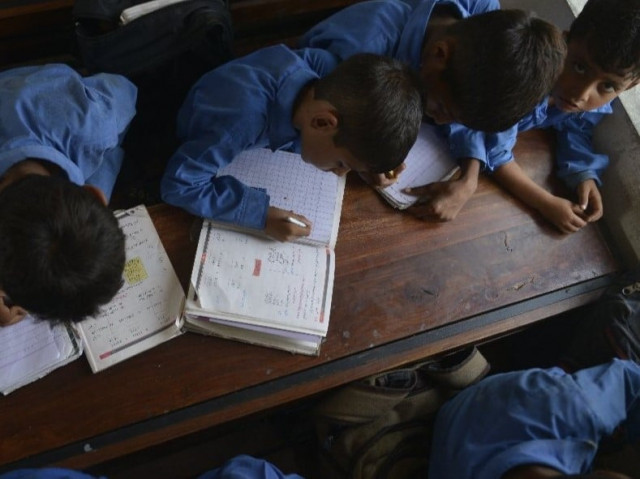
Students attend a class at a school on International Literacy Day in Lahore. PHOTO: AFP
Pakistan remains the lowest ranked country in South Asia in literacy, with 63% of people aged 10 and above being able to read and write, according to a new study by the Free and Fair Elections Network (FAFEN).
The review draws on official survey data from the Pakistan Household Living Standards and Social Measurement Integrated Economic Survey (PSLM-HEIS) 2024-2025 and compares Pakistan’s performance with World Bank literacy figures for the region.
It shows that the literacy rate increased from 60% in 2018-2019 to 63% in 2024-2025, an increase of three percentage points in about six years. Analysts described the pace of improvement as “alarmingly slow” for a country of more than 240 million people.
Regionally, the study places the Maldives at over 98% adult literacy, followed by Sri Lanka at 93%, India at 87% and Bangladesh at 79%. Nepal stands at 68% and Bhutan at 65%, while the South Asian average is 78%, 15 percentage points higher than Pakistan’s.
Read: WB warns of failure of Pakistan’s growth model
The data also highlights stark disparities within Pakistan. The literacy rate for men is 73%, compared to 54% for women. Punjab has the highest provincial literacy rate at 68%, while Sindh and Khyber-Pakhtunkhwa are both at 58%. Balochistan records the lowest rate at 49%.
The literacy rate for youth, aged 15 to 24, is 77%, but the overall literacy rate for adults aged 15 and over lags behind at 60%, indicating persistent education and skills gaps among older age groups.
FAFEN noted that the survey defines a “literate” person as someone aged 10 or older who can read and understand a simple statement and write a simple sentence.
The organization also highlighted Article 25A of the Pakistani Constitution, which guarantees free and compulsory education for children between the ages of five and 16. She said that education became a provincial subject after the 18th amendment, while Pakistan is also committed to the United Nations education goals under the Sustainable Development Goals.


