
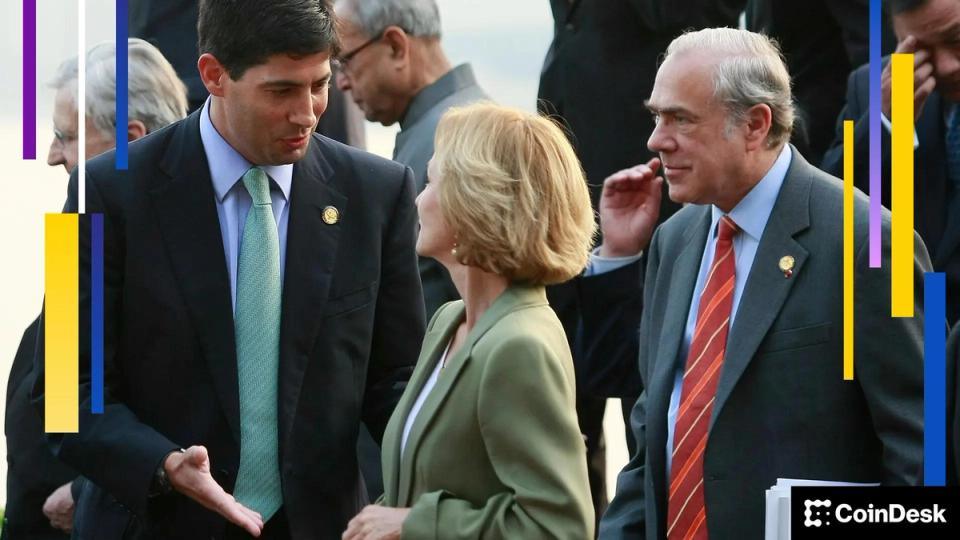
President Trump’s Fed nominee, Kevin Warsh, could cut interest rates drastically and quickly, an economist said Tuesday who rightly called out Japan’s fiscal problems, contradicting fears of a slowdown in liquidity easing under the new president.
Robin Brooks, a senior fellow at the Brookings Institution’s Global Economy and Development program, expects cuts of 100 basis points over the four meetings in June, July, September and October following Warsh’s nomination, he said Tuesday in his latest analysis.
“This could be described as a reset of monetary policy to recognize a lower neutral rate and it far exceeds the roughly 40 basis points of decline that markets are anticipating over this period, paving the way for further dollar weakness,” he added.
Brooks has been warning of a full-blown fiscal crisis in Japan for at least a year, with the first signs of crisis emerging last month as yields on the national government’s borrowing costs rose to record levels.
Its latest forecast calls for the Fed’s benchmark borrowing rate to fall to a range of 2.5% to 2.75%, from the current 3.5% to 3.75%, ahead of the November midterm elections.
Outgoing President Jerome Powell’s term ends in May. Last month, the Powell-led Fed kept interest rates steady in a range of 3.5% to 3.75% after cutting them by 75 basis points over the previous three meetings.
This projection of aggressive rate cuts could reignite a bull run on Bitcoin and the broader crypto market. Warsh’s hawkish past as Fed governor, when he clung to his anti-inflationary stance during the 2008-09 crisis, spooked markets into believing rates would not fall easily under his presidency, sparking a new clash between the central bank and the White House. Trump has repeatedly attacked Powell for failing to aggressively cut rates to 1% and for killing the U.S. economy.
The way markets have reacted since rumors about Warsh’s presidency began circulating Thursday evening reveals this concern. Bitcoin plunged from $84,500 on Thursday to below $75,000 over the weekend as hawkish Fed fears fueled major risk aversion. Gold and silver fell 9% and 26% respectively on Friday, while the dollar index rose.
“Many came away from last week with the mistaken impression that Warsh would be hawkish. He cannot and will not be. In fact, his worst nightmare is probably to see Trump turn on him the way he did against Powell,” Brooks noted.
He expects Warsh to cement a narrative of high productivity and low inflation for lower rates, which is certainly possible as Warsh sees the AI boom as a disinflationary force that increases productivity and strengthens American competitiveness.
“Improvements in productivity are expected to lead to significant increases in real take-home wages. A one-percentage-point increase in annual productivity growth would double living standards in a single generation,” Warsh noted in a November 2025 Wall Street Journal opinion piece titled “The Federal Reserve’s Broken Leadership.”


