
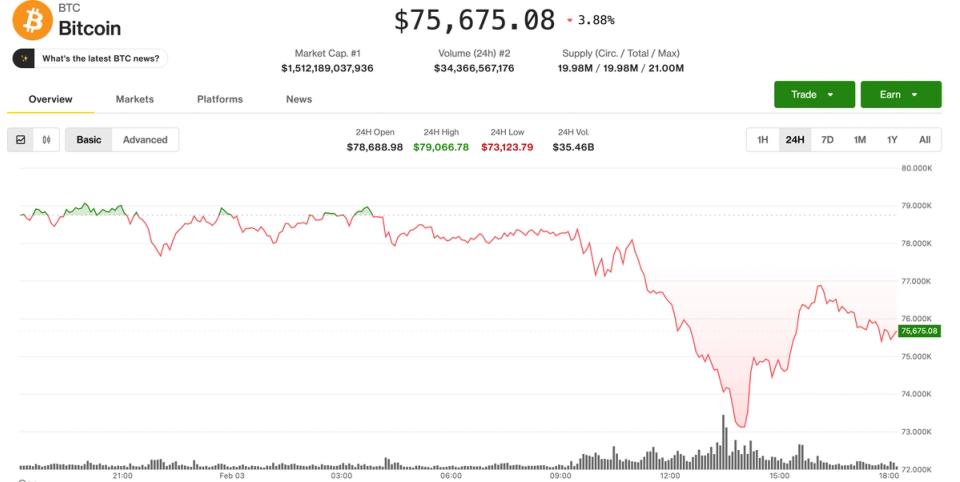
Bitcoin hit Tuesday, plunging to a 14-month low before climbing back above $76,000 as turmoil in the tech sector sent markets spinning.
The largest cryptocurrency fell to $72,900 at the start of the US session – its lowest level since November 2024, when Donald Trump was elected. Afterwards, BTC has since rebounded 5% from the lows, climbing back to $76,800, before the advance faded again. Ethereum Ether rebounded 10% from session lows to over $2,300 before giving back some of the gains, according to CoinDesk data.
The rebound came as Congress reached an agreement to end the partial government shutdown, which offered some short-term relief to markets.
Helping to ease further pressure on risk assets was Nvidia’s (NVDA) CEO Jensen Huang’s appearance on CNBC, where he dismissed speculation about friction between the chipmaker and OpenAI. “There’s no controversy. It’s completely absurd,” Huang said, reaffirming Nvidia’s commitment to investing in OpenAI’s next fundraising round. His comments come amid growing concerns about the stability of ChatGPT creator OpenAI, a key driver of sentiment in the AI-powered tech rally.
Still, crypto’s sharp decline has left a trail of damage. According to CoinGlass, total liquidations of digital asset derivatives reached $740 million in the last 24 hours. Long positions, those betting on higher prices, were hit hardest by the wipe, with $287 million of long BTC positions and $267 million of long ETH positions having been emptied.
Technical breach
Despite the rebound, Bitcoin breaking the April 2025 “price crisis” low marked a key technical breakdown, increasing the risk of a deeper correction.
Nonetheless, Benjamin Cowen, founder of analytics firm Into The Cryptoverse, said the prevailing bearish sentiment could pave the way for a counter-trend rally in the near term. Historically, he noted, when bitcoin breaks previous lows, it often triggers relief rallies.
He also warned that an impending rebound could make for “a hell of a year in the midterms,” referencing past Bitcoin bear markets, such as 2022 and 2018, which also coincided with the U.S. midterm elections.
“I feel like the bearish narrative has been very strong for a while, and so I would expect a counter-trend rally soon to give the bulls some hope for a while,” Cowen said in an X article.


