
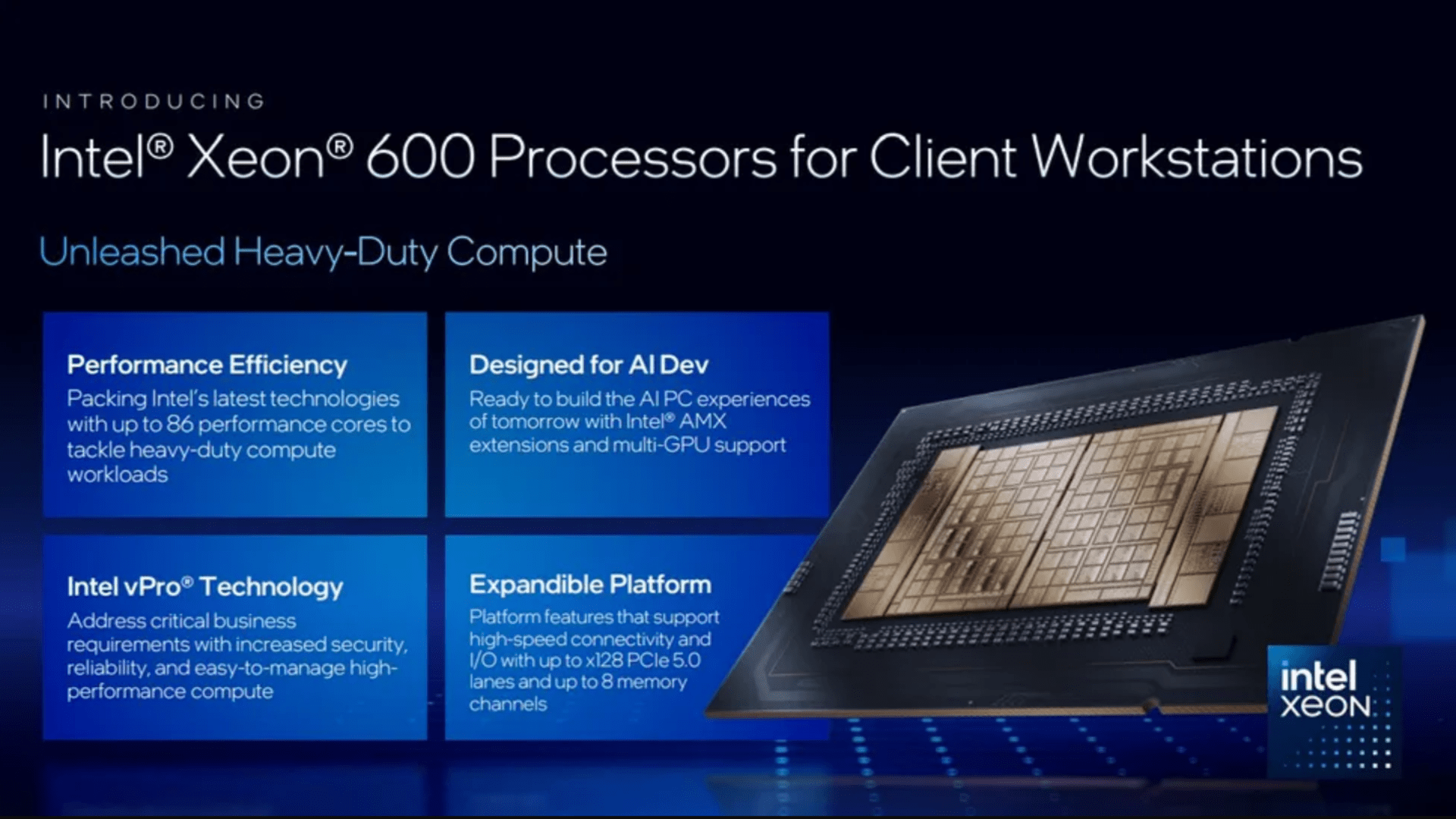
- Intel Xeon 600 series returns desktop workstations with up to 86 cores
- Octa-channel DDR5 and MRDIMM support delivers unprecedented memory bandwidth speeds
- All cores use Hyper-Threading for consistent performance on demanding workloads
Intel returned to the desktop workstation market after nearly three years with its new Xeon 600 series processors, offering up to 86 cores and clock speeds reaching 4.9 GHz.
Built on the Granite Rapids architecture, these chips expand on the 2025 Xeon 6700P series and support up to eight channels of DDR5 memory and 128 lanes of PCIe 5.0 connectivity.
The range extends from 12 to 86 cores, with memory capacities ranging from 4 GB to 4 TB, depending on the DIMM configuration.
Memory and bandwidth improvements
These processors use the Redwood Cove microarchitecture, which Intel first introduced in its mobile chips and then developed to deliver higher desktop performance.
All Xeon 600 processors support octa-channel memory officially rated at 6,400 MT/s, while all five major SKUs include MRDIMM support capable of reaching 8,000 MT/s.
This is the first introduction of MRDIMM to desktop workstations, allowing memory from multiple ranks to combine for higher transfer speeds.
Each processor can handle up to 4TB of memory, doubling the capacity of AMD’s Threadripper Pro 9000 WX and quadrupling that of the standard Threadripper 9000 series.
These changes benefit data-intensive workloads on high-end office workstations and content creation systems.
The flagship Xeon 698X offers 86 cores and 172 threads, while other SKUs are reduced to 12 cores.
Unlike previous heterogeneous Xeon designs, all Xeon 600 processors use only performance cores with Hyper-Threading enabled, ensuring consistent execution across all workloads.
The Xeon 600 processors also feature 128 PCIe 5.0 lanes and CXL 2.0 support. The AMX accelerators on each core now support FP16 instructions, improving AI performance.
Intel claims up to 9% higher single-threaded performance and 61% higher multi-threaded performance compared to the previous Xeon W-2500 and W-3500 chips.
SPEC Workstation 4 benchmarks indicate gains in AI, financial services, energy and life sciences workloads.
Applications such as Blender and Topaz Labs would benefit from built-in AMX accelerators.
While these claims indicate performance gains, Intel has not released direct comparisons to AMD’s Threadripper 9000, leaving performance per dollar and actual benefits unclear.
Series
New W890 motherboards from Dell, Lenovo, Supermicro and Puget are expected to arrive in late March 2026, although Intel has not confirmed a release window for the boxed chips.
Follow TechRadar on Google News And add us as your favorite source to get our news, reviews and expert opinions in your feeds. Make sure to click the Follow button!
And of course you can too follow TechRadar on TikTok for news, reviews, unboxings in video form and receive regular updates from us on WhatsApp Also.


