
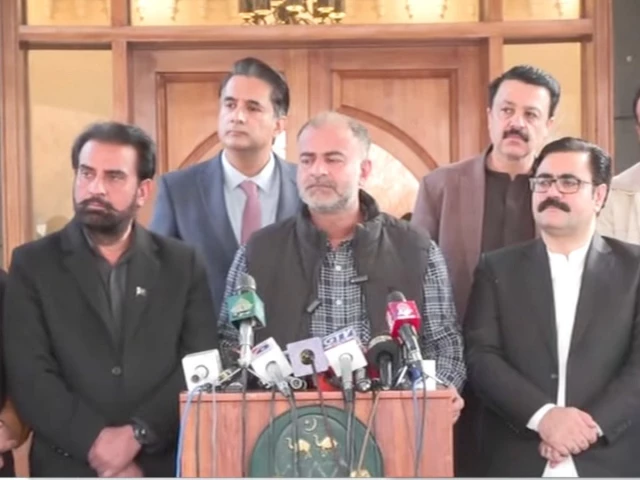
Balochistan Government Spokesperson Shahid Rind, accompanied by provincial officials, briefs the media on security operations and government response to recent militant activities in Balochistan. PHOTO: PTV (Screenshot)
QUETTA:
The Balochistan government announced on Thursday that internet services in the provincial capital should be restored by this evening following a series of coordinated terrorist attacks that left hundreds dead and disrupted communications in the region.
Balochistan witnessed a series of coordinated attacks in several locations across the province over the weekend. According to the Inter-Services Public Relations (ISPR), 92 terrorists were killed on Saturday as security forces repelled the attacks. The death toll rose as operations continued across the province, bringing the total number of terrorists killed to at least 216.
On Thursday, security forces successfully concluded Operation Radd-ul-Fitna-1 in Balochistan, carrying out a series of coordinated intelligence-led operations against what the army described as Indian-sponsored terrorist elements, the ISPR said.
Read: Security forces conclude operations after terror attacks in Balochistan
Provincial government spokesperson Shahid Rind, addressing a press conference on the security situation today, clarified that most of Quetta would see the return of internet services today. “In areas where search or sweep operations are underway, the internet may be slightly disrupted and there may be interference, but Quetta’s internet will be restored by this evening.”
Detailing the aftermath of the August 31 attacks, Rind revealed that 216 terrorists were killed in retaliation by security forces. The violence, which targeted 12 separate localities, including Quetta and Noshki, also resulted in the martyrdom of 36 civilians and 22 security personnel. Among the neutralized attackers were two women militants, while three civilians were martyred during the Gwadar assault.
He defended the delay in the security forces’ response, saying the operation took time because of concerns about collateral damage. “In the first few hours, the biggest problem we faced was that they were mixed with the general public, and there was a risk of collateral damage, which naturally leads to some delay. Noshki was one place where we encountered difficulties, and the fundamental reason for the problem there too was to avoid collateral damage.”
When asked if Quetta continued to face any threat, Rind said that in such situations, multiple threats were generated, to which the security forces responded accordingly. He said some threats had also existed in the past in relation to such incidents and initiatives had already been taken to respond to them.
Read also: Asif says evidence links India to BLA attacks in Balochistan
“At the time the red zone was attacked, there was no situation where senior officers were present at their homes. The DIG CTD was personally leading the operation and the IG police were themselves present at the spot. This means that a threat or alert had been received due to which such senior officers were on the ground.”
Security operations and weapons recovery
Rind detailed that security forces responded to the attacks in 12 different locations across the province. Even though most areas were cleared from day one, Noshki remained a focal point. In Quetta, ongoing search operations have led to the arrest of around 100 suspects currently being questioned.
The spokesperson noted a worrying trend regarding weapons recovered from residential properties during these raids. “During these operations, not only illegal small arms were recovered, but RR (Recoilless Rifle) guns, anti-aircraft guns and RPGs were also seized from some houses,” Rind said.
The government confirmed that militants targeted Noshki and Mastung prisons, leading to the escape of several undertrial prisoners and “major criminals.” Rind said a “pursuit” was underway to apprehend the fugitives and that the director of Noshki prison was now in a stable condition following the attack.
Addressing the identification of the slain terrorists, the spokesperson issued a stern warning to families harboring terrorists. He reiterated Chief Minister Sarfraz Bugti’s earlier stance, noting that families who fail to report children associated with terrorist organizations to the district administration or security agencies could face legal action if a link is discovered.
Learn more: Pakistan Railways restores Quetta train services after Balochistan attacks
Infrastructure and public services
Regarding the status of provincial connectivity, Rind informed that all national highways have been cleared except a stretch in Noshki damaged by bomb blasts. Repair crews were expected to restore the route within 12 to 24 hours.
Despite the volatility, the government maintained that essential services would continue. Secondary examinations for grades 8 and 9 in Quetta will go ahead as scheduled and the provincial polio campaign remains active in all regions except Noshki.
Read: ‘No one can rationalize terrorism under any pretext,’ says CDF Munir after Balochistan attacks
The provincial health minister, also present at the meeting, noted that the state of emergency remained in force in health facilities. He added that the government was launching a specialized mental health project to address the psychological trauma inflicted on the public by the recent wave of violence.


